Levin Rachel A, Beltran Victor H, Hill Ross, Kjelleberg Staffan, McDougald Diane, Steinberg Peter D, van Oppen Madeleine J H
Centre for Marine Bio-Innovation, The University of New South Wales, Sydney, NSW, Australia School of Biological Earth and Environmental Sciences, The University of New South Wales, Sydney, NSW, Australia
Australian Institute of Marine Science, Townsville MC, QLD, Australia.
Mol Biol Evol. 2016 Sep;33(9):2201-15. doi: 10.1093/molbev/msw119. Epub 2016 Jun 14.
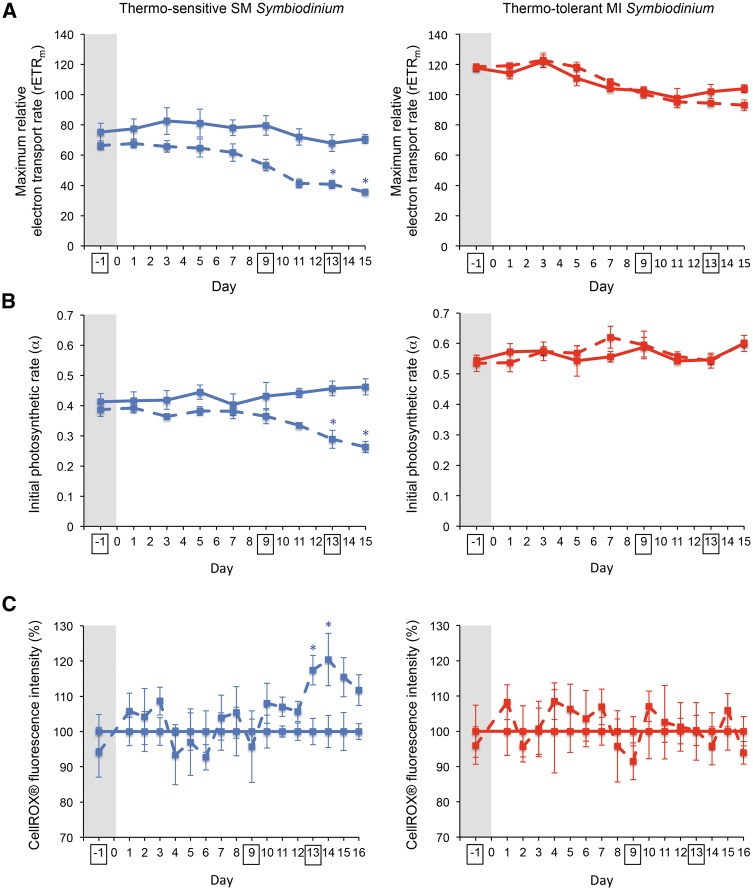
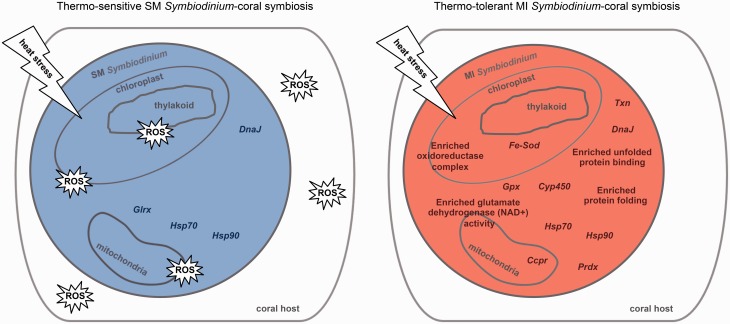
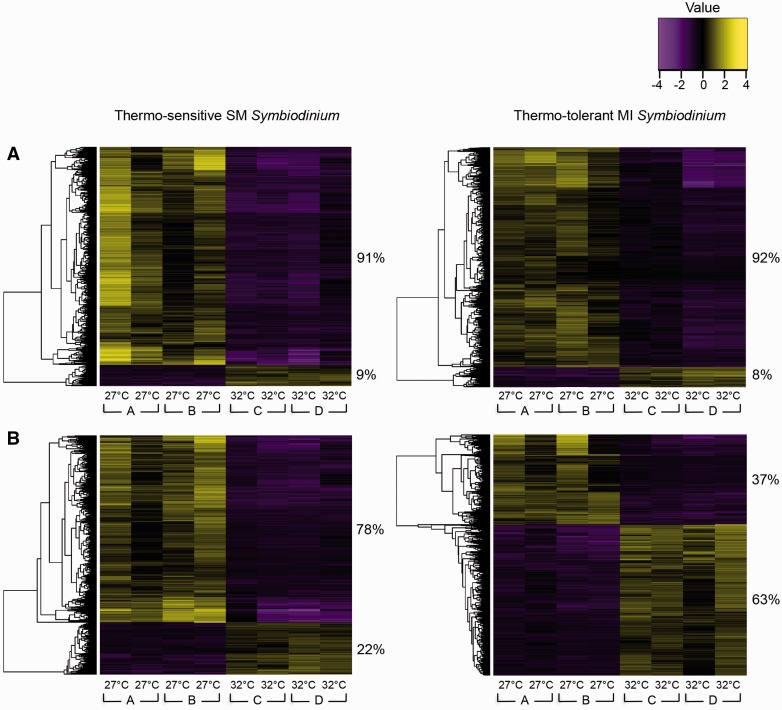
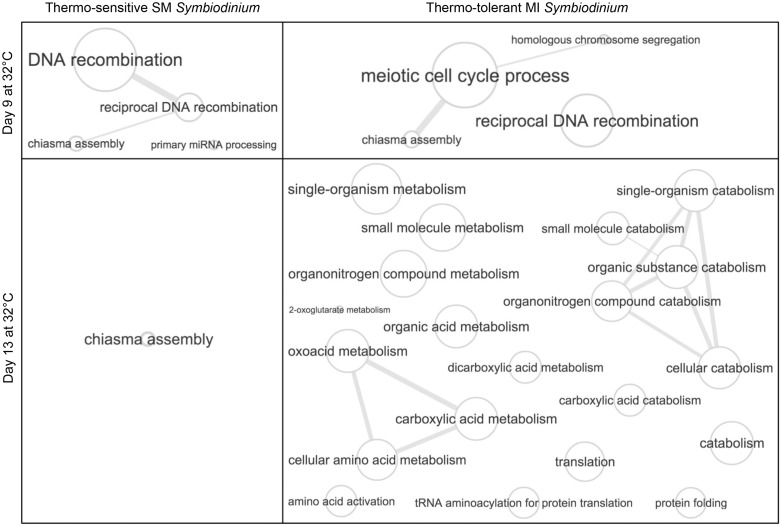
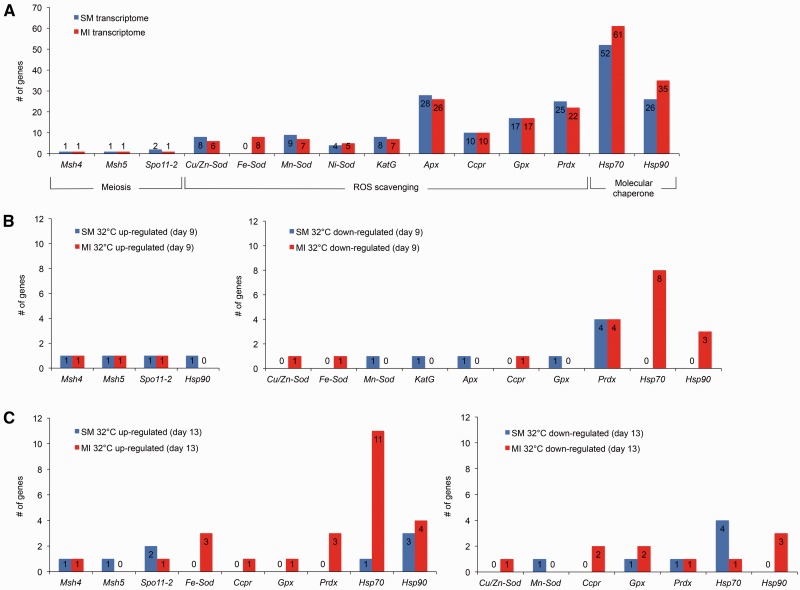
Corals rely on photosynthesis by their endosymbiotic dinoflagellates (Symbiodinium spp.) to form the basis of tropical coral reefs. High sea surface temperatures driven by climate change can trigger the loss of Symbiodinium from corals (coral bleaching), leading to declines in coral health. Different putative species (genetically distinct types) as well as conspecific populations of Symbiodinium can confer differing levels of thermal tolerance to their coral host, but the genes that govern dinoflagellate thermal tolerance are unknown. Here we show physiological and transcriptional responses to heat stress by a thermo-sensitive (physiologically susceptible at 32 °C) type C1 Symbiodinium population and a thermo-tolerant (physiologically healthy at 32 °C) type C1 Symbiodinium population. After nine days at 32 °C, neither population exhibited physiological stress, but both displayed up-regulation of meiosis genes by ≥ 4-fold and enrichment of meiosis functional gene groups, which promote adaptation. After 13 days at 32 °C, the thermo-sensitive population suffered a significant decrease in photosynthetic efficiency and increase in reactive oxygen species (ROS) leakage from its cells, whereas the thermo-tolerant population showed no signs of physiological stress. Correspondingly, only the thermo-tolerant population demonstrated up-regulation of a range of ROS scavenging and molecular chaperone genes by ≥ 4-fold and enrichment of ROS scavenging and protein-folding functional gene groups. The physiological and transcriptional responses of the Symbiodinium populations to heat stress directly correlate with the bleaching susceptibilities of corals that harbored these same Symbiodinium populations. Thus, our study provides novel, foundational insights into the molecular basis of dinoflagellate thermal tolerance and coral bleaching.
珊瑚依靠其共生的甲藻(共生藻属)进行光合作用,以此构成热带珊瑚礁的基础。气候变化导致的海水表面温度升高会引发珊瑚失去共生藻(珊瑚白化),进而导致珊瑚健康状况下降。不同的假定物种(基因上不同的类型)以及共生藻的同种群体能够赋予其珊瑚宿主不同程度的耐热性,但控制甲藻耐热性的基因尚不清楚。在此,我们展示了热敏型(在32°C时生理上敏感)C1型共生藻群体和耐热型(在32°C时生理上健康)C1型共生藻群体对热应激的生理和转录反应。在32°C下培养九天后,两个群体均未表现出生理应激,但两者的减数分裂基因均上调了≥4倍,且减数分裂功能基因组富集,这促进了适应性。在32°C下培养13天后,热敏型群体的光合效率显著下降,细胞内活性氧(ROS)泄漏增加,而耐热型群体未表现出生理应激迹象。相应地,只有耐热型群体展示了一系列ROS清除和分子伴侣基因上调≥4倍,以及ROS清除和蛋白质折叠功能基因组富集。共生藻群体对热应激的生理和转录反应与携带这些相同共生藻群体的珊瑚的白化易感性直接相关。因此,我们的研究为甲藻耐热性和珊瑚白化的分子基础提供了新的基础见解。