Dallaire Frédéric, Schreiner Sabrina, Blair G Eric, Dobner Thomas, Branton Philip E, Blanchette Paola
Department of Biochemistry, McGill University, Montreal, Québec, Canada.
Institute of Virology, Technische Universität München/Helmholtz Zentrum München, Munich, Germany.
mSphere. 2015 Nov 11;1(1). doi: 10.1128/mSphere.00015-15. eCollection 2016 Jan-Feb.
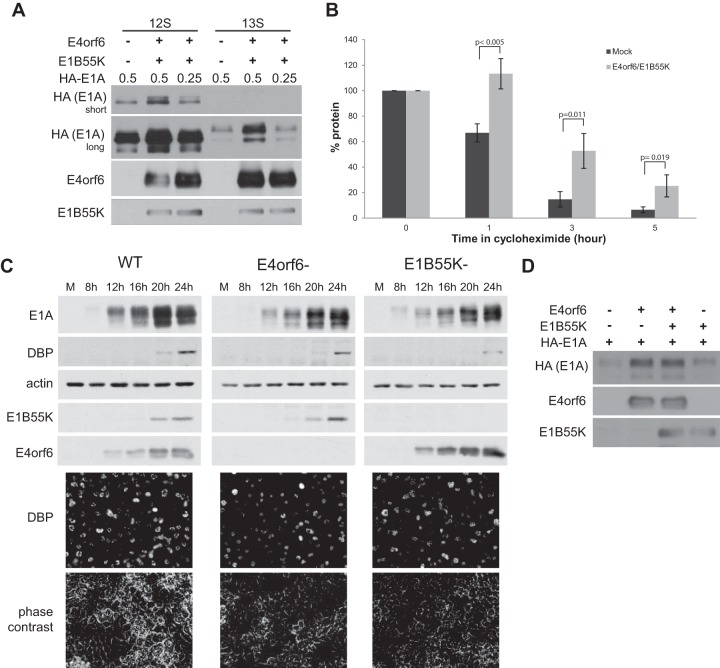
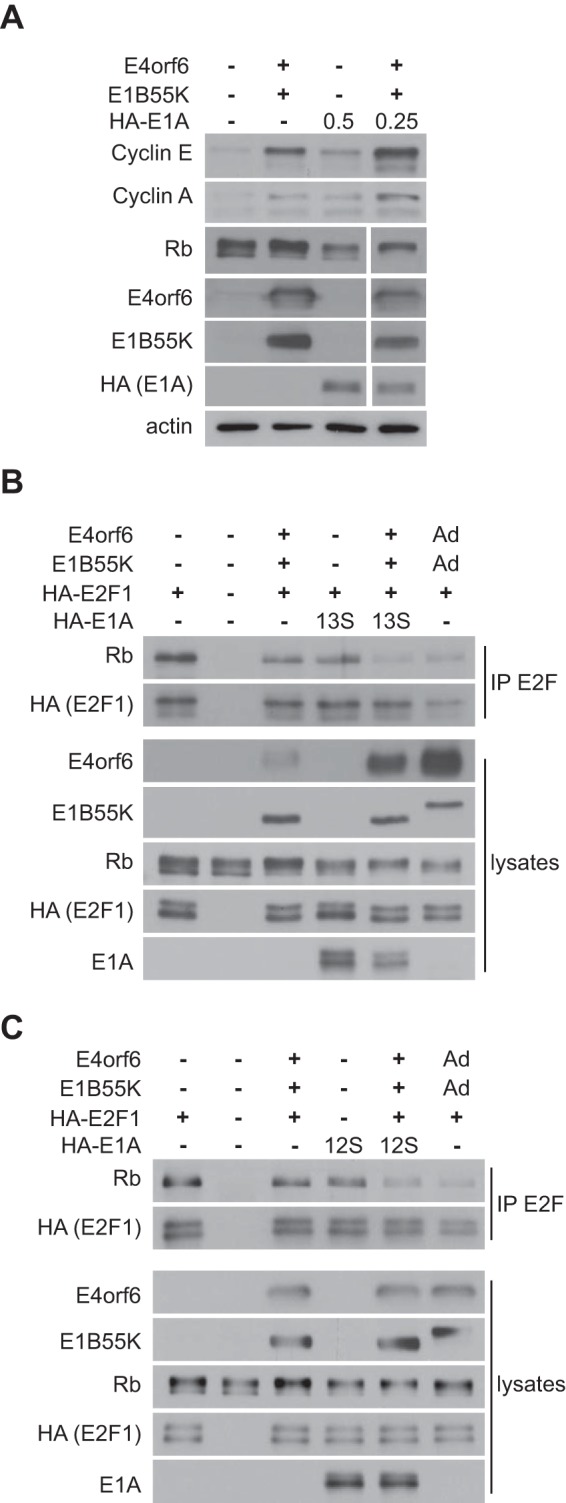
Human adenovirus (Ad) E1A proteins have long been known as the central regulators of virus infection as well as the major source of adenovirus oncogenic potential. Not only do they activate expression of other early viral genes, they make viral replication possible in terminally differentiated cells, at least in part, by binding to the retinoblastoma (Rb) tumor suppressor family of proteins to activate E2F transcription factors and thus viral and cellular DNA synthesis. We demonstrate in an accompanying article (F. Dallaire et al., mSphere 1:00014-15, 2016) that the human adenovirus E3 ubiquitin ligase complex formed by the E4orf6 and E1B55K proteins is able to mimic E1A activation of E2F transactivation factors. Acting alone in the absence of E1A, the Ad5 E4orf6 protein in complex with E1B55K was shown to bind E2F, disrupt E2F/Rb complexes, and induce hyperphosphorylation of Rb, leading to induction of viral and cellular DNA synthesis, as well as stimulation of early and late viral gene expression and production of viral progeny. While these activities were significantly lower than those exhibited by E1A, we report here that this ligase complex appeared to enhance E1A activity in two ways. First, the E4orf6/E1B55K complex was shown to stabilize E1A proteins, leading to higher levels in infected cells. Second, the complex was demonstrated to enhance the activation of E2F by E1A products. These findings indicated a new role of the E4orf6/E1B55K ligase complex in promoting adenovirus replication. IMPORTANCE Following our demonstration that adenovirus E3 ubiquitin ligase formed by the viral E4orf6 and E1B55K proteins is able to mimic the activation of E2F by E1A, we conducted a series of studies to determine if this complex might also promote the ability of E1A to do so. We found that the complex both significantly stabilizes E1A proteins and also enhances their ability to activate E2F. This finding is of significance because it represents an entirely new function for the ligase in regulating adenovirus replication by enhancing the action of E1A products.
人腺病毒(Ad)E1A蛋白长期以来被认为是病毒感染的核心调节因子,也是腺病毒致癌潜能的主要来源。它们不仅能激活其他早期病毒基因的表达,还能通过与视网膜母细胞瘤(Rb)肿瘤抑制蛋白家族结合,激活E2F转录因子,从而至少部分地使病毒在终末分化细胞中得以复制,进而实现病毒和细胞DNA的合成。我们在一篇随附文章(F. Dallaire等人,《mSphere》1:00014 - 15,2016年)中证明,由E4orf6和E1B55K蛋白形成的人腺病毒E3泛素连接酶复合物能够模拟E1A对E2F反式激活因子的激活作用。在没有E1A的情况下单独作用时,与E1B55K形成复合物的Ad5 E4orf蛋白被证明能结合E2F,破坏E2F/Rb复合物,并诱导Rb的过度磷酸化,从而导致病毒和细胞DNA合成的诱导,以及早期和晚期病毒基因表达的刺激和病毒子代的产生。虽然这些活性明显低于E1A所表现出的活性,但我们在此报告,这种连接酶复合物似乎以两种方式增强了E1A的活性。首先,E4orf6/E1B55K复合物被证明能稳定E1A蛋白,导致感染细胞中EIA蛋白水平升高。其次,该复合物被证明能增强E1A产物对E2F的激活作用。这些发现表明E4orf6/E1B55K连接酶复合物在促进腺病毒复制中具有新的作用。重要性 在我们证明由病毒E4orf6和E1B55K蛋白形成的腺病毒E3泛素连接酶能够模拟E1A对E2F的激活作用之后,我们进行了一系列研究,以确定该复合物是否也能促进E1A的这种激活能力。我们发现该复合物既能显著稳定E1A蛋白,又能增强其激活E2F的能力。这一发现具有重要意义,因为它代表了该连接酶在通过增强E1A产物的作用来调节腺病毒复制方面的全新功能。