Li Dan, Wang Siying, Ye Hongfei, Tang Yating, Qiu Xiaodi, Fan Qi, Rong Xianfang, Liu Xin, Chen Yuhong, Yang Jin, Lu Yi
Research Center, Eye & ENT Hospital of Fudan University, Shanghai, China; Key Laboratory of myopia,Ministry of Health, Shanghai, China.
Department of Ophthalmology, Shanghai Children's Hospital, Shanghai Jiao Tong University; Shanghai,China.
Mol Vis. 2016 Jun 8;22:589-98. eCollection 2016.
This study aimed to investigate the genetic effects underlying non-familial sporadic congenital cataract (SCC).
We collected DNA samples from 74 patients with SCC and 20 patients with traumatic cataract (TC) in an age-matched group and performed genomic sequencing of 61 lens-related genes with target region capture and next-generation sequencing (NGS). The suspected SCC variants were validated with MassARRAY and Sanger sequencing. DNA samples from 103 healthy subjects were used as additional controls in the confirmation examination.
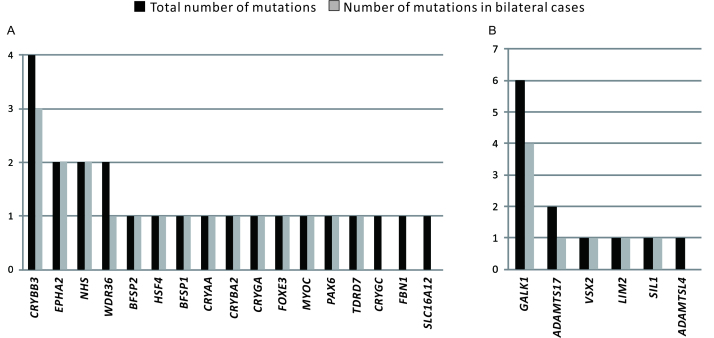
By filtering against common variants in public databases and those associated with TC cases, we identified 23 SCC-specific variants in 17 genes from 19 patients, which were predicted to be functional. These mutations were further confirmed by examination of the 103 healthy controls. Among the mutated genes, CRYBB3 had the highest mutation frequency with mutations detected four times in four patients, followed by EPHA2, NHS, and WDR36, the mutation of which were detected two times in two patients. We observed that the four patients with CRYBB3 mutations had three different cataract phenotypes.
From this study, we concluded the clinical and genetic heterogeneity of SCC. This is the first study to report broad spectrum genotyping for patients with SCC.
本研究旨在调查非家族性散发性先天性白内障(SCC)潜在的遗传效应。
我们收集了74例SCC患者和20例年龄匹配的外伤性白内障(TC)患者的DNA样本,并通过目标区域捕获和下一代测序(NGS)对61个晶状体相关基因进行了基因组测序。用MassARRAY和桑格测序法验证疑似SCC变异。在确认检查中,将103名健康受试者的DNA样本用作额外对照。
通过与公共数据库中的常见变异以及与TC病例相关的变异进行比对筛选,我们从19例患者的17个基因中鉴定出23个SCC特异性变异,这些变异被预测具有功能。通过对103名健康对照的检查进一步证实了这些突变。在突变基因中,CRYBB3的突变频率最高,在4例患者中检测到4次突变,其次是EPHA2、NHS和WDR36,它们的突变在2例患者中检测到2次。我们观察到4例CRYBB3突变患者有三种不同的白内障表型。
通过本研究,我们得出SCC存在临床和遗传异质性的结论。这是第一项报道SCC患者进行广谱基因分型的研究。