Adappa Nithin D, Truesdale Carl M, Workman Alan D, Doghramji Laurel, Mansfield Corrine, Kennedy David W, Palmer James N, Cowart Beverly J, Cohen Noam A
Department of Otorhinolaryngology-Head and Neck Surgery, Hospital of the University of Pennsylvania, Philadelphia, PA.
Perelman School of Medicine at the University of Pennsylvania, Philadelphia, PA.
Int Forum Allergy Rhinol. 2016 Aug;6(8):783-91. doi: 10.1002/alr.21803. Epub 2016 Jun 16.
Sinonasal biofilms have been demonstrated in specimens collected from chronic rhinosinusitis (CRS) patients. Mounting evidence suggests that biofilms contribute to therapeutically recalcitrant CRS. Recently, the bitter taste receptor T2R38 has been implicated in the regulation of the sinonasal mucosal innate immune response. TAS2R38 gene polymorphisms affect receptor functionality and contribute to variations seen in sinonasal innate defense as well as taste perception reflected in gustatory sensitivity to the bitter compound phenylthiocarbamide (PTC). In a population of CRS patients with active infection or inflammation, we sought to determine if a correlation between T2R38 phenotype and in vitro biofilm formation existed.
Endoscopically guided sinonasal swabs were obtained prospectively from CRS (±polyp) patients with evidence of persistent inflammation or mucopurulence. In vitro biofilm formation was assessed with a modified Calgary Biofilm Detection Assay. Patients' phenotypic (functional) expression of the bitter taste receptor T2R38 was evaluated with a taste test including the compound PTC. Linear regression was used to determine the level of significance between mean in vitro biofilm formation levels and mean PTC taste test intensity ratings across CRS patients.
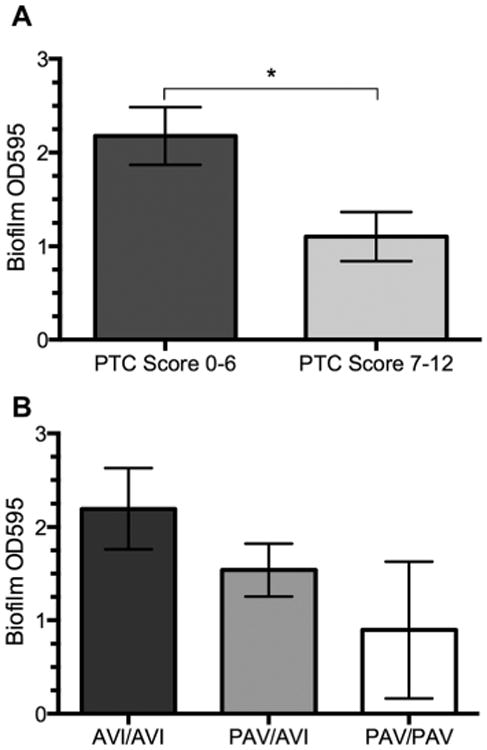
Sinonasal swabs were obtained from 59 patients, with 42 of the 59 samples demonstrating in vitro biofilm formation. Analysis revealed an inverse linear association between in vitro biofilm formation and PTC taste intensity ratings (p = 0.019) for all patients. This association was exclusively driven by nonpolypoid CRS patients (p = 0.0026).
In vitro biofilm formation from sinonasal clinical isolates is inversely correlated with PTC taste sensitivity in nonpolypoid CRS patients.
从慢性鼻窦炎(CRS)患者采集的标本中已证实存在鼻窦生物膜。越来越多的证据表明,生物膜导致CRS治疗效果不佳。最近,苦味受体T2R38与鼻窦黏膜固有免疫反应的调节有关。TAS2R38基因多态性影响受体功能,并导致鼻窦固有防御以及对苦味化合物苯硫脲(PTC)味觉敏感性所反映的味觉感知出现差异。在一群有活动性感染或炎症的CRS患者中,我们试图确定T2R38表型与体外生物膜形成之间是否存在相关性。
前瞻性地从有持续炎症或黏液脓性分泌物证据的CRS(±息肉)患者中获取经内镜引导的鼻窦拭子。采用改良的卡尔加里生物膜检测法评估体外生物膜形成情况。通过包括化合物PTC的味觉测试评估患者苦味受体T2R38的表型(功能)表达。采用线性回归确定CRS患者体外生物膜形成平均水平与PTC味觉测试强度评分之间的显著程度。
从59例患者中获取了鼻窦拭子,59份样本中有42份显示出体外生物膜形成。分析显示,所有患者的体外生物膜形成与PTC味觉强度评分呈负线性相关(p = 0.019)。这种相关性完全由非息肉样CRS患者驱动(p = 0.0026)。
鼻窦临床分离株的体外生物膜形成与非息肉样CRS患者的PTC味觉敏感性呈负相关。