Chauhan Anil K
Division of Adult and Pediatric Rheumatology, Saint Louis University School of Medicine , St. Louis, MO , USA.
Front Immunol. 2016 Jun 1;7:215. doi: 10.3389/fimmu.2016.00215. eCollection 2016.
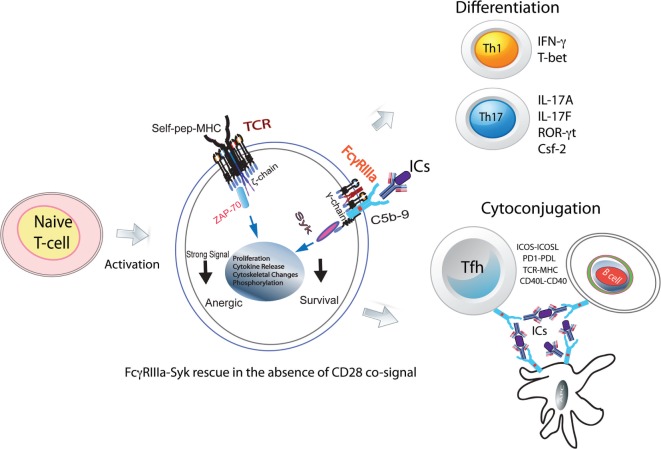
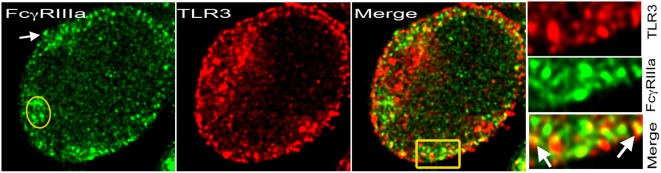
Both lymphoid and myeloid cells express Fc receptors (FcRs). Low-affinity FcRs engage circulating immune complexes, which results in the cellular activation and pro-inflammatory cytokine production. FcRs participate in the internalization, transport, and/or recycling of antibodies and antigens. Cytosolic FcRs also route these proteins to proteasomes and antigen-presentation pathways. Non-activated CD4(+) T-cells do not express FcRs. Once activated, naive CD4(+) T-cells express FcγRIIIa, which, upon IC ligation, provide a costimulatory signal for the differentiation of these cells into effector cell population. FcγRIIIa present on CD4(+) T-cell membrane could internalize nucleic acid-containing ICs and elicit a cross-talk with toll-like receptors. FcγRIIIa common γ-chain forms a heterodimer with the ζ-chain of T-cell receptor complex, suggesting a synergistic role for these receptors. This review first summarizes our current understanding of FcRs on CD4(+) T-cells. Thereafter, I will attempt to correlate the findings from the recent literature on FcRs and propose a role for these receptors in modulating adaptive immune responses via TLR signaling, nucleic acid sensing, and epigenetic changes in CD4(+) T-cells.
淋巴细胞和髓细胞均表达Fc受体(FcRs)。低亲和力FcRs与循环免疫复合物结合,导致细胞活化和促炎细胞因子产生。FcRs参与抗体和抗原的内化、运输及/或再循环。胞质FcRs还将这些蛋白质导向蛋白酶体和抗原呈递途径。未活化的CD4(+) T细胞不表达FcRs。一旦活化,初始CD4(+) T细胞表达FcγRIIIa,在免疫复合物(IC)连接时,为这些细胞分化为效应细胞群体提供共刺激信号。CD4(+) T细胞膜上的FcγRIIIa可内化含核酸的IC,并引发与Toll样受体的串扰。FcγRIIIa的共同γ链与T细胞受体复合物的ζ链形成异二聚体,提示这些受体具有协同作用。本综述首先总结了我们目前对CD4(+) T细胞上FcRs的认识。此后,我将尝试关联近期关于FcRs的文献研究结果,并提出这些受体在通过Toll样受体信号传导、核酸传感和CD4(+) T细胞表观遗传变化调节适应性免疫反应中的作用。