Bi Jia-Qi, Li Wei, Yang Qi, Li Bao-Lin, Meng Qing-Gang, Liu Yu-Fu
Department of Study Center, The First Hospital of Harbin City, Harbin Medical University, Harbin 150001, China.
Department of Study Center, The First Hospital of Harbin City, Harbin Medical University, Harbin 150001, China; Department of Study Center, Medical Science Institute of Harbin, Harbin 150001, China.
Evid Based Complement Alternat Med. 2016;2016:3961450. doi: 10.1155/2016/3961450. Epub 2016 May 24.
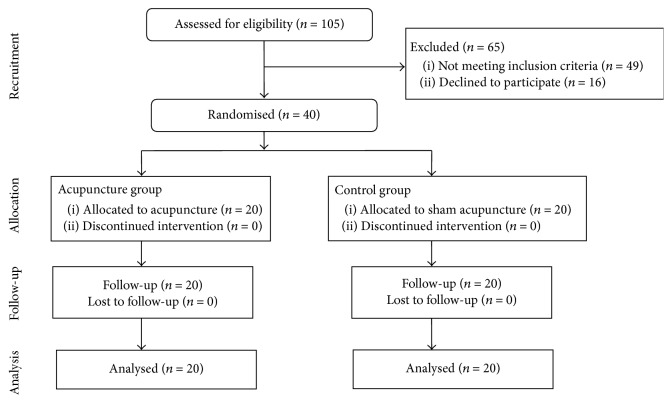
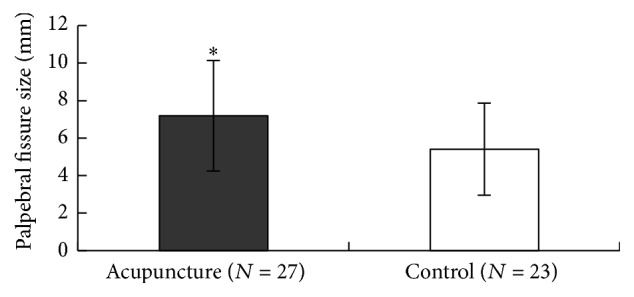
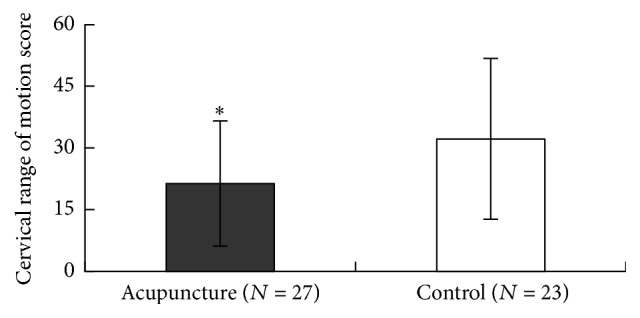
This study consisted of a single centre randomised controlled trial with two parallel arms: an acupuncture group (n = 20) with 27 affected eyes and a sham group (n = 20) with 23 affected eyes. Participants in the acupuncture group received acupuncture treatment once daily, three times weekly for four weeks. Participants assigned to the control group received sham acupuncture, the same protocol as that used for the acupuncture group but without insertion of needles into the skin. The primary outcome measure was the cervical range of motion (CROM) score. Secondary outcome measures were the palpebral fissure size, response rate, and adverse events. All 40 participants completed the study. In the comparison of acupuncture and sham acupuncture, a significant difference was observed between acupuncture and sham acupuncture in CROM score (21.37 ± 15.16 and 32.21 ± 19.54, resp.) (P < 0.05) and palpebral fissure size (7.19 ± 2.94 and 5.41 ± 2.45, resp.) (P < 0.05). Response rate was also significantly different in the acupuncture group (P < 0.05). No adverse events were reported in both groups in this study. In summary, it was demonstrated that acupuncture had a feasibility positive effect on oculomotor paralysis.
本研究为单中心随机对照试验,设有两个平行组:针刺组(n = 20),患眼27只;假针刺组(n = 20),患眼23只。针刺组参与者每天接受1次针刺治疗,每周3次,共4周。分配到对照组的参与者接受假针刺,其方案与针刺组相同,但不将针插入皮肤。主要结局指标为颈部活动范围(CROM)评分。次要结局指标为睑裂大小、有效率和不良事件。所有40名参与者均完成了研究。在针刺与假针刺的比较中,针刺组和假针刺组在CROM评分(分别为21.37±15.16和32.21±19.54)(P<0.05)和睑裂大小(分别为7.19±2.94和5.41±2.45)(P<0.05)方面存在显著差异。针刺组的有效率也有显著差异(P<0.05)。本研究中两组均未报告不良事件。总之,结果表明针刺对动眼神经麻痹具有可行性积极作用。