Hartl Markus
Institute of Biochemistry and Center of Molecular Biosciences (CMBI), University of Innsbruck , Innsbruck , Austria.
Front Oncol. 2016 Jun 2;6:132. doi: 10.3389/fonc.2016.00132. eCollection 2016.
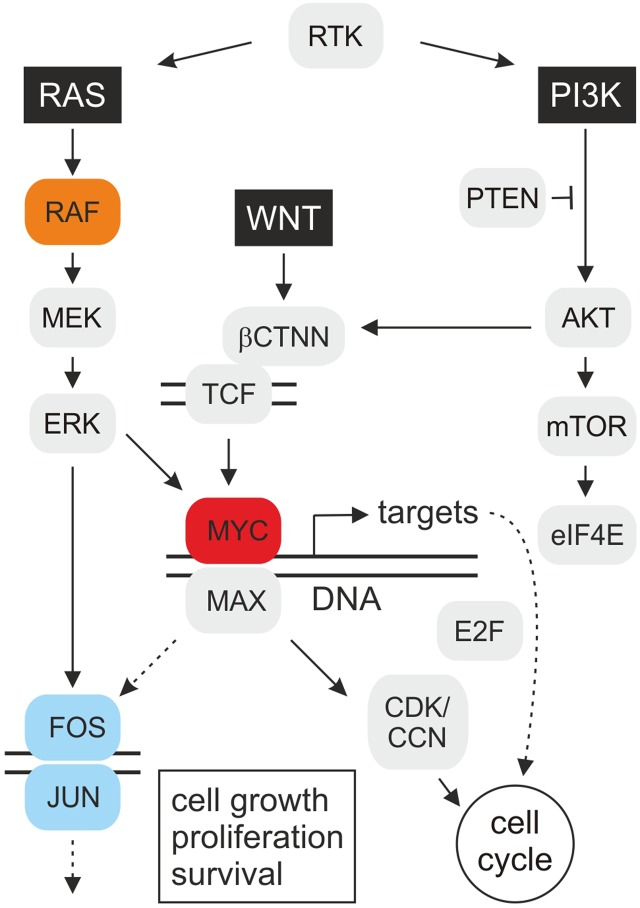
MYC represents a transcription factor with oncogenic potential converting multiple cellular signals into a broad transcriptional response, thereby controlling the expression of numerous protein-coding and non-coding RNAs important for cell proliferation, metabolism, differentiation, and apoptosis. Constitutive activation of MYC leads to neoplastic cell transformation, and deregulated MYC alleles are frequently observed in many human cancer cell types. Multiple approaches have been performed to isolate genes differentially expressed in cells containing aberrantly activated MYC proteins leading to the identification of thousands of putative targets. Functional analyses of genes differentially expressed in MYC-transformed cells had revealed that so far more than 40 upregulated or downregulated MYC targets are actively involved in cell transformation or tumorigenesis. However, further systematic and selective approaches are required for determination of the known or yet unidentified targets responsible for processing the oncogenic MYC program. The search for critical targets in MYC-dependent tumor cells is exacerbated by the fact that during tumor development, cancer cells progressively evolve in a multistep process, thereby acquiring their characteristic features in an additive manner. Functional expression cloning, combinatorial gene expression, and appropriate in vivo tests could represent adequate tools for dissecting the complex scenario of MYC-specified cell transformation. In this context, the central goal is to identify a minimal set of targets that suffices to phenocopy oncogenic MYC. Recently developed genomic editing tools could be employed to confirm the requirement of crucial transformation-associated targets. Knowledge about essential MYC-regulated genes is beneficial to expedite the development of specific inhibitors to interfere with growth and viability of human tumor cells in which MYC is aberrantly activated. Approaches based on the principle of synthetic lethality using MYC-overexpressing cancer cells and chemical or RNAi libraries have been employed to search for novel anticancer drugs, also leading to the identification of several druggable targets. Targeting oncogenic MYC effector genes instead of MYC may lead to compounds with higher specificities and less side effects. This class of drugs could also display a wider pharmaceutical window because physiological functions of MYC, which are important for normal cell growth, proliferation, and differentiation would be less impaired.
MYC是一种具有致癌潜能的转录因子,它能将多种细胞信号转化为广泛的转录反应,从而控制众多对细胞增殖、代谢、分化和凋亡至关重要的蛋白质编码和非编码RNA的表达。MYC的组成性激活会导致肿瘤细胞转化,并且在许多人类癌细胞类型中经常观察到MYC等位基因失调。人们已经采用多种方法来分离在含有异常激活的MYC蛋白的细胞中差异表达的基因,从而鉴定出数千个假定的靶点。对MYC转化细胞中差异表达基因的功能分析表明,到目前为止,有40多个上调或下调的MYC靶点积极参与细胞转化或肿瘤发生。然而,需要进一步系统和有选择性的方法来确定负责处理致癌MYC程序的已知或尚未确定的靶点。在肿瘤发展过程中,癌细胞会在多步骤过程中逐渐进化,从而以累加的方式获得其特征,这一事实加剧了在MYC依赖性肿瘤细胞中寻找关键靶点的难度。功能表达克隆、组合基因表达和适当的体内试验可能是剖析MYC特定细胞转化复杂情况的合适工具。在此背景下,核心目标是确定一组最小的靶点,这些靶点足以模拟致癌MYC。最近开发的基因组编辑工具可用于确认关键的转化相关靶点的需求。了解MYC调控的必需基因有利于加快开发特异性抑制剂,以干扰MYC异常激活的人类肿瘤细胞的生长和生存能力。基于合成致死原理,利用过表达MYC的癌细胞和化学或RNAi文库的方法已被用于寻找新型抗癌药物,也导致鉴定出几个可成药的靶点。靶向致癌MYC效应基因而非MYC可能会产生具有更高特异性和更少副作用的化合物。这类药物还可能具有更宽的治疗窗口,因为对正常细胞生长、增殖和分化很重要的MYC生理功能将受到较小的损害。