De Baets Kenneth, Antonelli Alexandre, Donoghue Philip C J
School of Earth Sciences, University of Bristol, Life Sciences Building, Tyndall Avenue, Bristol BS8 1TQ, UK GeoZentrum Nordbayern, Fachgruppe PaläoUmwelt, Friedrich-Alexander-Universität Erlangen-Nürnberg, Loewenichstr. 28, 91054 Erlangen, Germany
Department of Biological and Environmental Sciences, University of Gothenburg, Box 461, 405 30 Göteborg, Sweden Gothenburg Botanical Garden, Carl Skottsbergs gata 22A, 413 19 Göteborg, Sweden.
Philos Trans R Soc Lond B Biol Sci. 2016 Jul 19;371(1699). doi: 10.1098/rstb.2016.0098.
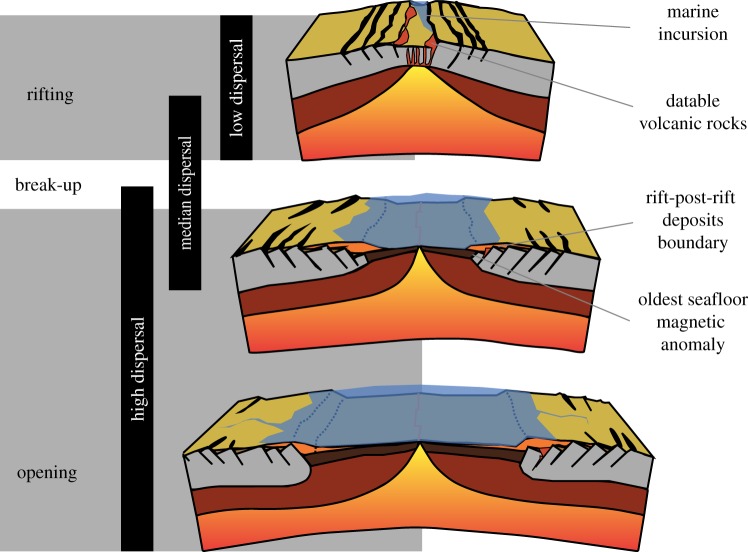
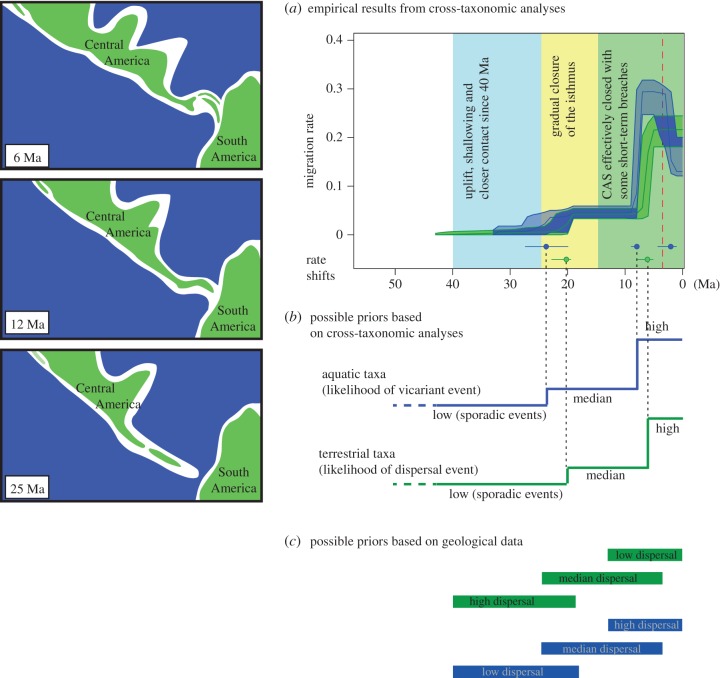
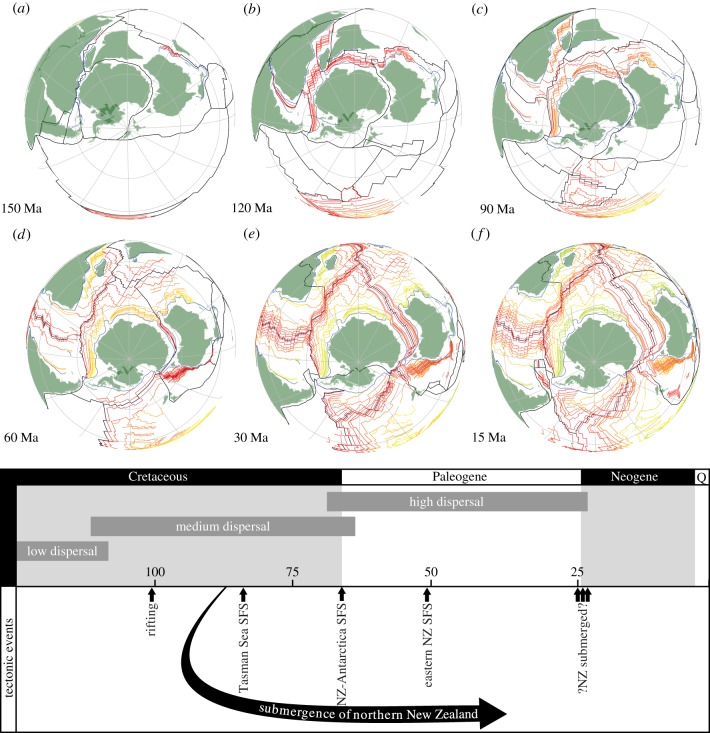
Evolutionary timescales have mainly used fossils for calibrating molecular clocks, though fossils only really provide minimum clade age constraints. In their place, phylogenetic trees can be calibrated by precisely dated geological events that have shaped biogeography. However, tectonic episodes are protracted, their role in vicariance is rarely justified, the biogeography of living clades and their antecedents may differ, and the impact of such events is contingent on ecology. Biogeographic calibrations are no panacea for the shortcomings of fossil calibrations, but their associated uncertainties can be accommodated. We provide examples of how biogeographic calibrations based on geological data can be established for the fragmentation of the Pangaean supercontinent: (i) for the uplift of the Isthmus of Panama, (ii) the separation of New Zealand from Gondwana, and (iii) for the opening of the Atlantic Ocean. Biogeographic and fossil calibrations are complementary, not competing, approaches to constraining molecular clock analyses, providing alternative constraints on the age of clades that are vital to avoiding circularity in investigating the role of biogeographic mechanisms in shaping modern biodiversity.This article is part of the themed issue 'Dating species divergences using rocks and clocks'.
进化时间尺度主要利用化石来校准分子钟,不过化石实际上只能提供分支最小年龄限制。取而代之的是,可以通过塑造生物地理学的精确测年地质事件来校准系统发育树。然而,构造事件持续时间长,其在地理隔离中的作用很少有合理依据,现存分支及其祖先的生物地理学可能不同,而且此类事件的影响取决于生态学。生物地理学校准并非化石校准缺点的万灵药,但可以处理其相关的不确定性。我们提供了一些例子,说明如何基于地质数据为泛大陆超级大陆的分裂建立生物地理学校准:(i)巴拿马地峡的隆起,(ii)新西兰与冈瓦纳大陆的分离,以及(iii)大西洋的形成。生物地理学校准和化石校准是相互补充而非相互竞争的方法,用于限制分子钟分析,为分支年龄提供替代限制,这对于避免在研究生物地理学机制在塑造现代生物多样性中的作用时出现循环论证至关重要。本文是主题为“利用岩石和时钟确定物种分歧时间”的特刊的一部分。