O'Reilly Joseph E, Donoghue Philip C J
School of Earth Sciences, University of Bristol, Life Sciences Building, Bristol BS8 1TQ, UK
Biol Lett. 2016 Apr;12(4). doi: 10.1098/rsbl.2015.0975.
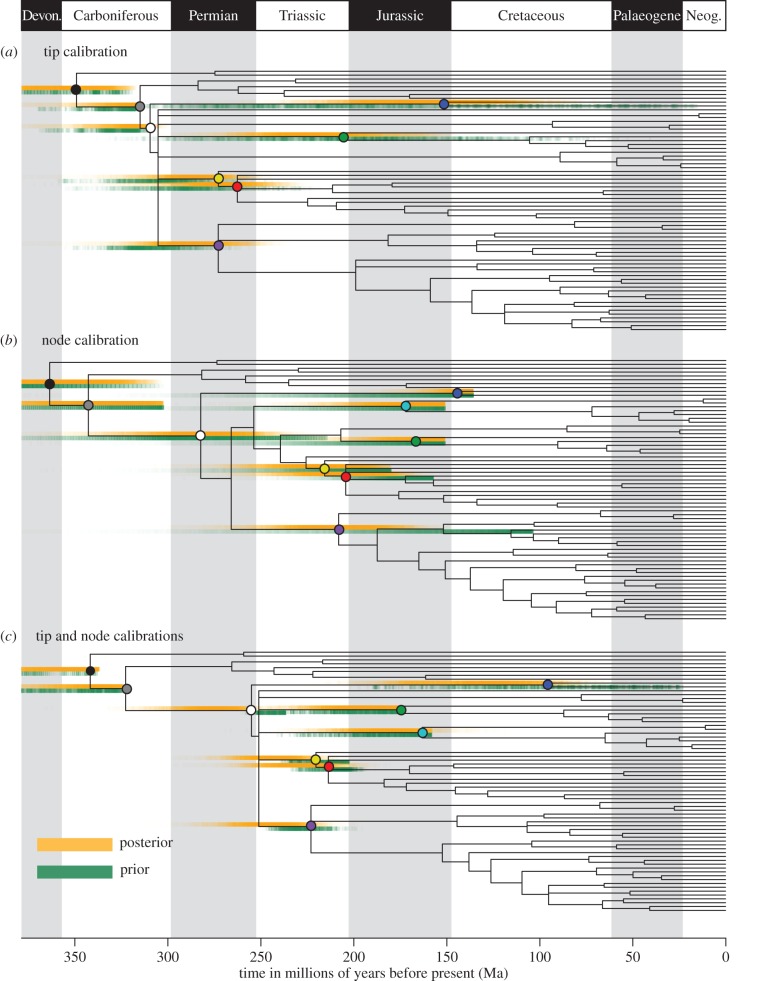
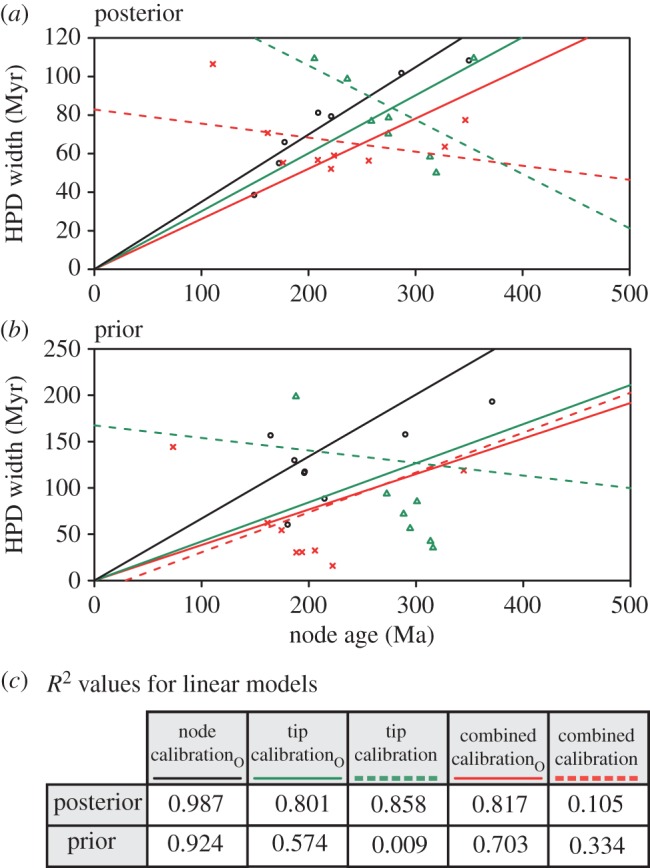
Molecular clock methodology provides the best means of establishing evolutionary timescales, the accuracy and precision of which remain reliant on calibration, traditionally based on fossil constraints on clade (node) ages. Tip calibration has been developed to obviate undesirable aspects of node calibration, including the need for maximum age constraints that are invariably very difficult to justify. Instead, tip calibration incorporates fossil species as dated tips alongside living relatives, potentially improving the accuracy and precision of divergence time estimates. We demonstrate that tip calibration yields node calibrations that violate fossil evidence, contributing to unjustifiably young and ancient age estimates, less precise and (presumably) accurate than conventional node calibration. However, we go on to show that node and tip calibrations are complementary, producing meaningful age estimates, with node minima enforcing realistic ages and fossil tips interacting with node calibrations to objectively define maximum age constraints on clade ages. Together, tip and node calibrations may yield evolutionary timescales that are better justified, more precise and accurate than either calibration strategy can achieve alone.
分子钟方法提供了建立进化时间尺度的最佳手段,其准确性和精确性仍依赖于校准,传统上是基于对分支(节点)年龄的化石约束。末端校准已被开发出来,以避免节点校准的不良方面,包括需要始终很难证明其合理性的最大年龄约束。相反,末端校准将已确定年代的化石物种与现存亲属一起作为带时间标记的末端纳入,这有可能提高分歧时间估计的准确性和精确性。我们证明,末端校准产生的节点校准违反了化石证据,导致不合理的年轻和古老年龄估计,比传统的节点校准更不精确且(大概)不准确。然而,我们接着表明,节点校准和末端校准是互补的,能产生有意义的年龄估计,节点最小值强制规定现实的年龄,而化石末端与节点校准相互作用,以客观地确定分支年龄的最大年龄约束。总之,末端校准和节点校准可能产生比任何一种校准策略单独所能实现的更合理、更精确和准确的进化时间尺度。