Zdzisińska Barbara, Żurek Aleksandra, Kandefer-Szerszeń Martyna
Department of Virology and Immunology, Institute of Microbiology and Biotechnology, Maria Curie-Sklodowska University, Akademicka 19, 20-033, Lublin, Poland.
Arch Immunol Ther Exp (Warsz). 2017 Feb;65(1):21-36. doi: 10.1007/s00005-016-0406-x. Epub 2016 Jun 20.
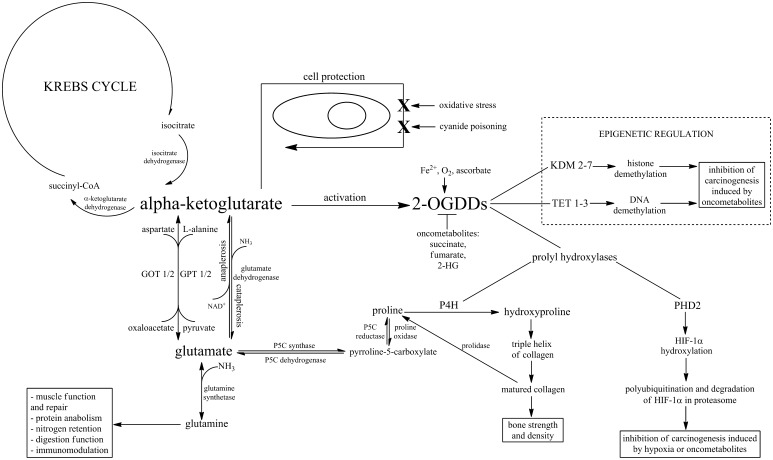
Alpha-ketoglutarate (AKG), an endogenous intermediary metabolite in the Krebs cycle, is a molecule involved in multiple metabolic and cellular pathways. It functions as an energy donor, a precursor in the amino acid biosynthesis, a signalling molecule, as well as a regulator of epigenetic processes and cellular signalling via protein binding. AKG is an obligatory co-substrate for 2-oxoglutarate-dependent dioxygenases, which catalyse hydroxylation reactions on various types of substrates. It regulates the activity of prolyl-4 hydroxylase, which controls the biosynthesis of collagen, a component of bone tissue. AKG also affects the functioning of prolyl hydroxylases, which, in turn, influences the function of the hypoxia-inducible factor, an important transcription factor in cancer development and progression. Additionally, it affects the functioning of enzymes that influence epigenetic modifications of chromatin: ten-eleven translocation hydroxylases involved in DNA demethylation and the Jumonji C domain containing lysine demethylases, which are the major histone demethylases. Thus, it regulates gene expression. The metabolic and extrametabolic function of AKG in cells and the organism open many different fields for therapeutic interventions for treatment of diseases. This review presents the results of studies conducted with the use of AKG in states of protein deficiency and oxidative stress conditions. It also discusses current knowledge about AKG as an immunomodulatory agent and a bone anabolic factor. Additionally, the regulatory role of AKG and its structural analogues in carcinogenesis as well as the results of studies of AKG as an anticancer agent are discussed.
α-酮戊二酸(AKG)是三羧酸循环中的一种内源性中间代谢产物,是一种参与多种代谢和细胞途径的分子。它作为能量供体、氨基酸生物合成的前体、信号分子,以及通过蛋白质结合对表观遗传过程和细胞信号传导起调节作用。AKG是2-氧代戊二酸依赖性双加氧酶的必需共底物,该酶催化各种类型底物上的羟基化反应。它调节脯氨酰-4-羟化酶的活性,该酶控制骨组织成分胶原蛋白的生物合成。AKG还影响脯氨酰羟化酶的功能,进而影响缺氧诱导因子的功能,缺氧诱导因子是癌症发生和发展中的一种重要转录因子。此外,它还影响影响染色质表观遗传修饰的酶的功能:参与DNA去甲基化的10-11易位羟化酶和含赖氨酸去甲基化酶的Jumonji C结构域,它们是主要的组蛋白去甲基化酶。因此,它调节基因表达。AKG在细胞和生物体中的代谢和代谢外功能为疾病治疗干预开辟了许多不同领域。本综述介绍了在蛋白质缺乏和氧化应激状态下使用AKG进行的研究结果。它还讨论了关于AKG作为免疫调节剂和骨合成代谢因子的现有知识。此外,还讨论了AKG及其结构类似物在致癌作用中的调节作用以及AKG作为抗癌剂的研究结果。