Jiao Xiaodong, Kabir Firoz, Irum Bushra, Khan Arif O, Wang Qiwei, Li David, Khan Asma A, Husnain Tayyab, Akram Javed, Riazuddin Sheikh, Hejtmancik J Fielding, Riazuddin S Amer
Ophthalmic Genetics and Visual Function Branch, National Eye Institute, National Institutes of Health, Bethesda, MD, 20892, United States of America.
The Wilmer Eye Institute, Johns Hopkins University School of Medicine, Baltimore, MD, 21287, United States of America.
PLoS One. 2016 Jun 21;11(6):e0157005. doi: 10.1371/journal.pone.0157005. eCollection 2016.
This study was performed to investigate the genetic determinants of autosomal recessive congenital cataracts in large consanguineous families.
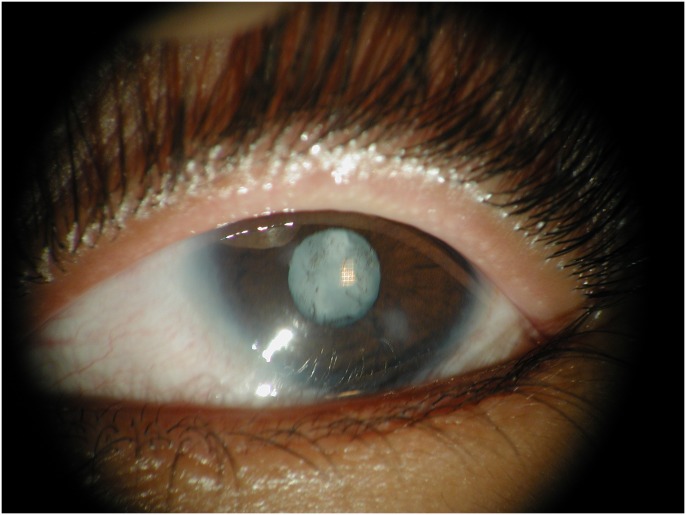
Affected individuals underwent a detailed ophthalmological examination and slit-lamp photographs of the cataractous lenses were obtained. An aliquot of blood was collected from all participating family members and genomic DNA was extracted from white blood cells. Initially, a genome-wide scan was performed with genomic DNAs of family PKCC025 followed by exclusion analysis of our familial cohort of congenital cataracts. Protein-coding exons of CRYBB1, CRYBB2, CRYBB3, and CRYBA4 were sequenced bidirectionally. A haplotype was constructed with SNPs flanking the causal mutation for affected individuals in all four families, while the probability that the four familial cases have a common founder was estimated using EM and CHM-based algorithms. The expression of Crybb3 in the developing murine lens was investigated using TaqMan assays.
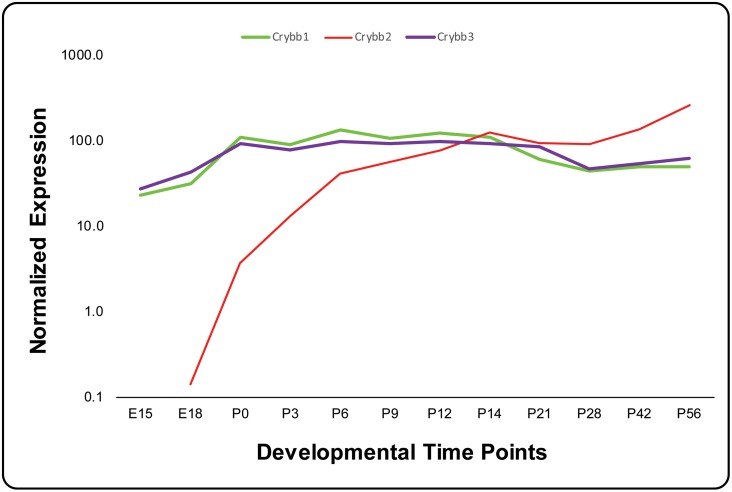
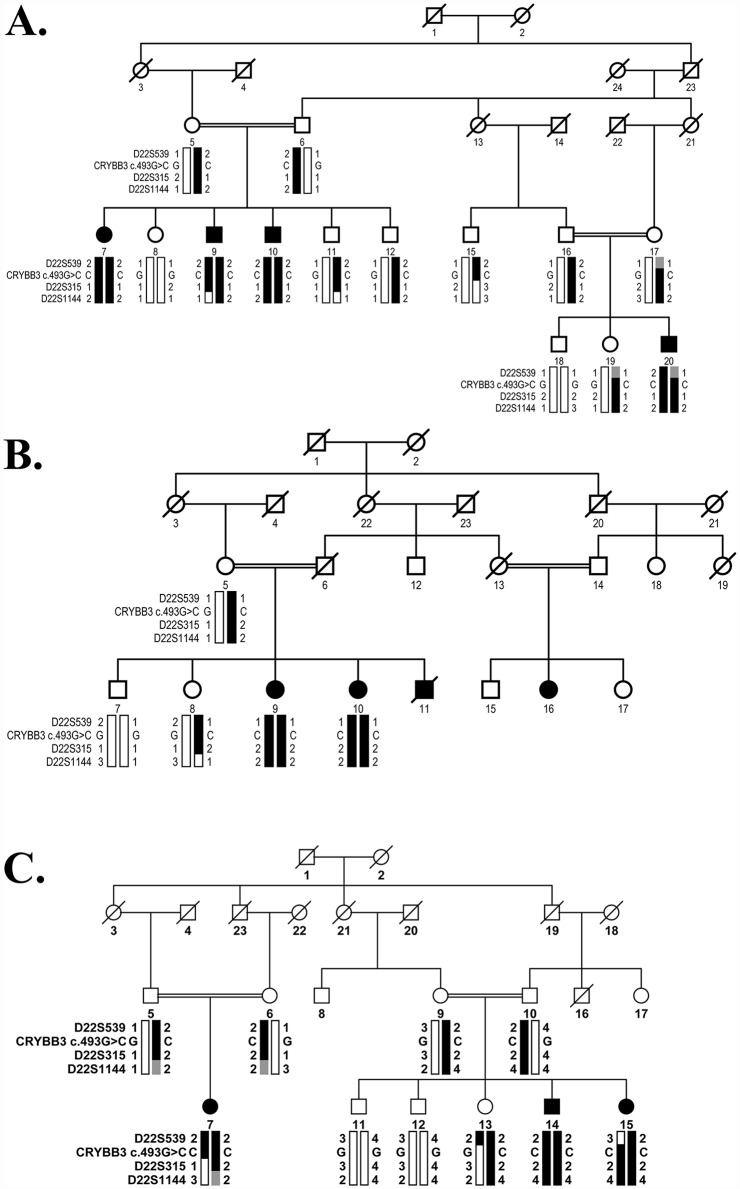
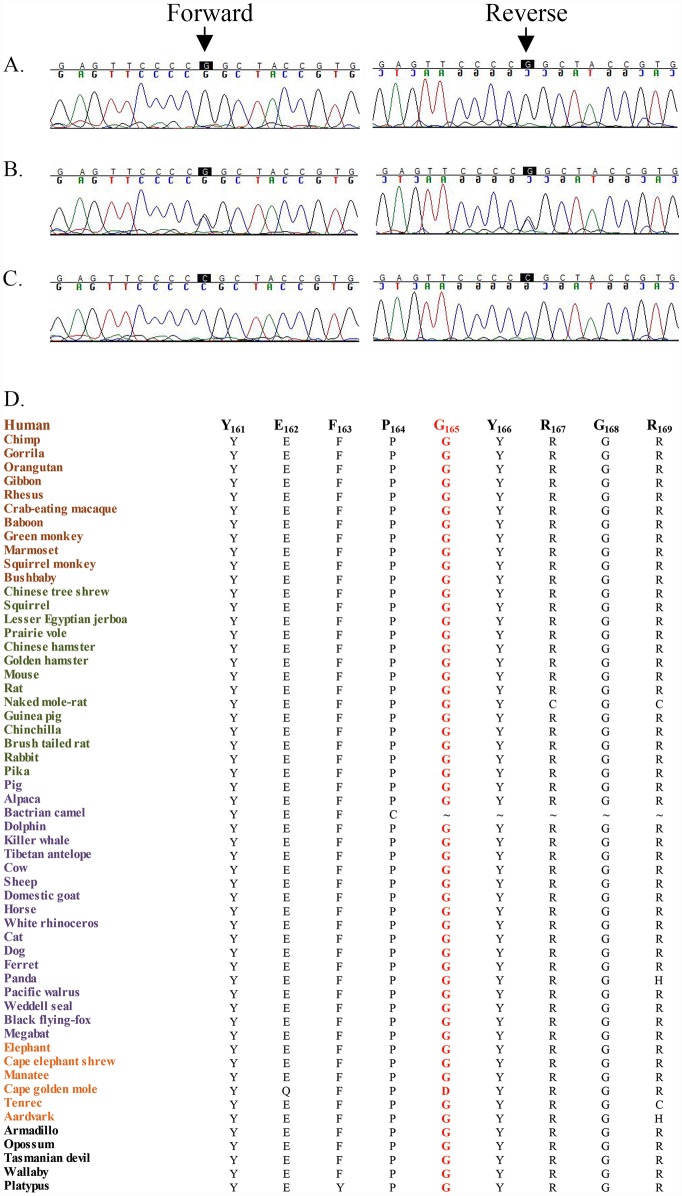
The clinical and ophthalmological examinations suggested that all affected individuals had nuclear cataracts. Genome-wide linkage analysis localized the causal phenotype in family PKCC025 to chromosome 22q with statistically significant two-point logarithm of odds (LOD) scores. Subsequently, we localized three additional families, PKCC063, PKCC131, and PKCC168 to chromosome 22q. Bidirectional Sanger sequencing identified a missense variation: c.493G>C (p.Gly165Arg) in CRYBB3 that segregated with the disease phenotype in all four familial cases. This variation was not found in ethnically matched control chromosomes, the NHLBI exome variant server, or the 1000 Genomes or dbSNP databases. Interestingly, all four families harbor a unique disease haplotype that strongly suggests a common founder of the causal mutation (p<1.64E-10). We observed expression of Crybb3 in the mouse lens as early as embryonic day 15 (E15), and expression remained relatively steady throughout development.
Here, we report a common ancestral mutation in CRYBB3 associated with autosomal recessive congenital cataracts identified in four familial cases of Pakistani origin.
本研究旨在调查大型近亲家庭中常染色体隐性先天性白内障的遗传决定因素。
对受影响个体进行详细的眼科检查,并获取白内障晶状体的裂隙灯照片。从所有参与研究的家庭成员中采集一份血液样本,从白细胞中提取基因组DNA。最初,对PKCC025家族的基因组DNA进行全基因组扫描,随后对我们的先天性白内障家族队列进行排除分析。对CRYBB1、CRYBB2、CRYBB3和CRYBA4的蛋白质编码外显子进行双向测序。为所有四个家族中受影响个体构建了一个单倍型,该单倍型位于因果突变两侧的单核苷酸多态性(SNP),同时使用基于期望最大化(EM)和单倍型模块(CHM)的算法估计这四个家族病例有共同祖先的概率。使用TaqMan分析研究Crybb3在发育中的小鼠晶状体中的表达。
临床和眼科检查表明,所有受影响个体均患有核性白内障。全基因组连锁分析将PKCC025家族中的因果表型定位到22号染色体长臂(22q),两点对数优势(LOD)分数具有统计学意义。随后,我们将另外三个家族PKCC063、PKCC131和PKCC168定位到22q染色体。双向桑格测序鉴定出一个错义变异:CRYBB3基因中的c.493G>C(p.Gly165Arg),该变异在所有四个家族病例中均与疾病表型共分离。在种族匹配的对照染色体、美国国立心肺血液研究所(NHLBI)外显子变异服务器、千人基因组或单核苷酸多态性数据库(dbSNP)中均未发现该变异。有趣的是,所有四个家族都拥有独特的疾病单倍型,强烈提示因果突变有共同的祖先(p<1.64E-10)。我们观察到Crybb3早在胚胎第15天(E15)就在小鼠晶状体中表达,并且在整个发育过程中表达相对稳定。
在此,我们报告了在四个巴基斯坦裔家族病例中鉴定出的与常染色体隐性先天性白内障相关的CRYBB3基因中的一个共同祖先突变。