Sörstedt Erik, Nilsson Staffan, Blaxhult Anders, Gisslén Magnus, Flamholc Leo, Sönnerborg Anders, Yilmaz Aylin
Department of Infectious Diseases, Institute of Biomedicine, Sahlgrenska Academy, University of Gothenburg, 413 90, Gothenburg, Sweden.
Department of Mathematical Sciences, Chalmers University of Technology, 412 58, Gothenburg, Sweden.
BMC Infect Dis. 2016 Jun 21;16:305. doi: 10.1186/s12879-016-1628-6.
Many HIV-1-infected patients on suppressive antiretroviral therapy (ART) have transiently elevated HIV RNA levels. The clinical significance of these viral blips is uncertain. We have determined the incidence of blips and investigated important associations in the Swedish HIV-cohort.
HIV-1-infected ART naïve adults who commenced ART 2007-2013 were retrospectively included. Viral blips were defined as a transient viral load between 50 and 500 copies/mL Subjects not suppressed after six months on ART were excluded.
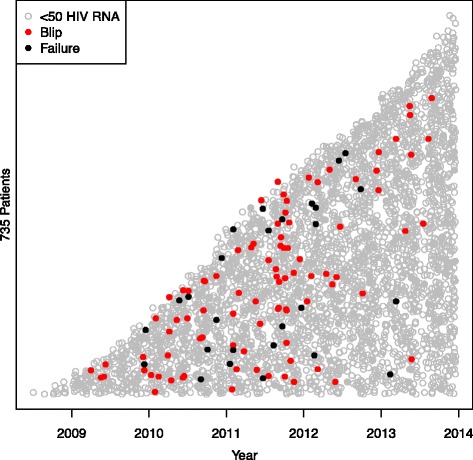
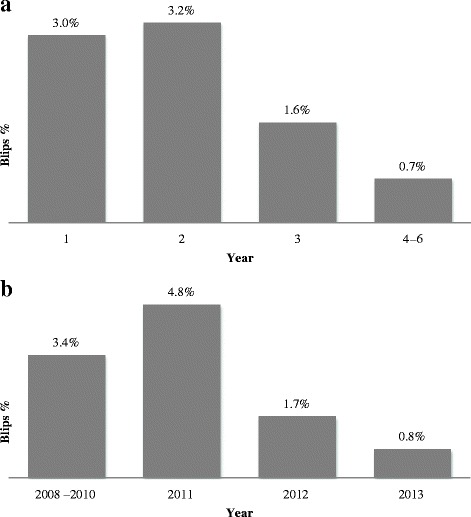
Viral blips were found in 76/735 included subjects (10.3 %) and in 90/4449 samples (2.0 %). Median blip viral load was 76 copies/mL (range 56-138). Median follow-up time was 170 weeks (range 97-240). Baseline viral load was higher in subjects with viral blips (median log10 4.85 copies/mL) compared with subjects without blips (median log10 4.55 copies/mL) (p < 0.01). There was a significant association between viral blips and risk for subsequent virological failure (p < 0.001).
The Swedish national HIV-cohort has a low incidence of viral blips (10 %). Blips were associated with high baseline viral load and an increased risk of subsequent virological failure.
许多接受抑制性抗逆转录病毒疗法(ART)的HIV-1感染患者的HIV RNA水平会短暂升高。这些病毒波动的临床意义尚不确定。我们已经确定了瑞典HIV队列中病毒波动的发生率,并研究了重要的关联因素。
回顾性纳入2007年至2013年开始接受ART的初治HIV-1感染成年患者。病毒波动定义为病毒载量在50至500拷贝/毫升之间的短暂升高。ART治疗六个月后未被抑制的受试者被排除。
在735名纳入的受试者中有76名(10.3%)出现病毒波动,在4449份样本中有90份(2.0%)出现病毒波动。病毒波动的中位病毒载量为76拷贝/毫升(范围56 - 138)。中位随访时间为170周(范围97 - 240)。出现病毒波动的受试者的基线病毒载量(中位对数10 4.85拷贝/毫升)高于未出现病毒波动的受试者(中位对数10 4.55拷贝/毫升)(p < 0.01)。病毒波动与后续病毒学失败风险之间存在显著关联(p < 0.001)。
瑞典国家HIV队列中病毒波动的发生率较低(10%)。病毒波动与高基线病毒载量以及后续病毒学失败风险增加有关。