Fratta Elisabetta, Montico Barbara, Rizzo Aurora, Colizzi Francesca, Sigalotti Luca, Dolcetti Riccardo
Cancer Bio-Immunotherapy Unit, Centro di Riferimento Oncologico, IRCCS, National Cancer Institute, Aviano, PN, Italy.
University of Queensland Diamantina Institute, Translational Research Institute, Brisbane, Australia.
Oncotarget. 2016 Aug 30;7(35):57327-57350. doi: 10.18632/oncotarget.10033.
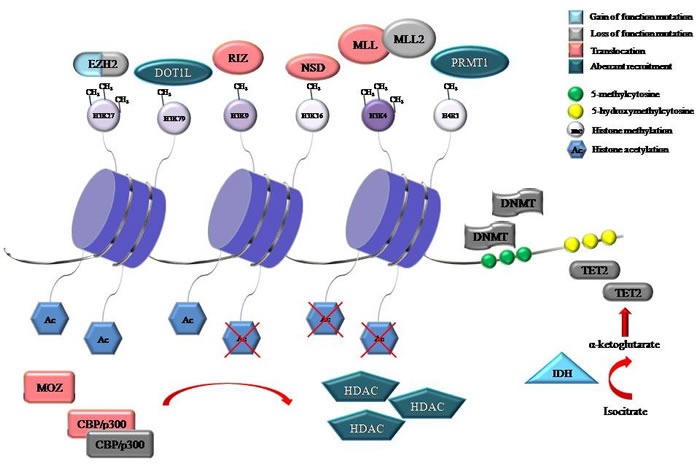
In recent years, recurrent somatic mutations in epigenetic regulators have been identified in patients with hematological malignancies. Furthermore, chromosomal translocations in which the fusion protein partners are themselves epigenetic regulators or where epigenetic regulators are recruited/targeted by oncogenic fusion proteins have also been described. Evidence has accumulated showing that "epigenetic drugs" are likely to provide clinical benefits in several hematological malignancies, granting their approval for the treatment of myelodysplastic syndromes and cutaneous T-cell lymphomas. A large number of pre-clinical and clinical trials evaluating epigenetic drugs alone or in combination therapies are ongoing. The aim of this review is to provide a comprehensive summary of known epigenetic alterations and of the current use of epigenetic drugs for the treatment of hematological malignancies.
近年来,在血液系统恶性肿瘤患者中已发现表观遗传调节因子的复发性体细胞突变。此外,也有报道称存在染色体易位,其中融合蛋白伴侣本身就是表观遗传调节因子,或者致癌融合蛋白招募/靶向表观遗传调节因子。越来越多的证据表明,“表观遗传药物”可能会给多种血液系统恶性肿瘤带来临床益处,这使得它们被批准用于治疗骨髓增生异常综合征和皮肤T细胞淋巴瘤。大量评估表观遗传药物单药治疗或联合治疗的临床前和临床试验正在进行。本综述的目的是全面总结已知的表观遗传改变以及目前表观遗传药物在治疗血液系统恶性肿瘤中的应用情况。