van Besien Koen, Koshy Nebu, Gergis Usama, Mayer Sebastian, Cushing Melissa, Rennert Hannah, Reich-Slotky Ronit, Mark Tomer, Pearse Roger, Rossi Adriana, Phillips Adrienne, Vasovic Liljana, Ferrante Rosanna, Hsu Yen-Michael, Shore Tsiporah
a Division of Hematology/Oncology, Weill Cornell Medical College , NY , USA.
b Department of Pathology, Weill Cornell Medical College , NY , USA.
Leuk Lymphoma. 2017 Feb;58(2):288-297. doi: 10.1080/10428194.2016.1190970. Epub 2016 Jun 23.
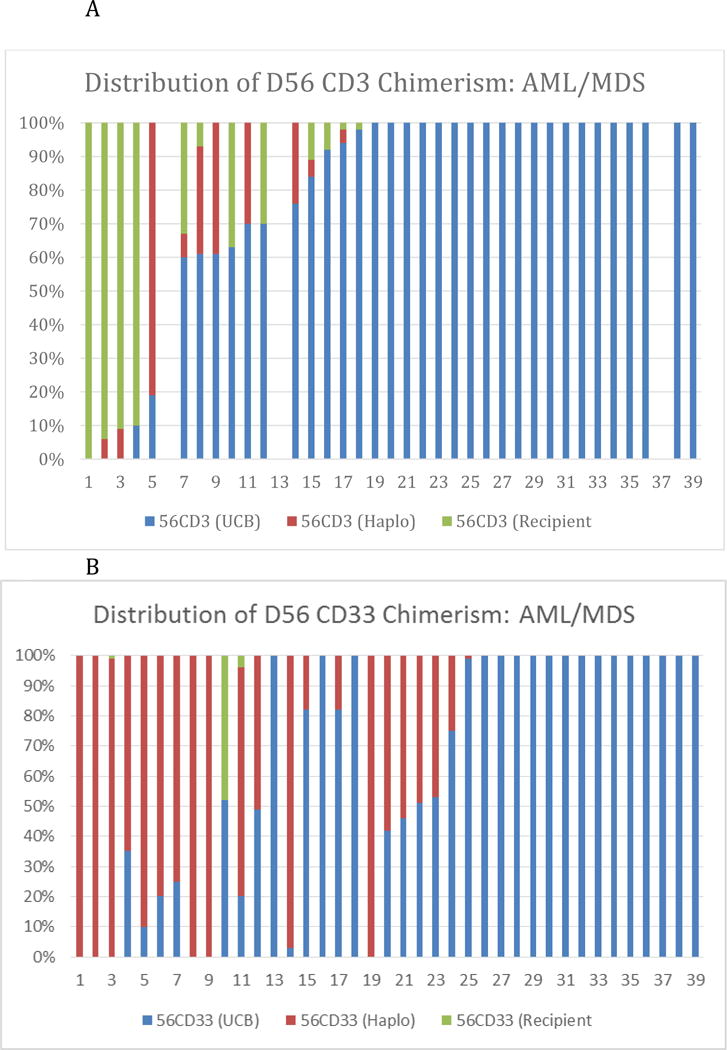
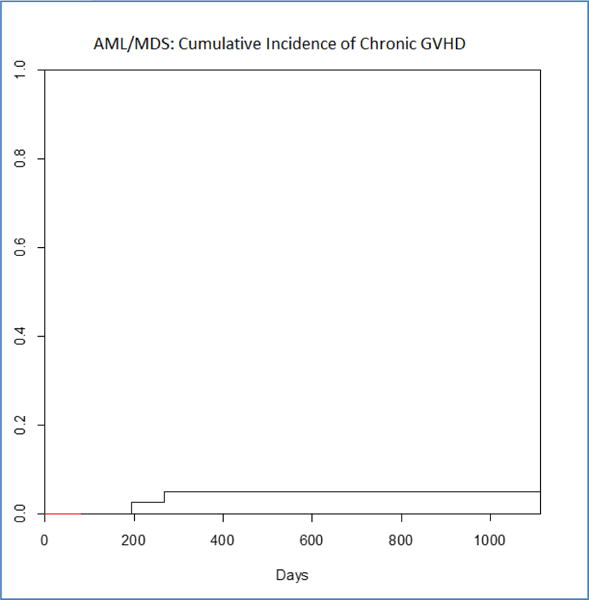
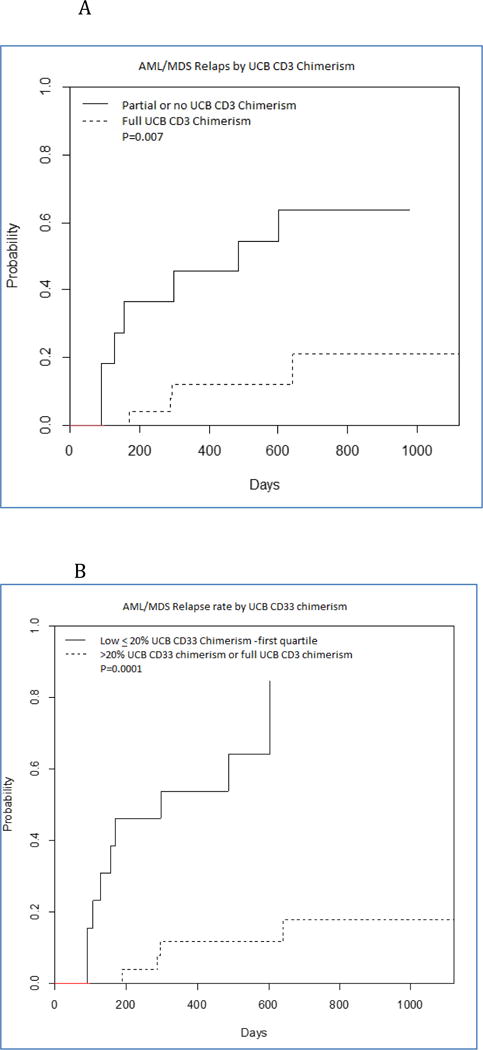
Haplo-cord stem cell transplantation combines the infusion of CD34 selected hematopoietic progenitors from a haplo-identical donor with an umbilical cord blood (UCB) graft from an unrelated donor and allows faster count recovery, with low rates of disease recurrence and chronic graft-versus-host disease (GVHD). But the contribution of the umbilical cord blood graft to long-term transplant outcome remains unclear. We analyzed 39 recipients of haplo-cord transplants with acute myeloid leukemia (AML) and myelodysplastic syndrome (MDS), engrafted and in remission at 2 months. Median age was 66 (18-72) and all had intermediate, high, or very-high risk disease. Less than 20% UCB chimerism in the CD33 lineage was associated with an increased rate of disease recurrence (54% versus 11% p < 0.0001) and decrease in one year progression-free (20% versus 55%, p = 0.004) and overall survival (30% versus 62%, p = 0.02). Less than 100% UCB chimerism in the CD3 lineage was associated with increase rate of disease recurrence (46% versus 12%, p = 0.007). Persistent haplo-chimerism in the CD3 lineage was associated with an increased rate of disease recurrence (40% versus 15%, p = 0.009) Chimerism did not predict for treatment related mortality. The cumulative incidence of acute GVHD by day 100 was 43%. The cumulative incidence of moderate/severe chronic GVHD was only 5%. Engraftment of the umbilical cord blood grafts provides powerful graft-versus-leukemia (GVL) effects which protect against disease recurrence and is associated with low risk of chronic GVHD. Engraftment of CD34 selected haplo-identical cells can lead to rapid development of circulating T-cells, but when these cells dominate, GVL-effects are limited and rates of disease recurrence are high.
单倍体脐带血干细胞移植将来自单倍体相合供者的经CD34选择的造血祖细胞输注与来自无关供者的脐带血(UCB)移植物相结合,可使血细胞计数恢复更快,疾病复发率和慢性移植物抗宿主病(GVHD)发生率较低。但脐带血移植物对长期移植结局的贡献仍不明确。我们分析了39例接受单倍体脐带血移植治疗急性髓系白血病(AML)和骨髓增生异常综合征(MDS)的患者,这些患者在2个月时植入并处于缓解期。中位年龄为66岁(18 - 72岁),所有患者均患有中危、高危或极高危疾病。CD33谱系中UCB嵌合率低于20%与疾病复发率增加相关(54%对11%,p < 0.0001),且无进展生存期降低(20%对55%,p = 0.004)以及总生存期降低(30%对62%,p = 0.02)。CD3谱系中UCB嵌合率低于100%与疾病复发率增加相关(46%对12%,p = 0.007)。CD3谱系中持续存在单倍体嵌合与疾病复发率增加相关(40%对15%,p = 0.009)。嵌合率不能预测治疗相关死亡率。至第100天急性GVHD的累积发生率为43%。中/重度慢性GVHD的累积发生率仅为5%。脐带血移植物的植入提供了强大的移植物抗白血病(GVL)效应,可预防疾病复发,且与慢性GVHD低风险相关。经CD34选择的单倍体相合细胞的植入可导致循环T细胞快速发育,但当这些细胞占主导时,GVL效应有限且疾病复发率高。