Hong Ki Hwan, Yang Woo Seok, Park Min Ju, Oh Jong Seok, Han Baek Hwa
Department of Otolaryngology-Head and Neck Surgery, Research Institute of Clinical Medicine of Chonbuk National University-Biomedical Research Institute of Chonbuk National University Hospital, Jeonju, Korea.
Speech Therapy, Research Institute of Clinical Medicine of Chonbuk National University-Biomedical Research Institute of Chonbuk National University Hospital, Jeonju, Korea.
Clin Exp Otorhinolaryngol. 2017 Jun;10(2):168-173. doi: 10.21053/ceo.2015.01585. Epub 2016 Jun 18.
Voice and speech alterations after total thyroidectomy may be associated with other extralaryngeal factors, such as neck muscle dysfunction and neck scar contracture. We evaluated the acoustic characteristics of oral vowel sounds and changes in hyoid bone movement before and after thyroidectomy.
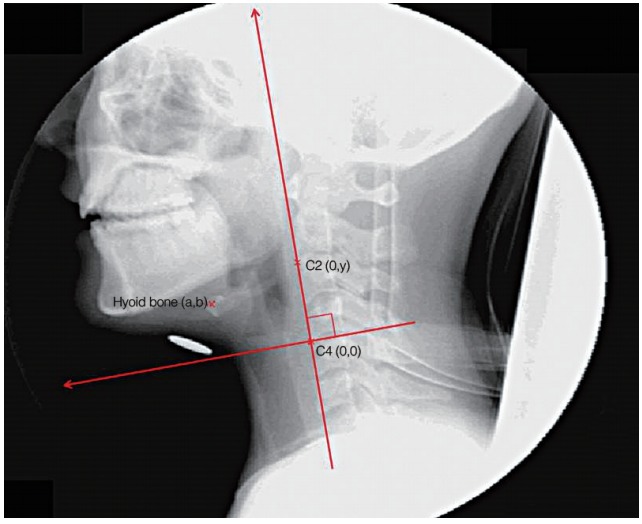
Twenty-nine female patients undergoing total thyroidectomy were included. Fundamental frequencies (Fo), formants and vowel space areas were evaluated before surgery and 7 days and 3 months after surgery to acoustically analyze the oral vowel sounds. Videofluoroscopic images were taken at the same times to evaluate hyoid bone movement.
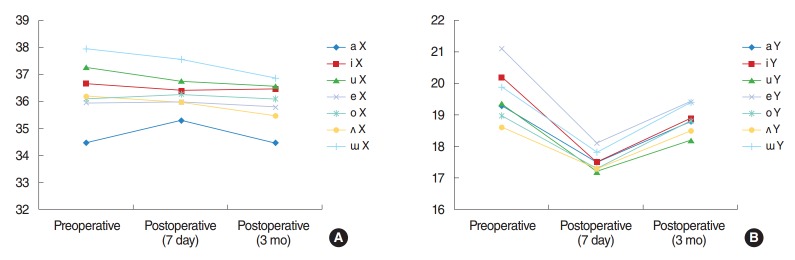
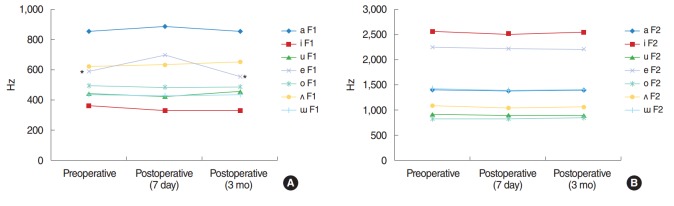
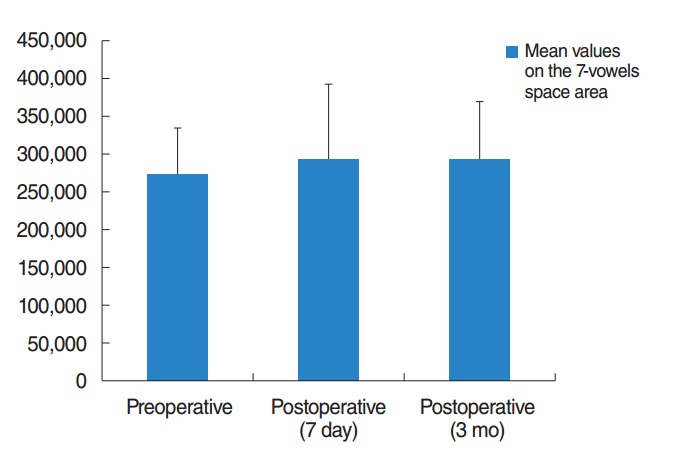
The Fo levels of seven vowels decreased significantly after surgery. The vowel formant changes the F1 of vowel /[e]/ decreased significantly from baseline at 3 months postoperatively, and the F3 of vowel /[i]/ decreased significantly from baseline 7 days postoperatively. The change in the vowel space area was not observed. The Y coordinate of the vowels /[i]/ and /[e]/ decreased significantly from baseline 7 days postoperatively due to changes in hyoid movement.
The damage to the neck muscles after thyroidectomy changes in Fo, formant and hyoid bone position. These quantitative results could be used as basic data for voice management in patients who undergo thyroidectomy.
全甲状腺切除术后的嗓音和言语改变可能与其他喉外因素有关,如颈部肌肉功能障碍和颈部瘢痕挛缩。我们评估了甲状腺切除术前、后的口腔元音声音的声学特征以及舌骨运动的变化。
纳入29例行全甲状腺切除术的女性患者。在手术前、术后7天和3个月评估基频(Fo)、共振峰和元音空间面积,以对口腔元音声音进行声学分析。在相同时间拍摄视频荧光图像以评估舌骨运动。
术后七个元音的Fo水平显著降低。元音共振峰发生变化,元音/[e]/的F1在术后3个月时较基线显著降低,元音/[i]/的F3在术后7天较基线显著降低。未观察到元音空间面积的变化。由于舌骨运动的改变,元音/[i]/和/[e]/的Y坐标在术后7天较基线显著降低。
甲状腺切除术后颈部肌肉损伤导致Fo、共振峰和舌骨位置发生变化。这些定量结果可作为甲状腺切除患者嗓音管理的基础数据。