Halonen Jaana I, Pulakka Anna, Stenholm Sari, Pentti Jaana, Kawachi Ichiro, Kivimäki Mika, Vahtera Jussi
From the aFinnish Institute of Occupational Health, Helsinki, Finland; bDepartment of Public Health, University of Turku, Turku, Finland; cSchool of Health Sciences, University of Tampere, Tampere, Finland; dDepartment of Social and Behavioral Sciences, Harvard School of Public Health, Boston, MA; eDepartment of Epidemiology and Public Health, University College London Medical School, London, United Kingdom; fClinicum, Faculty of Medicine, University of Helsinki, Helsinki, Finland; and gTurku University Hospital, Turku, Finland.
Epidemiology. 2016 Nov;27(6):803-9. doi: 10.1097/EDE.0000000000000530.
Evidence for an association between neighborhood disadvantage and smoking is mixed and mainly based on cross-sectional studies. To shed light on the causality of this association, we examined whether change in neighborhood socioeconomic disadvantage is associated with within-individual change in smoking behaviors.
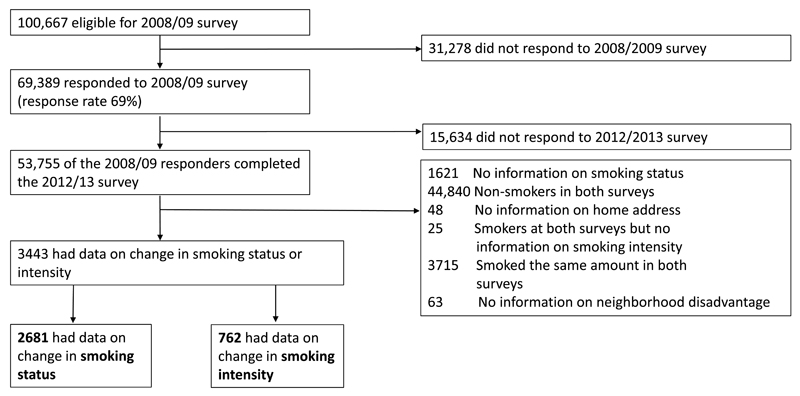
The study population comprised participants of the Finnish Public Sector study who reported a change in their smoking behavior between surveys in 2008/2009 and 2012/2013. We linked participants' residential addresses to a total population database on neighborhood disadvantage with 250 × 250-m resolution. The outcome variables were changes in smoking status (being a smoker vs. not) as well as the intensity (heavy/moderate vs. light smoker). We used longitudinal case-crossover design, a method that accounts for time-invariant confounders by design. We adjusted models for time-varying covariates.
Of the 3,443 participants, 1,714 quit, while 967 began to smoke between surveys. Smoking intensity increased among 398 and decreased among 364 participants. The level of neighborhood disadvantage changed for 1,078 participants because they moved residence. Increased disadvantage was associated with increased odds of being a smoker (odds ratio of taking up smoking 1.23 [95% confidence interval: 1.2, 1.5] per 1 SD increase in standardized national disadvantage score). Odds ratio for being a heavy/moderate (vs. light) smoker was 1.14 (95% confidence interval: 0.85, 1.52) when disadvantage increased by 1 SD.
These within-individual results link an increase in neighborhood socioeconomic disadvantage, due to move in residence, with subsequent smoking behaviors.
邻里贫困与吸烟之间关联的证据并不一致,且主要基于横断面研究。为了阐明这种关联的因果关系,我们研究了邻里社会经济贫困状况的变化是否与个体吸烟行为的变化相关。
研究人群包括芬兰公共部门研究的参与者,他们报告了在2008/2009年和2012/2013年调查之间吸烟行为的变化。我们将参与者的居住地址与一个分辨率为250×250米的邻里贫困总人口数据库相链接。结局变量包括吸烟状况的变化(吸烟者与非吸烟者)以及吸烟强度(重度/中度吸烟者与轻度吸烟者)。我们使用纵向病例交叉设计,该方法通过设计考虑了时间不变的混杂因素。我们对随时间变化的协变量进行了模型调整。
在3443名参与者中,1714人戒烟,而967人在两次调查之间开始吸烟。398名参与者的吸烟强度增加,364名参与者的吸烟强度降低。1078名参与者因搬家而导致邻里贫困水平发生变化。贫困程度增加与成为吸烟者的几率增加相关(标准化国家贫困得分每增加1个标准差,开始吸烟的比值比为1.23[95%置信区间:1.2,1.5])。当贫困程度增加1个标准差时,成为重度/中度(与轻度)吸烟者的比值比为1.14(95%置信区间:0.85,1.52)。
这些个体内部的结果表明,由于搬家导致的邻里社会经济贫困程度增加与随后的吸烟行为有关。