Albrecht Katinka, Richter Adrian, Callhoff Johanna, Huscher Dörte, Schett Georg, Strangfeld Anja, Zink Angela
German Rheumatism Research Centre, Epidemiology Unit, Charitéplatz 1, 10117, Berlin, Germany.
Department of Internal Medicine, University of Erlangen-Nuremberg, Erlangen, Germany.
Arthritis Res Ther. 2016 Jun 23;18:149. doi: 10.1186/s13075-016-1043-9.
METARTHROS (Metabolic impact on joint and bone disease) is a nationwide German network to investigate the overlap between inflammatory and metabolic diseases. The objective of this study was to compare the body mass index (BMI) distribution in patients with early and established rheumatoid arthritis (RA) with data from the general population, and to evaluate the association of BMI with patient characteristics and clinical markers.
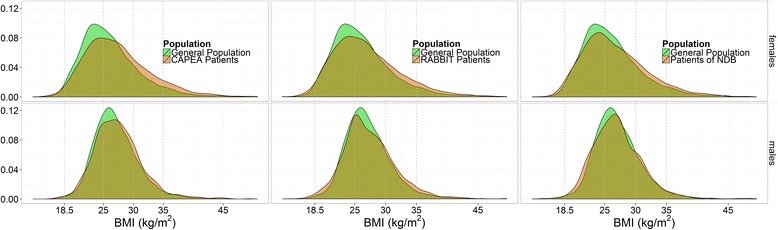
The BMI distribution was examined with data collected at inclusion of patients in the early arthritis cohort CAPEA, the biologics register RABBIT, and the National database of the German Collaborative Arthritis Centers. A data source with a representative sample of the German population (German Ageing Survey) was used as a comparator. BMI categories of <18.5 kg/m(2) (underweight), 18.5 to <25 kg/m(2) (normal weight), 25 to <30 kg/m(2) (overweight), and ≥30 kg/m(2) (obese) were used. Patients were stratified by age and sex, and compared to controls from the German Ageing Survey. Associations between BMI and markers of disease activity were analysed with non-parametric tests and linear models.
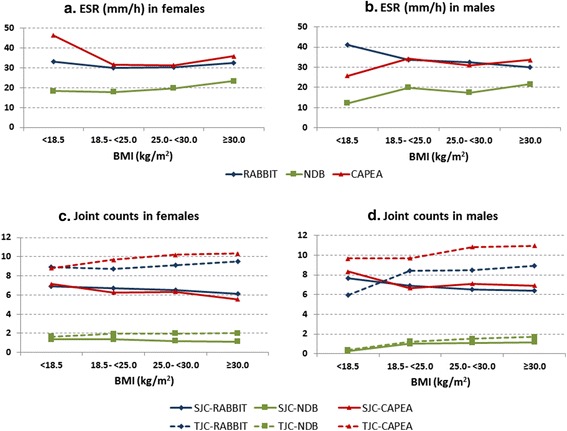
Data from 1207 (CAPEA), 12,230 (RABBIT), and 3424 (National database) RA patients and 6202 population controls were evaluated. The mean age was 56, 56, 62, and 62 years, respectively, the mean disease duration was 13 weeks, 9.9 years, and 13.5 years, respectively, and the mean disease activity score (DAS28) was 5.1, 5.2, and 3.1, respectively. In all RA cohorts, obesity was more frequent (23.8 %, 23.4 %, 21.4 %, respectively) than in controls (18.2 %). This applied to all age groups <70 years, was independent of disease duration, and was more pronounced in females. In all cohorts, the age at RA onset was associated with BMI, being higher in overweight/obese patients compared to normal-weight patients. Current smoking was negatively associated with BMI. Linear analyses revealed increased erythrocyte sedimentation rate (ESR) values in underweight and obese females, and an increasing disparity between tender joint counts (TJCs) and swollen joint counts (SJCs) in higher BMI categories.
Compared to the general population, a higher prevalence of obesity was observed in all RA cohorts. The dominance of obesity in females and the different behaviour of disease activity markers in relation to the BMI in females indicate that additional parameters need to be considered when analysing the impact of obesity on inflammation in RA.
METARTHROS(代谢对关节和骨骼疾病的影响)是一个德国全国性网络,旨在研究炎症性疾病和代谢性疾病之间的重叠情况。本研究的目的是将早期和确诊的类风湿关节炎(RA)患者的体重指数(BMI)分布与普通人群的数据进行比较,并评估BMI与患者特征及临床指标之间的关联。
利用早期关节炎队列CAPEA、生物制剂登记册RABBIT以及德国协作关节炎中心的国家数据库中患者入组时收集的数据,对BMI分布进行研究。将具有德国人群代表性样本的数据源(德国老龄化调查)用作对照。采用<18.5 kg/m²(体重过轻)、18.5至<25 kg/m²(正常体重)、25至<30 kg/m²(超重)和≥30 kg/m²(肥胖)的BMI分类。患者按年龄和性别分层,并与德国老龄化调查的对照组进行比较。使用非参数检验和线性模型分析BMI与疾病活动指标之间的关联。
对1207例(CAPEA)、12230例(RABBIT)和3424例(国家数据库)RA患者以及6202例人群对照的数据进行了评估。平均年龄分别为56岁、56岁、62岁和62岁,平均病程分别为13周、9.9年和13.5年,平均疾病活动评分(DAS28)分别为5.1、5.2和3.1。在所有RA队列中,肥胖的发生率(分别为23.8%、23.4%、21.4%)高于对照组(18.2%)。这适用于所有<70岁的年龄组,与病程无关,且在女性中更为明显。在所有队列中,RA发病年龄与BMI相关,超重/肥胖患者的发病年龄高于正常体重患者。当前吸烟与BMI呈负相关。线性分析显示,体重过轻和肥胖女性的红细胞沉降率(ESR)值升高,且在较高BMI类别中,压痛关节计数(TJC)和肿胀关节计数(SJC)之间的差异增大。
与普通人群相比,所有RA队列中肥胖的患病率更高。肥胖在女性中的主导地位以及女性疾病活动指标与BMI的不同表现表明,在分析肥胖对RA炎症影响时需要考虑其他参数。