Qiu Jiaen, Henderson Sam W, Tester Mark, Roy Stuart J, Gilliham Mathew
School of Agriculture, Food, and Wine, University of Adelaide, PMB1, Glen Osmond, SA 5064, Australia Australian Centre for Plant Functional Genomics, PMB1, Glen Osmond, SA 5064, Australia ARC Centre of Excellence in Plant Energy Biology, PMB1, Glen Osmond, SA 5064, Australia.
School of Agriculture, Food, and Wine, University of Adelaide, PMB1, Glen Osmond, SA 5064, Australia ARC Centre of Excellence in Plant Energy Biology, PMB1, Glen Osmond, SA 5064, Australia.
J Exp Bot. 2016 Aug;67(15):4495-505. doi: 10.1093/jxb/erw237. Epub 2016 Jun 23.
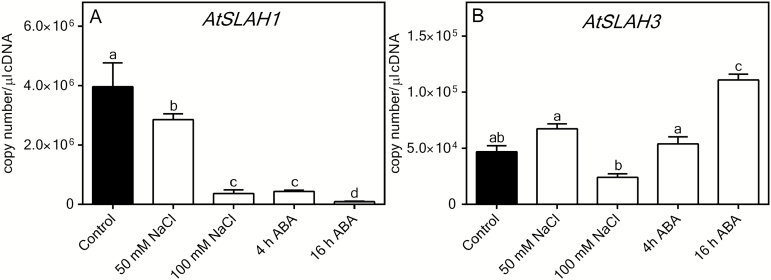
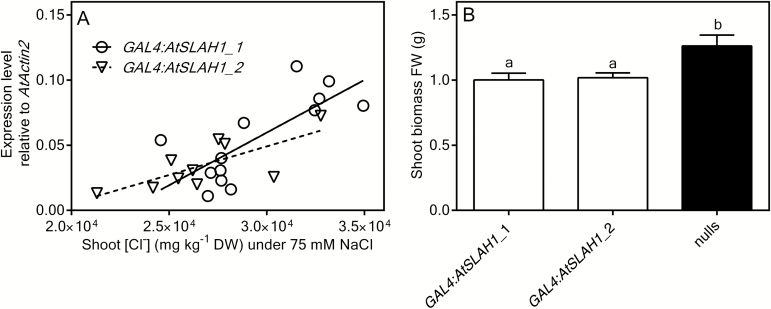
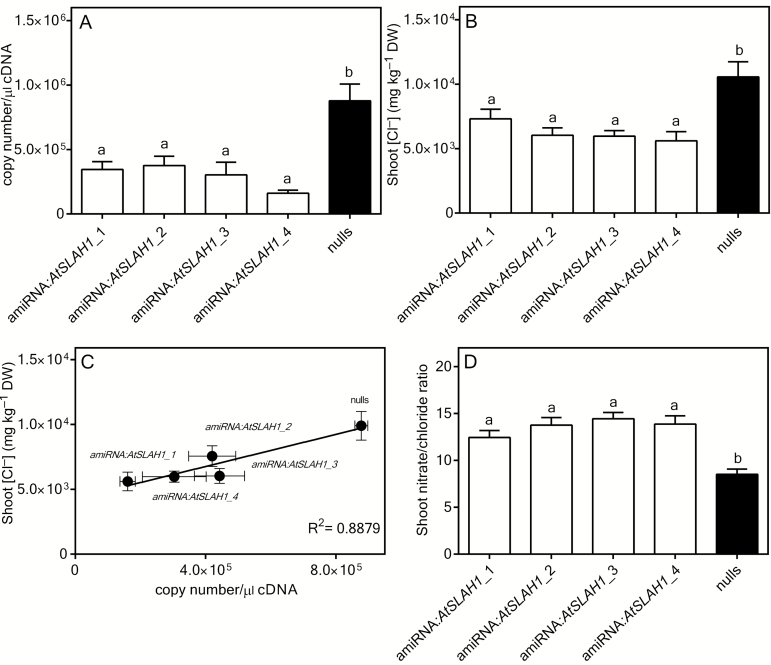
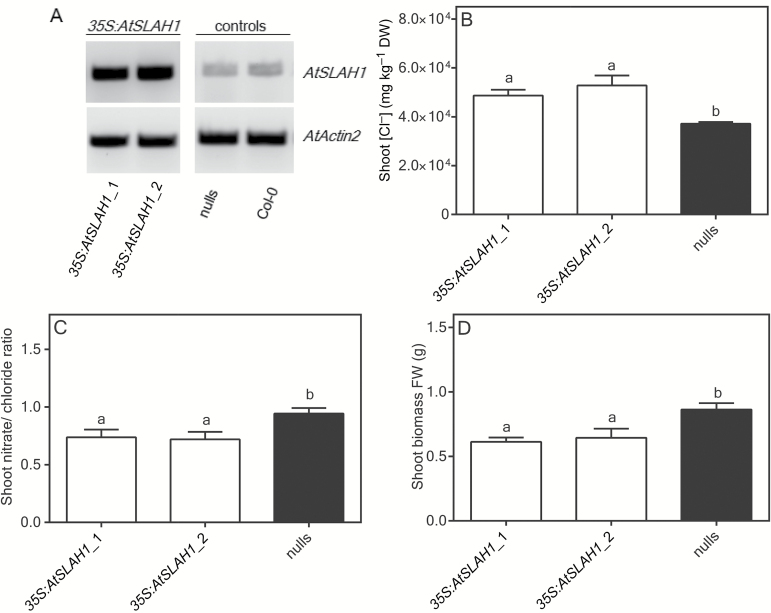
Salinity tolerance is correlated with shoot chloride (Cl(-)) exclusion in multiple crops, but the molecular mechanisms of long-distance Cl(-) transport are poorly defined. Here, we characterize the in planta role of AtSLAH1 (a homologue of the slow type anion channel-associated 1 (SLAC1)). This protein, localized to the plasma membrane of root stelar cells, has its expression reduced by salt or ABA, which are key predictions for a protein involved with loading Cl(-) into the root xylem. Artificial microRNA knockdown mutants of AtSLAH1 had significantly reduced shoot Cl(-) accumulation when grown under low Cl(-), whereas shoot Cl(-) increased and the shoot nitrate/chloride ratio decreased following AtSLAH1 constitutive or stelar-specific overexpression when grown in high Cl(-) In both sets of overexpression lines a significant reduction in shoot biomass over the null segregants was observed under high Cl(-) supply, but not low Cl(-) supply. Further in planta data showed AtSLAH3 overexpression increased the shoot nitrate/chloride ratio, consistent with AtSLAH3 favouring nitrate transport. Heterologous expression of AtSLAH1 in Xenopus laevis oocytes led to no detectible transport, suggesting the need for post-translational modifications for AtSLAH1 to be active. Our in planta data are consistent with AtSLAH1 having a role in controlling root-to-shoot Cl(-) transport.
多种作物的耐盐性与地上部氯离子(Cl⁻)的外排相关,但长距离Cl⁻运输的分子机制尚不清楚。在这里,我们描述了AtSLAH1(慢型阴离子通道相关蛋白1(SLAC1)的同源物)在植物体内的作用。该蛋白定位于根中柱细胞的质膜,其表达受盐或脱落酸(ABA)的抑制,这是参与将Cl⁻装载到根木质部的蛋白的关键预测特征。AtSLAH1的人工微小RNA敲除突变体在低Cl⁻条件下生长时,地上部Cl⁻积累显著减少,而在高Cl⁻条件下生长时,AtSLAH1组成型或中柱特异性过表达后,地上部Cl⁻增加,地上部硝酸盐/氯离子比值降低。在两组过表达系中,在高Cl⁻供应下观察到地上部生物量比空分离株显著降低,但在低Cl⁻供应下没有。进一步的植物体内数据表明,AtSLAH3过表达增加了地上部硝酸盐/氯离子比值,这与AtSLAH3有利于硝酸盐运输一致。AtSLAH1在非洲爪蟾卵母细胞中的异源表达未检测到转运,这表明AtSLAH1需要翻译后修饰才能激活。我们的植物体内数据与AtSLAH1在控制根到地上部Cl⁻运输中起作用一致。