Selb Regina, Eckl-Dorna Julia, Twaroch Teresa E, Lupinek Christian, Teufelberger Andrea, Hofer Gerhard, Focke-Tejkl Margarete, Gepp Barbara, Linhart Birgit, Breiteneder Heimo, Ellinger Adolf, Keller Walter, Roux Kenneth H, Valenta Rudolf, Niederberger Verena
Department of Otorhinolaryngology, Medical University of Vienna, Vienna, Austria.
Division of Immunopathology, Department of Pathophysiology and Allergy Research, Center for Pathophysiology, Infectiology and Immunology, Medical University of Vienna, Vienna, Austria.
J Allergy Clin Immunol. 2017 Jan;139(1):281-289.e5. doi: 10.1016/j.jaci.2016.04.015. Epub 2016 May 7.
The low-affinity receptor for IgE, FcεRII (CD23), contributes to allergic inflammation through allergen presentation to T cells, regulation of IgE responses, and enhancement of transepithelial allergen migration.
We sought to investigate the interaction between CD23, chimeric monoclonal human IgE, and the corresponding birch pollen allergen Bet v 1 at a molecular level.
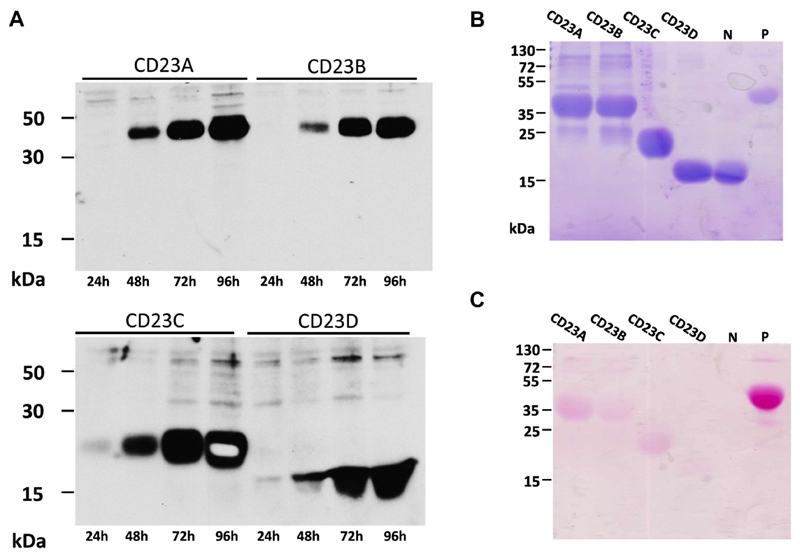
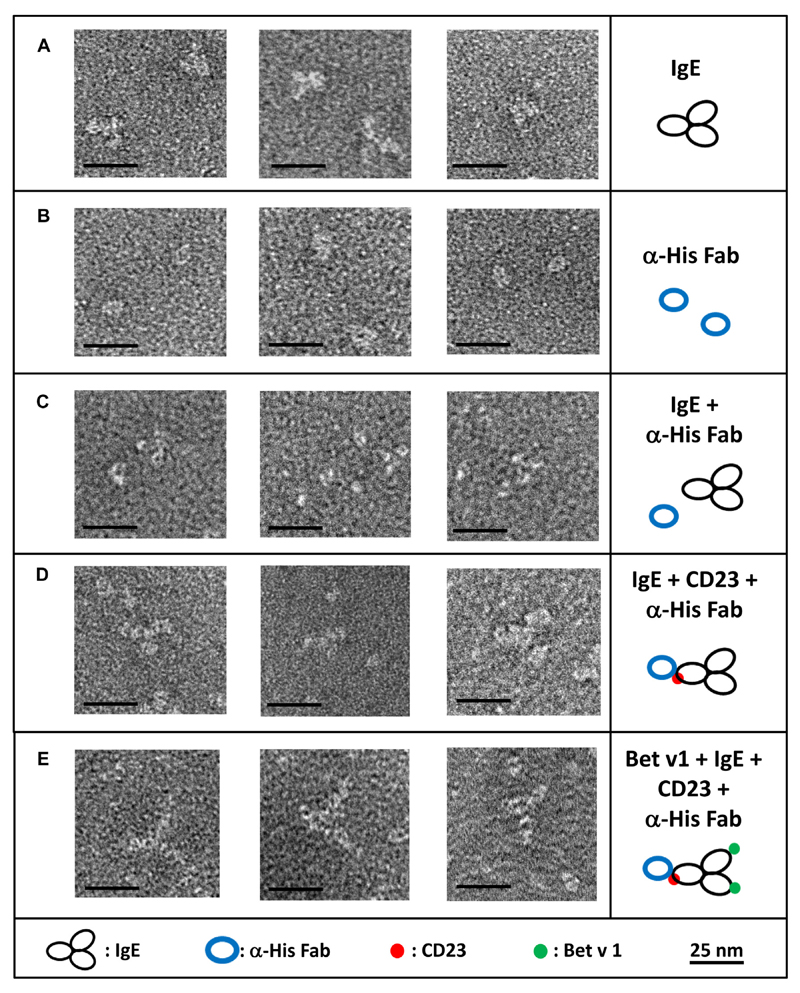
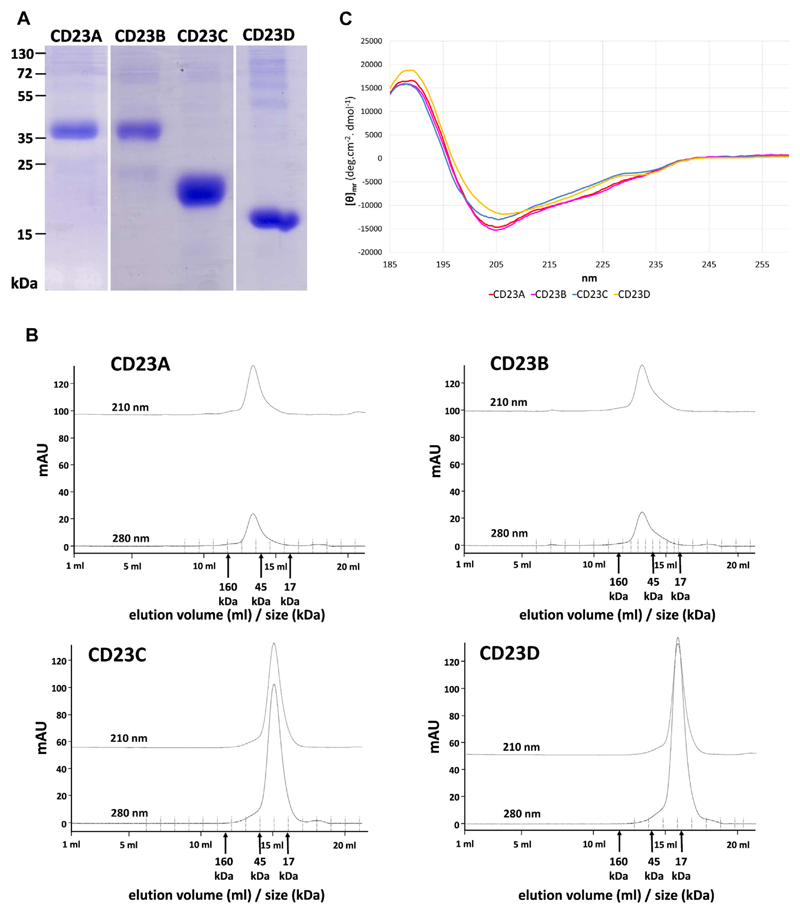
We expressed 4 CD23 variants. One variant comprised the full extracellular portion of CD23, including the stalk and head domain; 1 variant was identical with the first, except for an amino acid exchange in the stalk region abolishing the N-linked glycosylation site; and 2 variants represented the head domain, 1 complete and 1 truncated. The 4 CD23 variants were purified as monomeric and structurally folded proteins, as demonstrated by gel filtration and circular dichroism. By using a human IgE mAb, the corresponding allergen Bet v 1, and a panel of antibodies specific for peptides spanning the CD23 surface, both binding and inhibition assays and negative stain electron microscopy were performed.
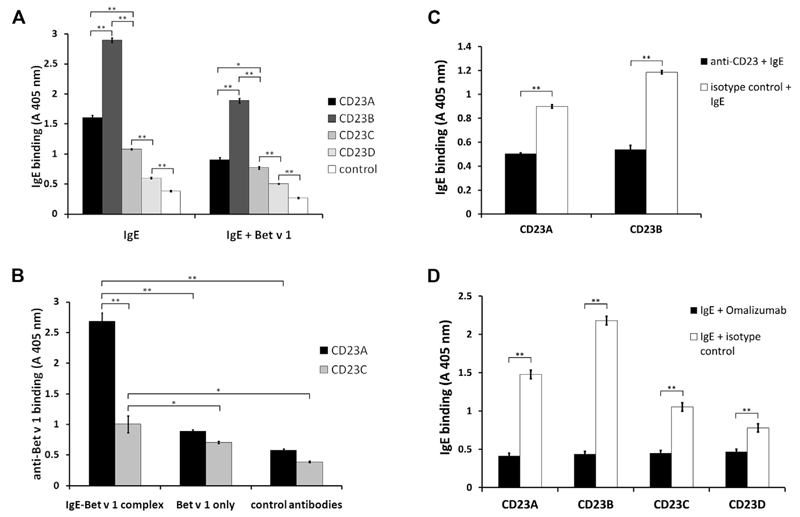
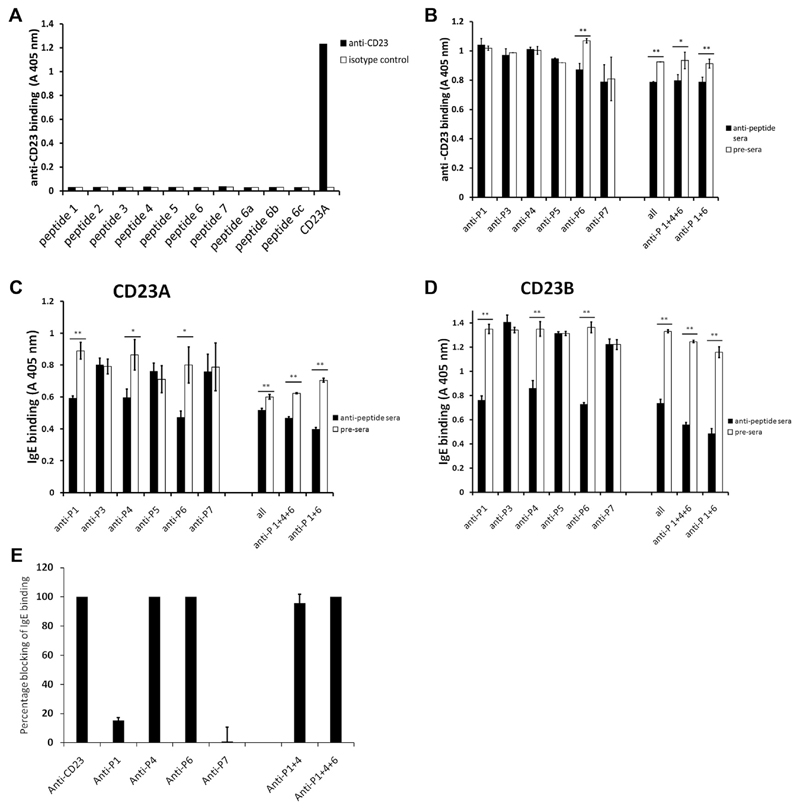
A hitherto unknown IgE-binding site was mapped on the stalk region of CD23, and the non-N-glycosylated monomeric version of CD23 was superior in IgE binding compared with glycosylated CD23. Furthermore, we demonstrated that a therapeutic anti-IgE antibody, omalizumab, which inhibits IgE binding to FcεRI, also inhibited IgE binding to CD23.
Our results provide a new model for the CD23-IgE interaction. We show that the stalk region of CD23 is crucially involved in IgE binding and that the interaction can be blocked by the therapeutic anti-IgE antibody omalizumab.
IgE低亲和力受体FcεRII(CD23)通过向T细胞呈递变应原、调节IgE反应以及增强变应原经上皮迁移,参与过敏性炎症。
我们试图在分子水平上研究CD23、嵌合单克隆人IgE与相应桦树花粉变应原Bet v 1之间的相互作用。
我们表达了4种CD23变体。一种变体包含CD23的完整细胞外部分,包括柄部和头部结构域;一种变体与第一种相同,只是柄部区域的一个氨基酸交换消除了N-连接糖基化位点;另外2种变体代表头部结构域,一种完整,一种截短。通过凝胶过滤和圆二色性证明,4种CD23变体被纯化为单体且结构折叠的蛋白质。使用人IgE单克隆抗体、相应的变应原Bet v 1以及一组针对跨越CD23表面的肽的特异性抗体,进行了结合和抑制试验以及负染电子显微镜观察。
在CD23的柄部区域定位了一个迄今未知的IgE结合位点,与糖基化的CD23相比,非N-糖基化的单体形式的CD23在IgE结合方面更具优势。此外,我们证明了一种治疗性抗IgE抗体奥马珠单抗,它抑制IgE与FcεRI的结合,也抑制IgE与CD23的结合。
我们的结果为CD23-IgE相互作用提供了一个新模型。我们表明CD23的柄部区域在IgE结合中起关键作用,并且这种相互作用可以被治疗性抗IgE抗体奥马珠单抗阻断。