Miao Yinglong, McCammon J Andrew
Howard Hughes Medical Institute, University of California San Diego, La Jolla, CA 92093, United States; Department of Pharmacology, University of California San Diego, La Jolla, CA 92093, United States.
Howard Hughes Medical Institute, University of California San Diego, La Jolla, CA 92093, United States; Department of Pharmacology, University of California San Diego, La Jolla, CA 92093, United States; Department of Chemistry and Biochemistry, University of California San Diego, La Jolla, CA 92093, United States.
Curr Opin Struct Biol. 2016 Dec;41:83-89. doi: 10.1016/j.sbi.2016.06.008. Epub 2016 Jun 22.
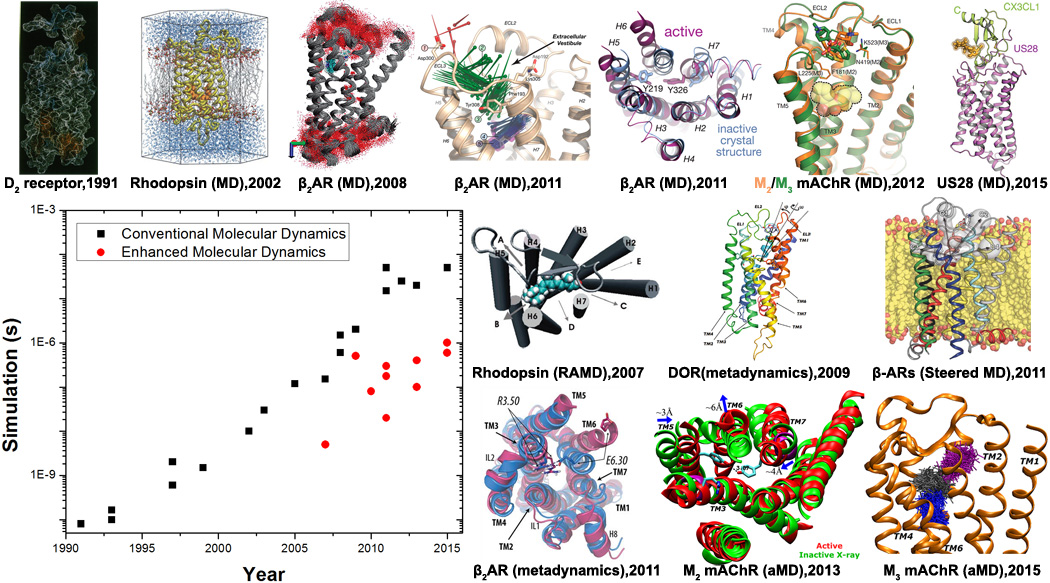
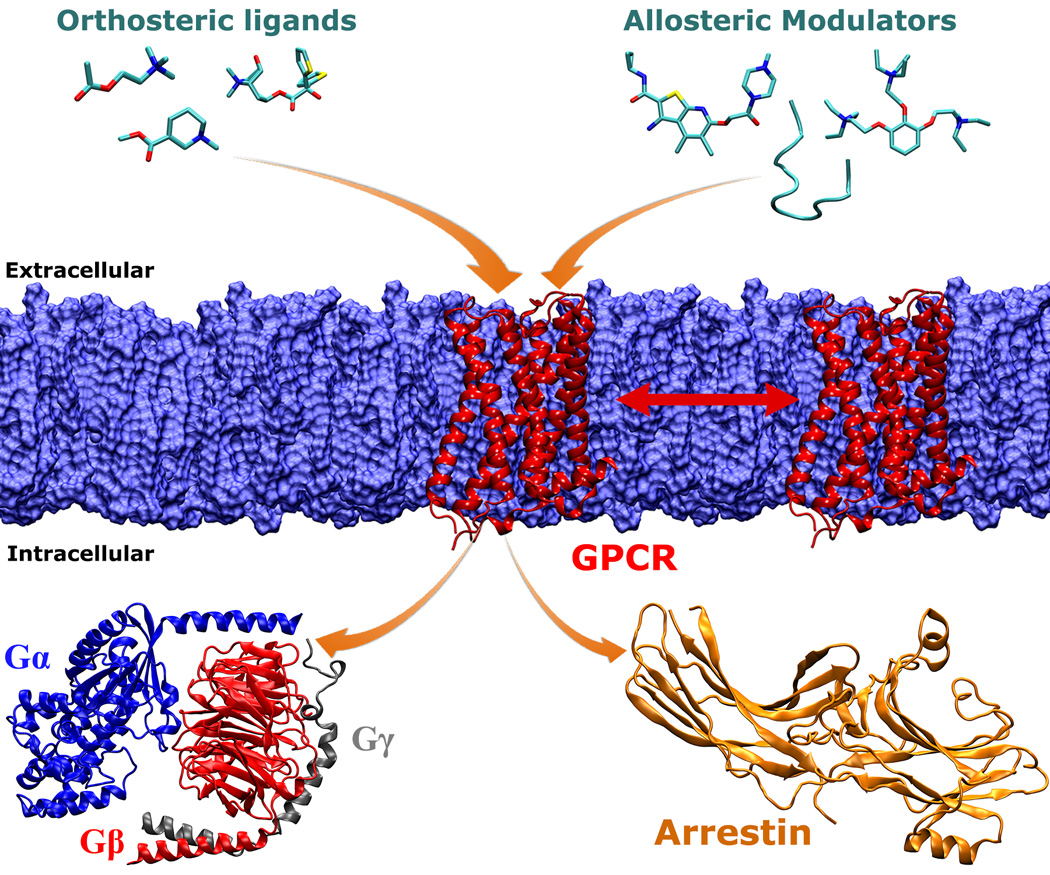
G-protein coupled receptors (GPCRs), the largest family of human membrane proteins, mediate cellular signaling and represent primary targets of about one third of currently marketed drugs. GPCRs undergo highly dynamic structural transitions during signal transduction, from binding of extracellular ligands to coupling with intracellular effector proteins. Molecular dynamics (MD) simulations have been utilized to investigate GPCR signaling mechanisms (such as pathways of ligand binding and receptor activation/deactivation) and to design novel small-molecule drug candidates. Future research directions point towards modeling cooperative binding of multiple orthosteric and allosteric ligands to GPCRs, GPCR oligomerization and interactions of GPCRs with different intracellular signaling proteins. Through methodological and supercomputing advances, MD simulations will continue to provide important insights into GPCR signaling mechanisms and further facilitate structure-based drug design.
G蛋白偶联受体(GPCRs)是人类膜蛋白中最大的家族,介导细胞信号传导,并且是目前约三分之一上市药物的主要作用靶点。GPCRs在信号转导过程中经历高度动态的结构转变,从细胞外配体的结合到与细胞内效应蛋白的偶联。分子动力学(MD)模拟已被用于研究GPCR信号传导机制(如配体结合途径和受体激活/失活)以及设计新型小分子候选药物。未来的研究方向指向对多个正构和变构配体与GPCRs的协同结合、GPCR寡聚化以及GPCRs与不同细胞内信号蛋白的相互作用进行建模。通过方法学和超级计算的进步,MD模拟将继续为GPCR信号传导机制提供重要见解,并进一步促进基于结构的药物设计。