Mueller Natalie, Rojas-Rueda David, Basagaña Xavier, Cirach Marta, Cole-Hunter Tom, Dadvand Payam, Donaire-Gonzalez David, Foraster Maria, Gascon Mireia, Martinez David, Tonne Cathryn, Triguero-Mas Margarita, Valentín Antònia, Nieuwenhuijsen Mark
ISGlobal, Centre for Research in Environmental Epidemiology (CREAL), Barcelona, Spain.
Environ Health Perspect. 2017 Jan;125(1):89-96. doi: 10.1289/EHP220. Epub 2016 Jun 27.
By 2050, nearly 70% of the global population is projected to live in urban areas. Because the environments we inhabit affect our health, urban and transport designs that promote healthy living are needed.
We estimated the number of premature deaths preventable under compliance with international exposure recommendations for physical activity (PA), air pollution, noise, heat, and access to green spaces.
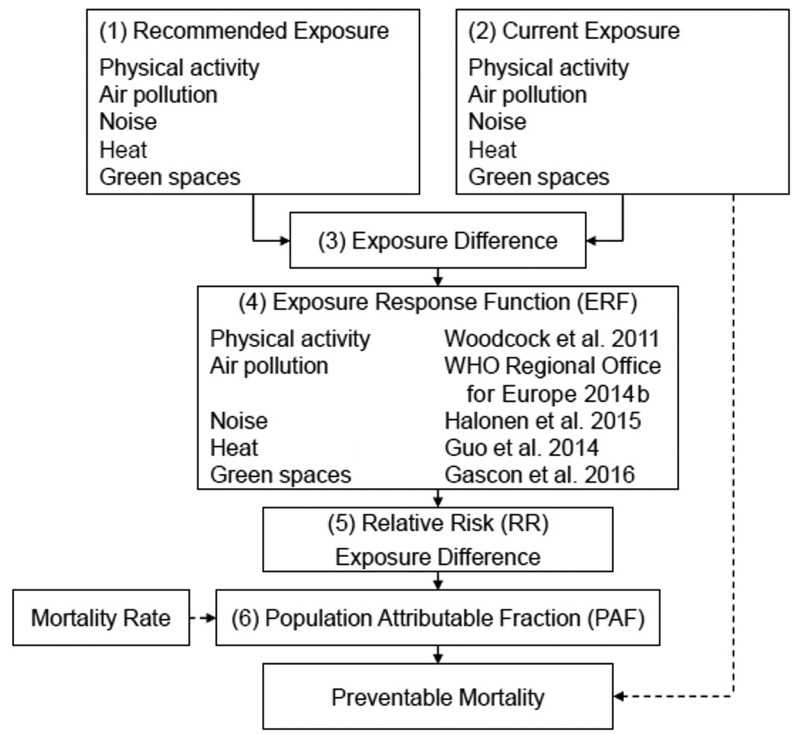
We developed and applied the Urban and TranspOrt Planning Health Impact Assessment (UTOPHIA) tool to Barcelona, Spain. Exposure estimates and mortality data were available for 1,357,361 residents. We compared recommended with current exposure levels. We quantified the associations between exposures and mortality and calculated population attributable fractions to estimate the number of premature deaths preventable. We also modeled life-expectancy and economic impacts.
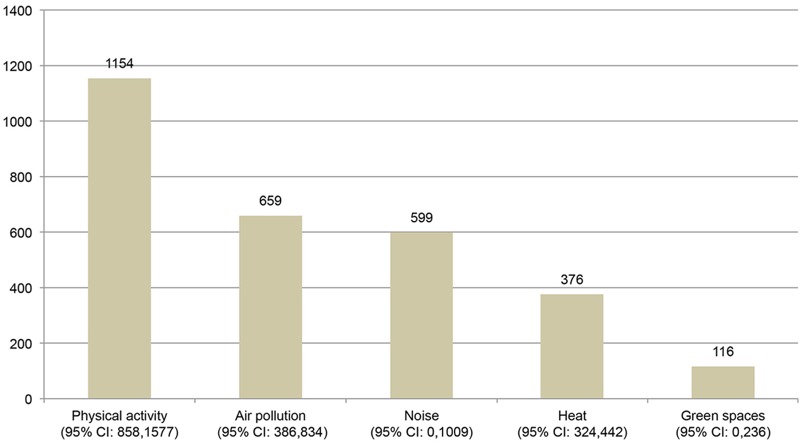
We estimated that annually, nearly 20% of mortality could be prevented if international recommendations for performance of PA; exposure to air pollution, noise, and heat; and access to green space were followed. Estimations showed that the greatest portion of preventable deaths was attributable to increases in PA, followed by reductions of exposure to air pollution, traffic noise, and heat. Access to green spaces had smaller effects on mortality. Compliance was estimated to increase the average life expectancy by 360 (95% CI: 219, 493) days and result in economic savings of 9.3 (95% CI: 4.9, 13.2) billion EUR/year.
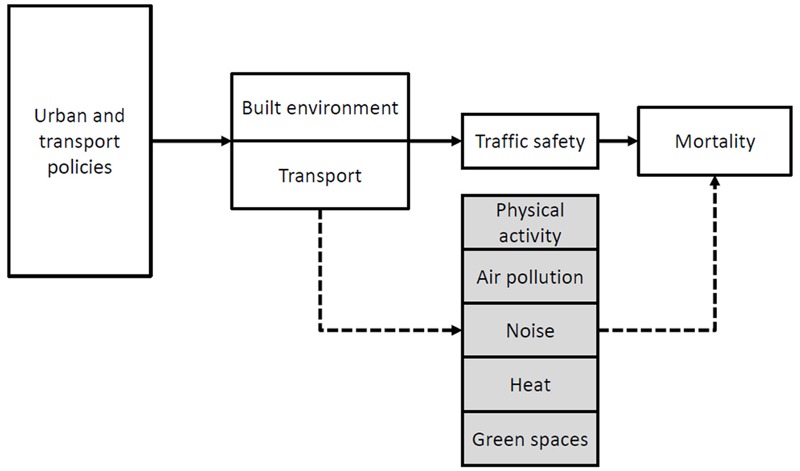
PA factors and environmental exposures can be modified by changes in urban and transport planning. We emphasize the need for a) the reduction of motorized traffic through the promotion of active and public transport and b) the provision of green infrastructure, both of which are suggested to provide opportunities for PA and for mitigation of air pollution, noise, and heat. Citation: Mueller N, Rojas-Rueda D, Basagaña X, Cirach M, Cole-Hunter T, Dadvand P, Donaire-Gonzalez D, Foraster M, Gascon M, Martinez D, Tonne C, Triguero-Mas M, Valentín A, Nieuwenhuijsen M. 2017. Urban and transport planning related exposures and mortality: a health impact assessment for cities. Environ Health Perspect 125:89-96; http://dx.doi.org/10.1289/EHP220.
预计到2050年,全球近70%的人口将居住在城市地区。由于我们所处的环境会影响健康,因此需要有利于健康生活的城市和交通设计。
我们估算了在遵循国际上关于身体活动(PA)、空气污染、噪音、高温以及绿地可达性的暴露建议的情况下可预防的过早死亡人数。
我们针对西班牙巴塞罗那开发并应用了城市与交通规划健康影响评估(UTOPHIA)工具。有1357361名居民的暴露估算值和死亡率数据。我们将推荐的暴露水平与当前暴露水平进行了比较。我们量化了暴露与死亡率之间的关联,并计算了人群归因分数以估算可预防的过早死亡人数。我们还对预期寿命和经济影响进行了建模。
我们估计,如果遵循关于PA表现、空气污染暴露、噪音暴露、高温暴露以及绿地可达性的国际建议,每年近20%的死亡可被预防。估算结果表明,可预防死亡的最大部分归因于PA的增加,其次是空气污染暴露、交通噪音暴露和高温暴露的减少。绿地可达性对死亡率的影响较小。据估计,遵循这些建议将使平均预期寿命增加360天(95%可信区间:219,493),并每年节省93亿欧元(95%可信区间:49,132)的经济成本。
PA因素和环境暴露可通过城市和交通规划的改变而得到改善。我们强调需要:a)通过推广主动式交通和公共交通来减少机动化交通;b)提供绿色基础设施,这两者都被认为可为PA以及减轻空气污染、噪音和高温提供机会。引文:穆勒N,罗哈斯 - 鲁埃达D,巴萨尼亚X,西拉奇M,科尔 - 亨特T,达万德P,多纳雷 - 冈萨雷斯D,福拉斯泰尔M,加斯孔M,马丁内斯D,托内C,特里格罗 - 马斯M,巴伦廷A,纽文惠森M。2017年。与城市和交通规划相关的暴露与死亡率:城市健康影响评估。《环境健康展望》125:89 - 96;http://dx.doi.org/10.1289/EHP220。