Rensch Thomas, Villar Diego, Horvath Julie, Odom Duncan T, Flicek Paul
European Molecular Biology Laboratory, European Bioinformatics Institute, Wellcome Genome Campus, Hinxton, Cambridge, CB10 1SD, UK.
Cancer Research UK Cambridge Institute, University of Cambridge, Robinson Way, Cambridge, CB2 0RE, UK.
Genome Biol. 2016 Jun 27;17(1):139. doi: 10.1186/s13059-016-0996-y.
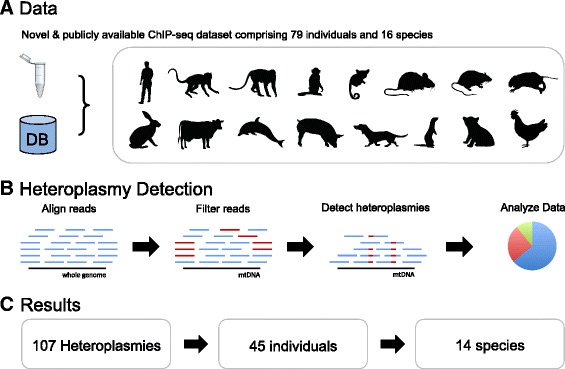
Mitochondrial heteroplasmy, the presence of more than one mitochondrial DNA (mtDNA) variant in a cell or individual, is not as uncommon as previously thought. It is mostly due to the high mutation rate of the mtDNA and limited repair mechanisms present in the mitochondrion. Motivated by mitochondrial diseases, much focus has been placed into studying this phenomenon in human samples and in medical contexts. To place these results in an evolutionary context and to explore general principles of heteroplasmy, we describe an integrated cross-species evaluation of heteroplasmy in mammals that exploits previously reported NGS data. Focusing on ChIP-seq experiments, we developed a novel approach to detect heteroplasmy from the concomitant mitochondrial DNA fraction sequenced in these experiments.
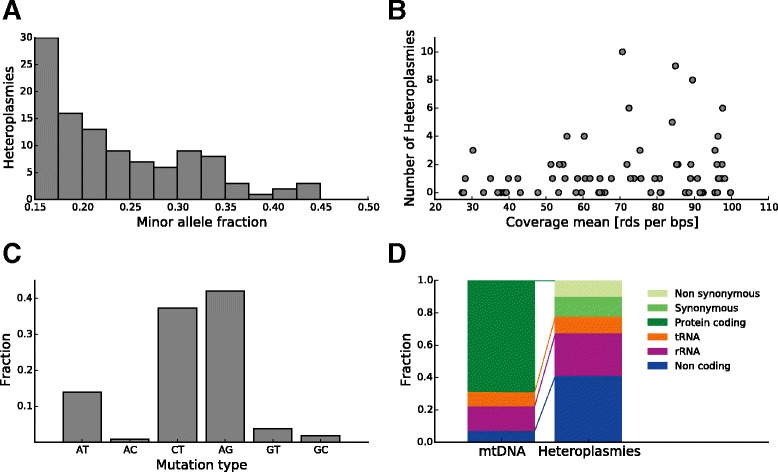
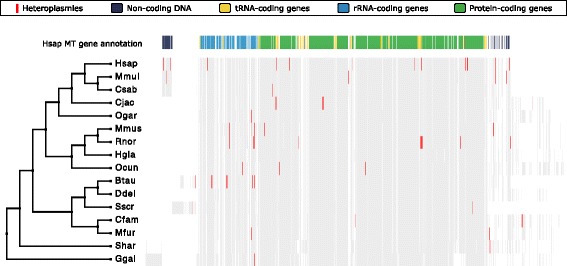
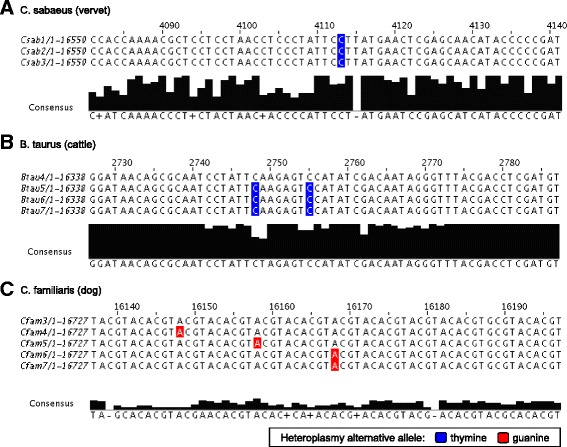
We first demonstrate that the sequencing coverage of mtDNA in ChIP-seq experiments is sufficient for heteroplasmy detection. We then describe a novel detection method for accurate detection of heteroplasmies, which also accounts for the error rate of NGS technology. Applying this method to 79 individuals from 16 species resulted in 107 heteroplasmic positions present in a total of 45 individuals. Further analysis revealed that the majority of detected heteroplasmies occur in intergenic regions.
In addition to documenting the prevalence of mtDNA in ChIP-seq data, the results of our mitochondrial heteroplasmy detection method suggest that mitochondrial heteroplasmies identified across vertebrates share similar characteristics as found for human heteroplasmies. Although largely consistent with previous studies in individual vertebrates, our integrated cross-species analysis provides valuable insights into the evolutionary dynamics of mitochondrial heteroplasmy.
线粒体异质性,即细胞或个体中存在一种以上的线粒体DNA(mtDNA)变体,并不像以前认为的那样罕见。这主要是由于mtDNA的高突变率以及线粒体中存在的有限修复机制。受线粒体疾病的驱动,人们将大量精力投入到在人类样本和医学背景下研究这一现象。为了将这些结果置于进化背景中并探索异质性的一般原则,我们描述了一种利用先前报道的二代测序(NGS)数据对哺乳动物异质性进行的综合跨物种评估。聚焦于染色质免疫沉淀测序(ChIP-seq)实验,我们开发了一种新方法,用于从这些实验中伴随测序的线粒体DNA片段中检测异质性。
我们首先证明ChIP-seq实验中线粒体DNA的测序覆盖度足以检测异质性。然后,我们描述了一种用于准确检测异质性的新方法,该方法也考虑了NGS技术的错误率。将此方法应用于来自16个物种的79个个体,共在45个个体中发现了107个异质位点。进一步分析表明,大多数检测到的异质性发生在基因间区域。
除了记录ChIP-seq数据中线粒体DNA的普遍性外,我们的线粒体异质性检测方法的结果表明,在脊椎动物中鉴定出的线粒体异质性与人类异质性具有相似的特征。尽管在很大程度上与先前对单个脊椎动物的研究一致,但我们的综合跨物种分析为线粒体异质性的进化动态提供了有价值的见解。