Fokstuen S, Makrythanasis P, Hammar E, Guipponi M, Ranza E, Varvagiannis K, Santoni F A, Albarca-Aguilera M, Poleggi M E, Couchepin F, Brockmann C, Mauron A, Hurst S A, Moret C, Gehrig C, Vannier A, Bevillard J, Araud T, Gimelli S, Stathaki E, Paoloni-Giacobino A, Bottani A, Sloan-Béna F, Sizonenko L D'Amato, Mostafavi M, Hamamy H, Nouspikel T, Blouin J L, Antonarakis S E
Service of Genetic Medicine, University Hospitals of Geneva, Geneva, Switzerland.
Department of Genetic Medicine and Development, University of Geneva, 1 rue Michel-Servet, 1211, Geneva, Switzerland.
Hum Genomics. 2016 Jun 28;10(1):24. doi: 10.1186/s40246-016-0080-4.
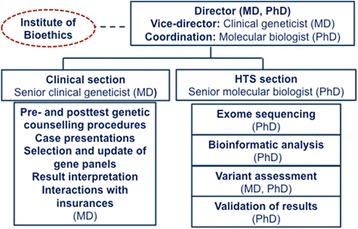
In order to optimally integrate the use of high-throughput sequencing (HTS) as a tool in clinical diagnostics of likely monogenic disorders, we have created a multidisciplinary "Genome Clinic Task Force" at the University Hospitals of Geneva, which is composed of clinical and molecular geneticists, bioinformaticians, technicians, bioethicists, and a coordinator.
We have implemented whole exome sequencing (WES) with subsequent targeted bioinformatics analysis of gene lists for specific disorders. Clinical cases of heterogeneous Mendelian disorders that could potentially benefit from HTS are presented and discussed during the sessions of the task force. Debate concerning the interpretation of identified variants and the content of the final report constitutes a major part of the task force's work. Furthermore, issues related to bioethics, genetic counseling, quality control, and reimbursement are also addressed.
This multidisciplinary task force has enabled us to create a platform for regular exchanges between all involved experts in order to deal with the multiple complex issues related to HTS in clinical practice and to continuously improve the diagnostic use of HTS. In addition, this task force was instrumental to formally approve the reimbursement of HTS for molecular diagnosis of Mendelian disorders in Switzerland.
为了优化高通量测序(HTS)作为一种工具在可能的单基因疾病临床诊断中的应用,我们在日内瓦大学医院组建了一个多学科的“基因组临床特别工作组”,其成员包括临床和分子遗传学家、生物信息学家、技术人员、生物伦理学家以及一名协调员。
我们实施了全外显子组测序(WES),随后对特定疾病的基因列表进行了针对性的生物信息学分析。在特别工作组会议期间,展示并讨论了可能从HTS中受益的孟德尔疾病异质性临床病例。关于已识别变异的解读以及最终报告内容的辩论构成了特别工作组工作的主要部分。此外,还讨论了与生物伦理、遗传咨询、质量控制和报销相关的问题。
这个多学科特别工作组使我们能够创建一个平台,让所有相关专家定期交流,以处理临床实践中与HTS相关的多个复杂问题,并不断改进HTS在诊断中的应用。此外,这个特别工作组有助于正式批准在瑞士对孟德尔疾病分子诊断的HTS报销。