Charng Wu-Lin, Karaca Ender, Coban Akdemir Zeynep, Gambin Tomasz, Atik Mehmed M, Gu Shen, Posey Jennifer E, Jhangiani Shalini N, Muzny Donna M, Doddapaneni Harsha, Hu Jianhong, Boerwinkle Eric, Gibbs Richard A, Rosenfeld Jill A, Cui Hong, Xia Fan, Manickam Kandamurugu, Yang Yaping, Faqeih Eissa A, Al Asmari Ali, Saleh Mohammed A M, El-Hattab Ayman W, Lupski James R
Department of Molecular and Human Genetics, Baylor College of Medicine, Houston, TX, 77030, USA.
The Baylor-Hopkins Center for Mendelian Genomics, Houston, TX, 77030, USA.
BMC Med Genomics. 2016 Jul 19;9(1):42. doi: 10.1186/s12920-016-0208-3.
Neurodevelopment is orchestrated by a wide range of genes, and the genetic causes of neurodevelopmental disorders are thus heterogeneous. We applied whole exome sequencing (WES) for molecular diagnosis and in silico analysis to identify novel disease gene candidates in a cohort from Saudi Arabia with primarily Mendelian neurologic diseases.
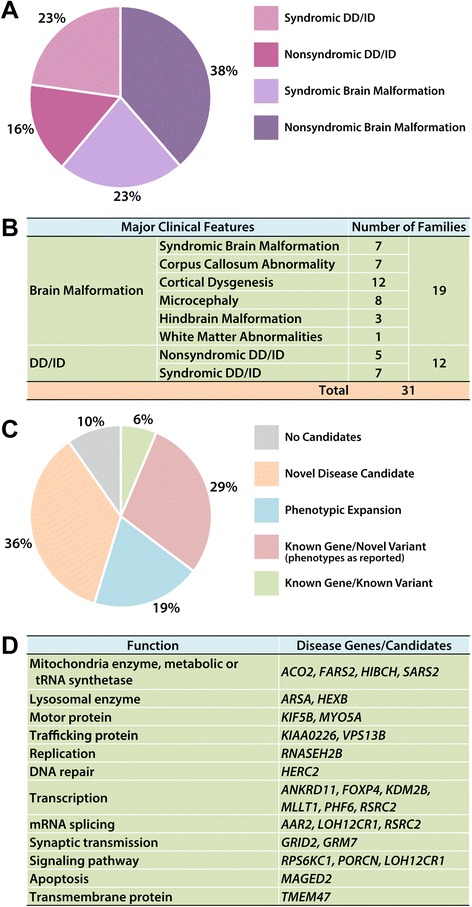
We performed WES in 31 mostly consanguineous Arab families and analyzed both single nucleotide and copy number variants (CNVs) from WES data. Interaction/expression network and pathway analyses, as well as paralog studies were utilized to investigate potential pathogenicity and disease association of novel candidate genes. Additional cases for candidate genes were identified through the clinical WES database at Baylor Miraca Genetics Laboratories and GeneMatcher.
We found known pathogenic or novel variants in known disease genes with phenotypic expansion in 6 families, disease-associated CNVs in 2 families, and 12 novel disease gene candidates in 11 families, including KIF5B, GRM7, FOXP4, MLLT1, and KDM2B. Overall, a potential molecular diagnosis was provided by variants in known disease genes in 17 families (54.8 %) and by novel candidate disease genes in an additional 11 families, making the potential molecular diagnostic rate ~90 %.
Molecular diagnostic rate from WES is improved by exome-predicted CNVs. Novel candidate disease gene discovery is facilitated by paralog studies and through the use of informatics tools and available databases to identify additional evidence for pathogenicity.
Not applicable.
神经发育由多种基因精心调控,因此神经发育障碍的遗传病因具有异质性。我们应用全外显子组测序(WES)进行分子诊断和计算机分析,以在来自沙特阿拉伯的主要患有孟德尔神经系统疾病的队列中鉴定新的疾病基因候选物。
我们对31个大多为近亲结婚的阿拉伯家庭进行了WES,并分析了WES数据中的单核苷酸和拷贝数变异(CNV)。利用相互作用/表达网络和通路分析以及旁系同源基因研究来调查新候选基因的潜在致病性和疾病关联性。通过贝勒米拉克遗传学实验室的临床WES数据库和基因匹配器确定了候选基因的其他病例。
我们在6个家系中发现已知疾病基因中的已知致病或新变异且伴有表型扩展,在2个家系中发现与疾病相关的CNV,在11个家系中发现12个新的疾病基因候选物,包括KIF5B、GRM7、FOXP4、MLLT1和KDM2B。总体而言,17个家系(54.8%)中已知疾病基因的变异以及另外11个家系中新的候选疾病基因提供了潜在的分子诊断,使潜在分子诊断率约为90%。
外显子预测的CNV提高了WES的分子诊断率。旁系同源基因研究以及通过使用信息学工具和可用数据库来识别致病性的其他证据,促进了新的候选疾病基因的发现。
不适用。