GROC·UJI, Institute of New Imaging Technologies (INIT), Universitat Jaume I, E12071 Castelló, Spain.
Servei Central d'Instrumentació Científica (SCIC), Universitat Jaume I, E12071 Castelló, Spain.
Sci Rep. 2016 Jun 29;6:29181. doi: 10.1038/srep29181.
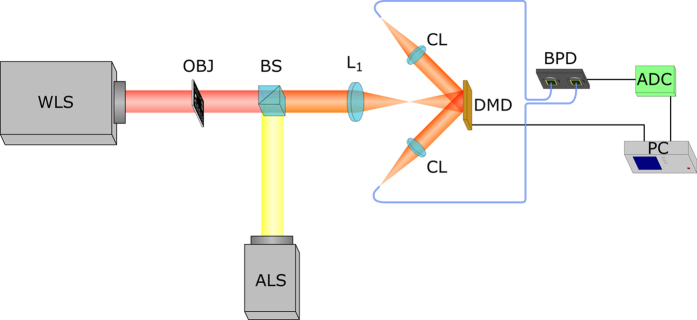
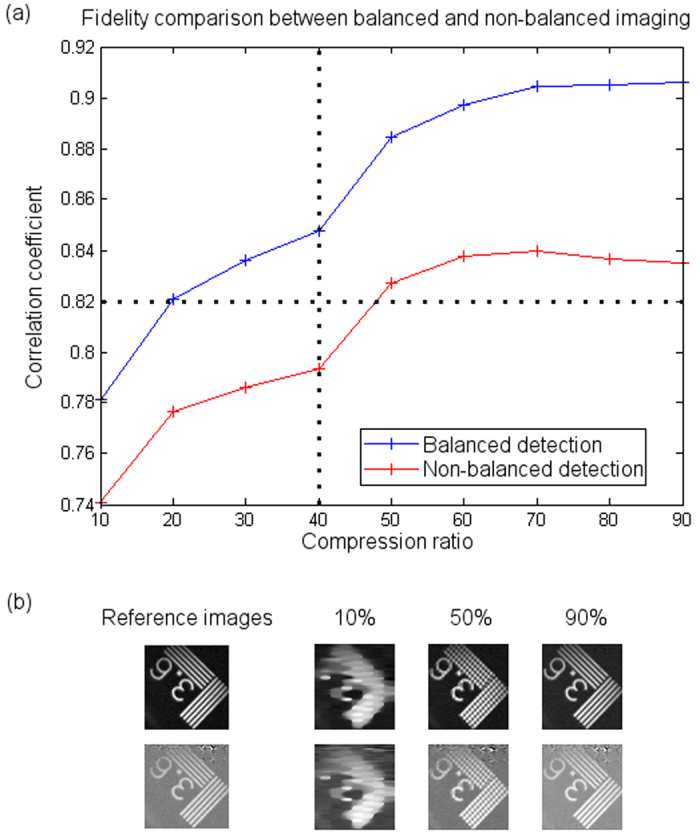
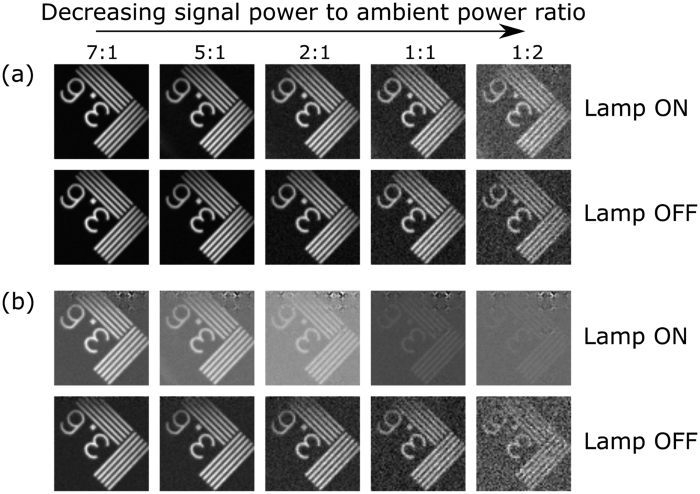
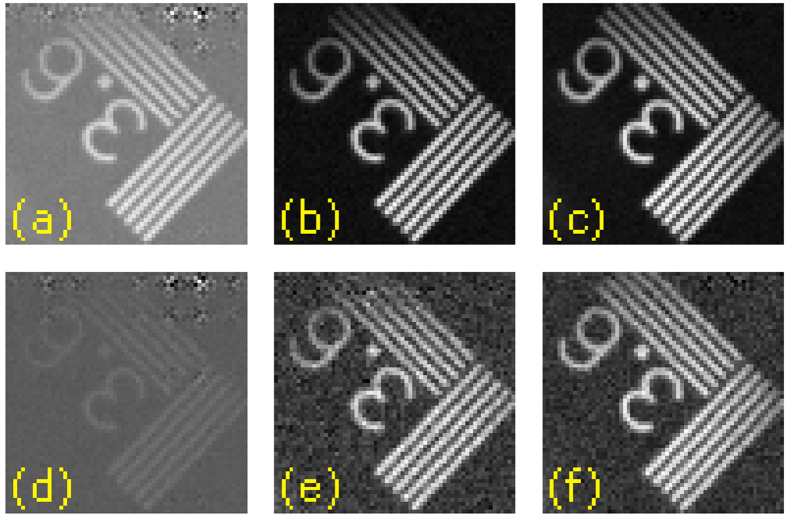
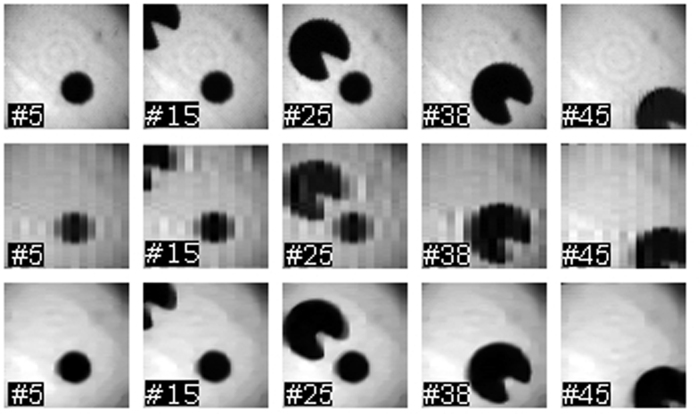
Single-pixel cameras allow to obtain images in a wide range of challenging scenarios, including broad regions of the electromagnetic spectrum and through scattering media. However, there still exist several drawbacks that single-pixel architectures must address, such as acquisition speed and imaging in the presence of ambient light. In this work we introduce balanced detection in combination with simultaneous complementary illumination in a single-pixel camera. This approach enables to acquire information even when the power of the parasite signal is higher than the signal itself. Furthermore, this novel detection scheme increases both the frame rate and the signal-to-noise ratio of the system. By means of a fast digital micromirror device together with a low numerical aperture collecting system, we are able to produce a live-feed video with a resolution of 64 × 64 pixels at 5 Hz. With advanced undersampling techniques, such as compressive sensing, we can acquire information at rates of 25 Hz. By using this strategy, we foresee real-time biological imaging with large area detectors in conditions where array sensors are unable to operate properly, such as infrared imaging and dealing with objects embedded in turbid media.
单像素相机允许在广泛的挑战性场景中获取图像,包括电磁光谱的广阔区域和通过散射介质。然而,单像素架构仍然存在一些必须解决的缺点,例如采集速度和在环境光存在下的成像。在这项工作中,我们在单像素相机中引入了平衡检测以及同时的互补照明。这种方法使得即使寄生信号的功率高于信号本身时也能够获取信息。此外,这种新颖的检测方案提高了系统的帧率和信噪比。通过快速数字微镜器件和低数值孔径收集系统,我们能够以 5 Hz 的帧率生成分辨率为 64×64 像素的实时视频。通过使用先进的欠采样技术,如压缩感知,我们可以以 25 Hz 的速率获取信息。通过使用这种策略,我们可以预见在阵列传感器无法正常工作的情况下,例如在红外成像和处理嵌入混浊介质的物体的情况下,使用大面积探测器进行实时生物成像。