Sun Ming-Jie, Wang Hao-Yu, Huang Ji-Yu
Department of Opto-electronic Engineering, Beihang University, Beijing, 100191, China.
Sci Rep. 2019 Mar 11;9(1):4105. doi: 10.1038/s41598-019-40798-x.
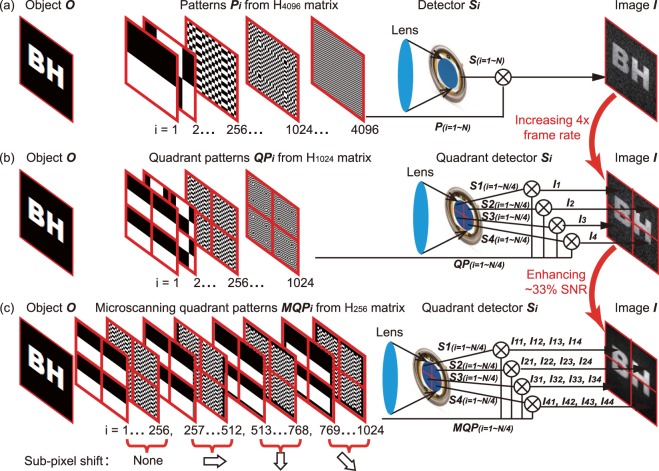
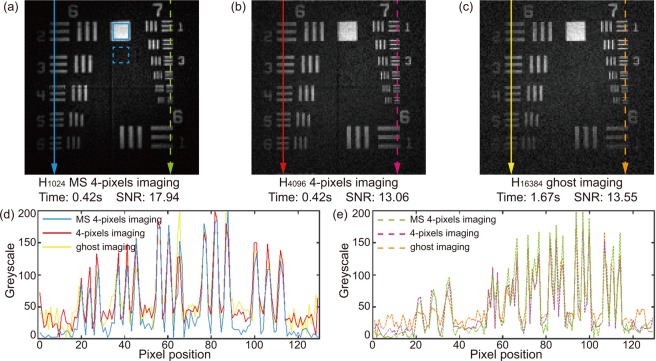
Computational ghost imaging systems reconstruct images using a single element detector, which measures the level of correlation between the scene and a set of projected patterns. The sequential nature of these measurements means that increasing the system frame-rate reduces the signal-to-noise ratio (SNR) of the captured images. Furthermore, a higher spatial resolution requires the projection of more patterns, and so both frame-rate and SNR suffer from the increase of the spatial resolution. In this work, we combat these limitations by developing a hybrid few-pixel imaging system that combines structured illumination with a quadrant photodiode detector. To further boost the SNR of our system, we employ digital micro-scanning of the projected patterns. Experimental results show that our proposed imaging system is capable of reconstructing images 4 times faster and with ~33% higher SNR than a conventional single-element computational ghost imaging system utilizing orthogonal Hadamard pattern projection. Our work demonstrates a computational imaging system in which there is a flexible trade-off between frame-rate, SNR and spatial resolution, and this trade-off can be optimized to match the requirements of different applications.
计算鬼成像系统使用单元素探测器重建图像,该探测器测量场景与一组投影图案之间的相关性水平。这些测量的顺序性质意味着提高系统帧率会降低所捕获图像的信噪比(SNR)。此外,更高的空间分辨率需要投影更多的图案,因此帧率和信噪比都会因空间分辨率的提高而受到影响。在这项工作中,我们通过开发一种将结构化照明与象限光电二极管探测器相结合的混合少像素成像系统来克服这些限制。为了进一步提高我们系统的信噪比,我们对投影图案采用数字微扫描。实验结果表明,与使用正交哈达玛图案投影的传统单元素计算鬼成像系统相比,我们提出的成像系统能够以快4倍的速度重建图像,且信噪比高约33%。我们的工作展示了一种计算成像系统,其中帧率、信噪比和空间分辨率之间存在灵活的权衡,并且这种权衡可以进行优化以匹配不同应用的要求。