Stuart Rhona K, Mayali Xavier, Boaro Amy A, Zemla Adam, Everroad R Craig, Nilson Daniel, Weber Peter K, Lipton Mary, Bebout Brad M, Pett-Ridge Jennifer, Thelen Michael P
Lawrence Livermore National Laboratory, Livermore, California, USA.
Pacific Northwest National Laboratory, Richland, Washington, USA.
mBio. 2016 Jun 28;7(3):e00650-16. doi: 10.1128/mBio.00650-16.
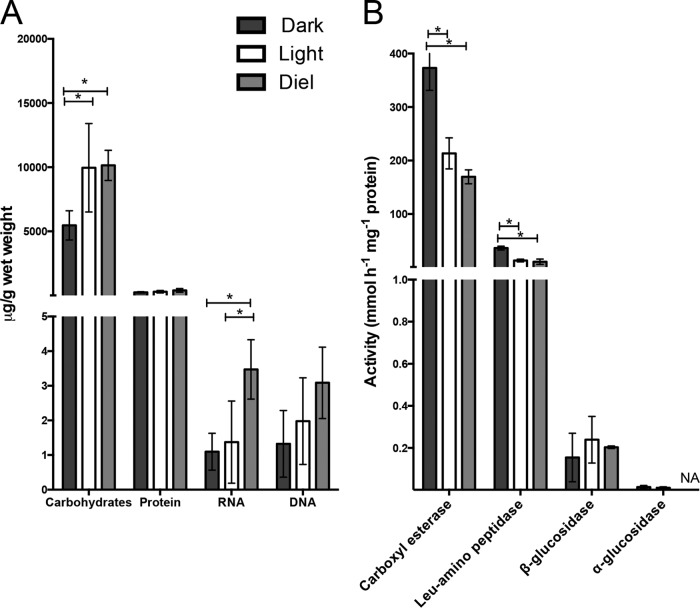
Although it is becoming clear that many microbial primary producers can also play a role as organic consumers, we know very little about the metabolic regulation of photoautotroph organic matter consumption. Cyanobacteria in phototrophic biofilms can reuse extracellular organic carbon, but the metabolic drivers of extracellular processes are surprisingly complex. We investigated the metabolic foundations of organic matter reuse by comparing exoproteome composition and incorporation of (13)C-labeled and (15)N-labeled cyanobacterial extracellular organic matter (EOM) in a unicyanobacterial biofilm incubated using different light regimes. In the light and the dark, cyanobacterial direct organic C assimilation accounted for 32% and 43%, respectively, of all organic C assimilation in the community. Under photosynthesis conditions, we measured increased excretion of extracellular polymeric substances (EPS) and proteins involved in micronutrient transport, suggesting that requirements for micronutrients may drive EOM assimilation during daylight hours. This interpretation was supported by photosynthesis inhibition experiments, in which cyanobacteria incorporated N-rich EOM-derived material. In contrast, under dark, C-starved conditions, cyanobacteria incorporated C-rich EOM-derived organic matter, decreased excretion of EPS, and showed an increased abundance of degradative exoproteins, demonstrating the use of the extracellular domain for C storage. Sequence-structure modeling of one of these exoproteins predicted a specific hydrolytic activity that was subsequently detected, confirming increased EOM degradation in the dark. Associated heterotrophic bacteria increased in abundance and upregulated transport proteins under dark relative to light conditions. Taken together, our results indicate that biofilm cyanobacteria are successful competitors for organic C and N and that cyanobacterial nutrient and energy requirements control the use of EOM.
Cyanobacteria are globally distributed primary producers, and the fate of their fixed C influences microbial biogeochemical cycling. This fate is complicated by cyanobacterial degradation and assimilation of organic matter, but because cyanobacteria are assumed to be poor competitors for organic matter consumption, regulation of this process is not well tested. In mats and biofilms, this is especially relevant because cyanobacteria produce an extensive organic extracellular matrix, providing the community with a rich source of nutrients. Light is a well-known regulator of cyanobacterial metabolism, so we characterized the effects of light availability on the incorporation of organic matter. Using stable isotope tracing at the single-cell level, we quantified photoautotroph assimilation under different metabolic conditions and integrated the results with proteomics to elucidate metabolic status. We found that cyanobacteria effectively compete for organic matter in the light and the dark and that nutrient requirements and community interactions contribute to cycling of extracellular organic matter.
尽管越来越明显的是,许多微生物初级生产者也可以作为有机消费者发挥作用,但我们对光合自养生物消耗有机物质的代谢调节知之甚少。光合生物膜中的蓝细菌可以再利用细胞外有机碳,但细胞外过程的代谢驱动因素却出奇地复杂。我们通过比较在不同光照条件下培养的单种蓝细菌生物膜中的外蛋白质组组成以及(13)C标记和(15)N标记的蓝细菌细胞外有机物质(EOM)的掺入情况,研究了有机物质再利用的代谢基础。在光照和黑暗条件下,蓝细菌直接有机碳同化分别占群落中所有有机碳同化的32%和43%。在光合作用条件下,我们测量到参与微量营养素运输的细胞外聚合物(EPS)和蛋白质的排泄增加,这表明对微量营养素的需求可能在白天驱动EOM同化。光合作用抑制实验支持了这一解释,在该实验中蓝细菌掺入了富含氮的EOM衍生物质。相比之下,在黑暗、碳饥饿条件下,蓝细菌掺入了富含碳的EOM衍生有机物质,EPS排泄减少,并显示出降解性外蛋白质的丰度增加,这表明利用细胞外区域进行碳储存。对其中一种外蛋白质的序列-结构建模预测了一种特定的水解活性,随后检测到该活性,证实了黑暗中EOM降解增加。与蓝细菌相关的异养细菌在黑暗条件下相对于光照条件下丰度增加且运输蛋白上调。综上所述,我们的结果表明生物膜蓝细菌是有机碳和氮的成功竞争者,并且蓝细菌的营养和能量需求控制着EOM的利用。
蓝细菌是全球分布的初级生产者,其固定碳的命运影响着微生物生物地球化学循环。蓝细菌对有机物质的降解和同化使这种命运变得复杂,但由于蓝细菌被认为在消耗有机物质方面竞争力较弱,因此对这一过程的调节尚未得到充分检验。在菌毯和生物膜中,这一点尤为重要,因为蓝细菌会产生广泛的有机细胞外基质,为群落提供丰富的营养来源。光是蓝细菌代谢的一个众所周知的调节因子,因此我们表征了光照可用性对有机物质掺入的影响。利用单细胞水平的稳定同位素示踪,我们量化了不同代谢条件下光合自养生物的同化作用,并将结果与蛋白质组学相结合以阐明代谢状态。我们发现蓝细菌在光照和黑暗条件下都能有效地竞争有机物质,并且营养需求和群落相互作用有助于细胞外有机物质的循环。