Bhaya Devaki
Carnegie Institution for Science, Stanford, California, USA
mBio. 2016 Jun 28;7(3):e00741-16. doi: 10.1128/mBio.00741-16.
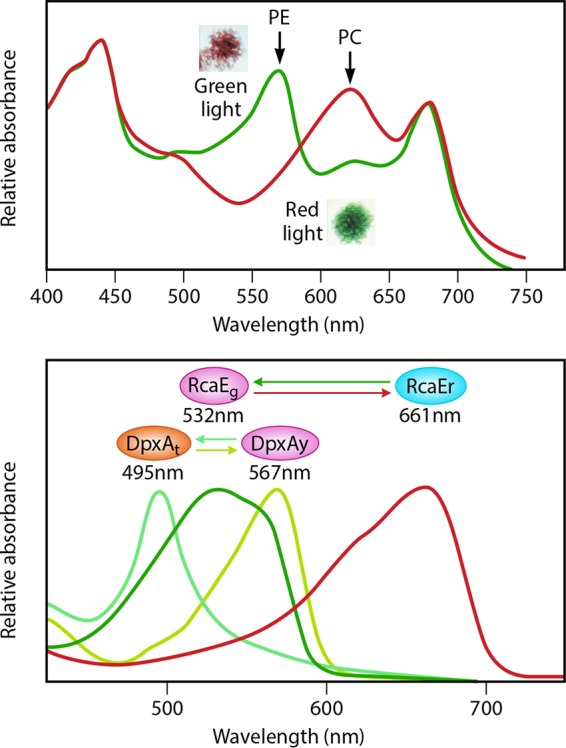
Certain cyanobacteria look green if grown in red light and vice versa. This dramatic color change, called complementary chromatic adaptation (CCA), is caused by alterations of the major colored light-harvesting proteins. A major controller of CCA is the cyanobacteriochrome (CBCR) RcaE, a red-green reversible photoreceptor that triggers a complex signal transduction pathway. Now, a new study demonstrates that CCA is also modulated by DpxA, a CBCR that senses yellow and teal (greenish blue) light. DpxA acts to expand the range of wavelengths that can impact CCA, by fine-tuning the process. This dual control of CCA might positively impact the fitness of cells growing in the shade of competing algae or in a water column where light levels and spectral quality change gradually with depth. This discovery adds to the growing number of light-responsive phenomena controlled by multiple CBCRs. Furthermore, the diverse CBCRs which are exclusively found in cyanobacteria have significant biotechnological potential.
某些蓝细菌在红光下生长时看起来是绿色的,反之亦然。这种显著的颜色变化称为互补色适应(CCA),是由主要的捕光色素蛋白的改变引起的。CCA的一个主要调控因子是蓝细菌视色素(CBCR)RcaE,它是一种红绿可逆光感受器,可触发复杂的信号转导途径。现在,一项新研究表明,CCA也受DpxA调控,DpxA是一种能感知黄色和蓝绿色光的CBCR。DpxA通过微调该过程,扩大了可影响CCA的波长范围。CCA的这种双重调控可能对在竞争藻类阴影下生长的细胞或在水柱中(光强度和光谱质量随深度逐渐变化)生长的细胞的适应性产生积极影响。这一发现增加了由多种CBCR控制的光响应现象的数量。此外,仅在蓝细菌中发现的多种CBCR具有巨大的生物技术潜力。