Shinmei Issei, Kobayashi Kei, Oe Yuki, Takagishi Yuriko, Kanie Ayako, Ito Masaya, Takebayashi Yoshitake, Murata Miho, Horikoshi Masaru, Dobkin Roseanne D
National Center for Cognitive Behavioral Therapy and Research, National Center of Neurology and Psychiatry, Tokyo, Japan; Department of Neuropsychiatry, Interdisciplinary Graduate School of Medicine and Engineering, University of Yamanashi, Yamanashi, Japan.
Department of Neurology, National Center of Neurology and Psychiatry, Tokyo, Japan.
Neuropsychiatr Dis Treat. 2016 Jun 8;12:1319-31. doi: 10.2147/NDT.S104777. eCollection 2016.
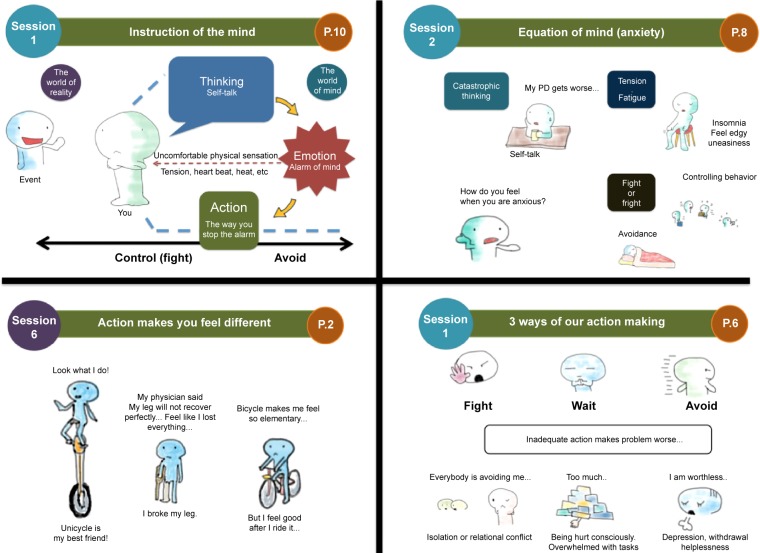
This study evaluated the feasibility of cognitive behavioral therapy (CBT) for Japanese Parkinson's disease (PD) patients with depression. To increase cultural acceptability, we developed the CBT program using manga, a type of Japanese comic novel.
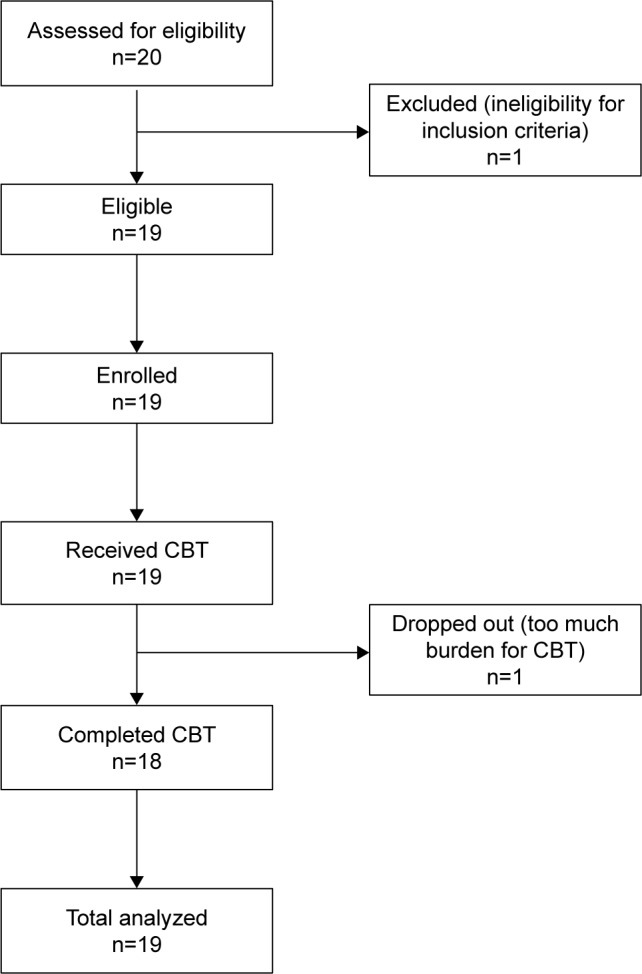
Participants included 19 non-demented PD patients who had depressive symptoms (GRID-Hamilton Rating Scale for Depression score ≥8). A CBT program comprising six sessions was individually administered. We evaluated the feasibility and safety of the CBT program in terms of the dropout rate and occurrence of adverse events. The primary outcome was depressive symptom reduction in the GRID-Hamilton Rating Scale for Depression upon completion of CBT. Secondary outcomes included changes in the self-report measures of depression (Beck Depression Inventory-II, Hospital Anxiety and Depression Scale-Depression), anxiety (Hospital Anxiety and Depression Scale-Anxiety, State and Trait Anxiety Inventory, Overall Anxiety Severity and Impairment Scale), functional impairment, and quality of life (Medical Outcomes Study 36-Item Short-Form Health Survey).
Of the 19 participants (mean age =63.8 years, standard deviation [SD] =9.9 years; mean Hohen-Yahr score =1.7, SD =0.8), one patient (5%) withdrew. No severe adverse event was observed. The patients reported significant improvements in depression (Hedges' g =-1.02, 95% confidence interval =-1.62 to -0.39). The effects were maintained over a 3-month follow-up period. Most of the secondary outcome measurements showed a small-to-moderate but nonsignificant effect size from baseline to post-intervention.
This study provides preliminary evidence that CBT is feasible among Japanese PD patients with depression. Similar approaches may be effective for people with PD from other cultural backgrounds. The results warrant replication in a randomized controlled trial.
本研究评估了认知行为疗法(CBT)对患有抑郁症的日本帕金森病(PD)患者的可行性。为了提高文化接受度,我们使用日本漫画小说形式的漫画开发了CBT项目。
参与者包括19名有抑郁症状的非痴呆PD患者(抑郁症状的汉密尔顿抑郁量表评分≥8)。一个包含六个疗程的CBT项目被单独实施。我们根据退出率和不良事件的发生情况评估了CBT项目的可行性和安全性。主要结局是CBT结束时汉密尔顿抑郁量表中抑郁症状的减轻。次要结局包括抑郁的自我报告测量指标(贝克抑郁量表第二版、医院焦虑抑郁量表-抑郁分量表)、焦虑(医院焦虑抑郁量表-焦虑分量表、状态特质焦虑量表、总体焦虑严重程度及功能损害量表)、功能损害以及生活质量(医学结局研究简明健康调查36项量表)的变化。
19名参与者(平均年龄=63.8岁,标准差[SD]=9.9岁;平均霍恩-亚尔分级=1.7,SD=0.8)中,有1名患者(5%)退出。未观察到严重不良事件。患者报告抑郁症状有显著改善(赫奇斯g=-1.02,95%置信区间=-1.62至-0.39)。这些效果在3个月的随访期内得以维持。大多数次要结局测量指标从基线到干预后显示出小到中等但无显著意义的效应量。
本研究提供了初步证据,表明CBT在患有抑郁症的日本PD患者中是可行的。类似的方法可能对来自其他文化背景的PD患者有效。这些结果值得在随机对照试验中进行重复验证。