Wang Huijuan, Zhang Hailong, Deng Pengchi, Liu Chunqi, Li Dandan, Jie Hui, Zhang Hu, Zhou Zongguang, Zhao Ying-Lan
College of Medicine, Henan University, Kaifeng, 475004, Henan, China.
State Key Laboratory of Biotherapy and Cancer Center, West China Hospital, West China Medical School, Sichuan University, and Collaborative Innovation Center for Biotherapy, Chengdu, Sichuan, People's Republic of China.
BMC Cancer. 2016 Jun 29;16:371. doi: 10.1186/s12885-016-2356-4.
Gastric cancer is the fourth most common cancer and the second most deadly cancer worldwide. Study on molecular mechanisms of carcinogenesis will play a significant role in diagnosing and treating gastric cancer. Metabolic profiling may offer the opportunity to understand the molecular mechanism of carcinogenesis and help to identify the potential biomarkers for the early diagnosis of gastric cancer.
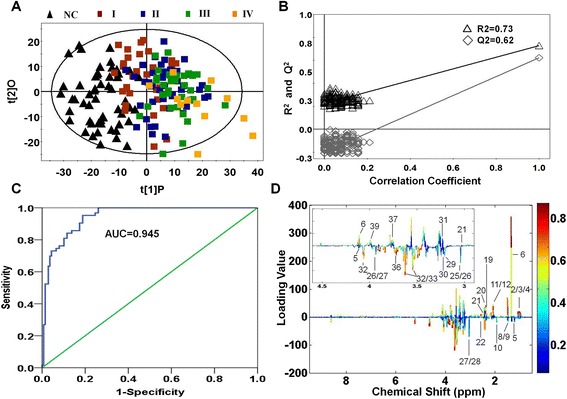
In this study, we reported the metabolic profiling of tissue samples on a large cohort of human gastric cancer subjects (n = 125) and normal controls (n = 54) based on (1)H nuclear magnetic resonance ((1)H NMR) together with multivariate statistical analyses (PCA, PLS-DA, OPLS-DA and ROC curve).
The OPLS-DA model showed adequate discrimination between cancer tissues and normal controls, and meanwhile, the model excellently discriminated the stage-related of tissue samples (stage I, 30; stage II, 46; stage III, 37; stage IV, 12) and normal controls. A total of 48 endogenous distinguishing metabolites (VIP > 1 and p < 0.05) were identified, 13 of which were changed with the progression of gastric cancer. These modified metabolites revealed disturbance of glycolysis, glutaminolysis, TCA, amino acids and choline metabolism, which were correlated with the occurrence and development of human gastric cancer. The receiver operating characteristic diagnostic AUC of OPLS-DA model between cancer tissues and normal controls was 0.945. And the ROC curves among different stages cancer subjects and normal controls were gradually improved, the corresponding AUC values were 0.952, 0.994, 0.998 and 0.999, demonstrating the robust diagnostic power of this metabolic profiling approach.
As far as we know, the present study firstly identified the differential metabolites in various stages of gastric cancer tissues. And the AUC values were relatively high. So these results suggest that the metabolic profiling of gastric cancer tissues has great potential in detecting this disease and helping to understand its underlying metabolic mechanisms.
胃癌是全球第四大常见癌症和第二大致命癌症。对致癌分子机制的研究将在胃癌的诊断和治疗中发挥重要作用。代谢谱分析可能为理解致癌分子机制提供机会,并有助于识别胃癌早期诊断的潜在生物标志物。
在本研究中,我们基于氢核磁共振((1)H NMR)以及多变量统计分析(主成分分析、偏最小二乘判别分析、正交偏最小二乘判别分析和ROC曲线),报告了一大群人类胃癌受试者(n = 125)和正常对照(n = 54)的组织样本代谢谱。
正交偏最小二乘判别分析模型显示出癌组织与正常对照之间有充分的区分度,同时,该模型能很好地区分不同分期的组织样本(I期,30例;II期,46例;III期,37例;IV期,12例)与正常对照。共鉴定出48种内源性差异代谢物(变量重要性投影>1且p<0.05),其中13种随胃癌进展而变化。这些改变的代谢物揭示了糖酵解、谷氨酰胺分解、三羧酸循环、氨基酸和胆碱代谢的紊乱,这与人类胃癌的发生发展相关。癌组织与正常对照之间的正交偏最小二乘判别分析模型的受试者工作特征诊断曲线下面积为0.945。不同分期癌症受试者与正常对照之间的ROC曲线逐渐改善,相应的曲线下面积值分别为0.952、0.994、0.998和0.999,表明这种代谢谱分析方法具有强大的诊断能力。
据我们所知,本研究首次鉴定了胃癌组织不同阶段的差异代谢物。且曲线下面积值相对较高。因此,这些结果表明胃癌组织的代谢谱分析在检测该疾病及帮助理解其潜在代谢机制方面具有巨大潜力。