Ding Hui, Gao Qin-Yan, Chen Hui-Min, Fang Jing-Yuan
Division of Gastroenterology and Hepatology, Renji Hospital, School of Medicine, Shanghai Jiao Tong University, Shanghai Institute of Digestive Disease, Shanghai, China.
Division of Gastroenterology and Hepatology, Renji Hospital, School of Medicine, Shanghai Jiao Tong University, Shanghai Institute of Digestive Disease, Shanghai, China
J Int Med Res. 2016 Aug;44(4):767-78. doi: 10.1177/0300060516650075. Epub 2016 Jun 29.
To investigate the potential association between serum folate levels and colorectal adenoma (CRA) occurrence and recurrence.
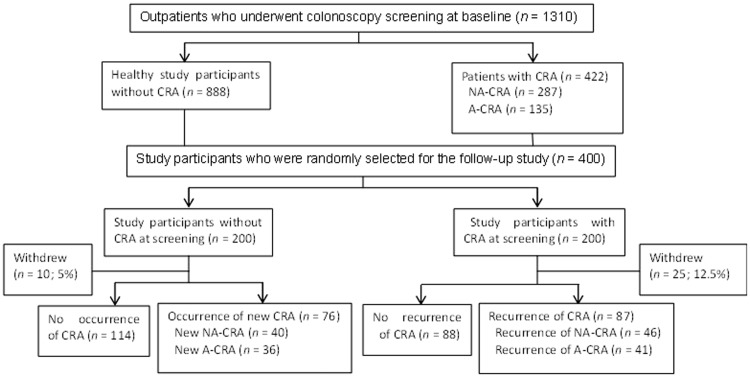
This prospective study measured baseline serum folate levels in outpatients who were screened for CRA using colonoscopy. Participants were then randomly selected to produce one group with CRA and one without CRA. These two subgroups underwent further follow-up observations of colonoscopy to determine the occurrence of new and recurrent CRA.
A total of 1310 participants were screened at baseline: 888 were healthy subjects without CRA; and 422 had CRA. Two subgroups were randomly selected (n = 200 per group) for follow-up. In the overall population, baseline serum folate levels were significantly lower in patients with CRA or advanced CRA (A-CRA) compared with healthy participants without CRA. Similar findings were shown for the follow-up study in terms of the association between CRA and A-CRA occurrence and recurrence and baseline serum folate levels. After controlling for confounders, increased serum folate was associated with a reduced risk of occurrence of CRA (odds ratio [OR] 0.993, 95% confidence interval [CI] 0.924, 1.066) and recurrence of CRA (OR 0.749, 95% CI 0.322, 1.742).
Higher serum folate levels may be protective against CRA and/or A-CRA.
探讨血清叶酸水平与结直肠腺瘤(CRA)发生及复发之间的潜在关联。
这项前瞻性研究测量了接受结肠镜检查以筛查CRA的门诊患者的基线血清叶酸水平。然后随机选择参与者,形成一组患有CRA的患者和一组未患CRA的患者。对这两个亚组进行进一步的结肠镜随访观察,以确定新的和复发性CRA的发生情况。
共有1310名参与者在基线时接受了筛查:888名是无CRA的健康受试者;422名患有CRA。随机选择两个亚组(每组n = 200)进行随访。在总体人群中,与无CRA的健康参与者相比,患有CRA或晚期CRA(A-CRA)的患者基线血清叶酸水平显著降低。在随访研究中,关于CRA和A-CRA的发生及复发与基线血清叶酸水平之间的关联也显示出类似的结果。在控制混杂因素后,血清叶酸水平升高与CRA发生风险降低(比值比[OR] 0.993,95%置信区间[CI] 0.924,1.066)和CRA复发风险降低(OR 0.749,95% CI 0.322,1.742)相关。
较高的血清叶酸水平可能对CRA和/或A-CRA具有保护作用。