Müller Astrid, Claes Laurence, Smits Dirk, Brähler Elmar, de Zwaan Martina
Department of Psychosomatic Medicine and Psychotherapy, Hannover Medical School, Hannover, Germany.
Faculty of Psychology and Educational Sciences, University of Leuven, Leuven, Belgium.
PLoS One. 2016 Jun 30;11(6):e0157928. doi: 10.1371/journal.pone.0157928. eCollection 2016.
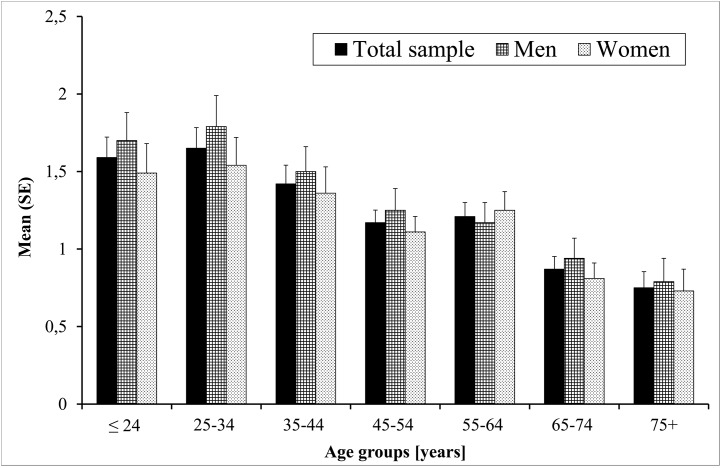
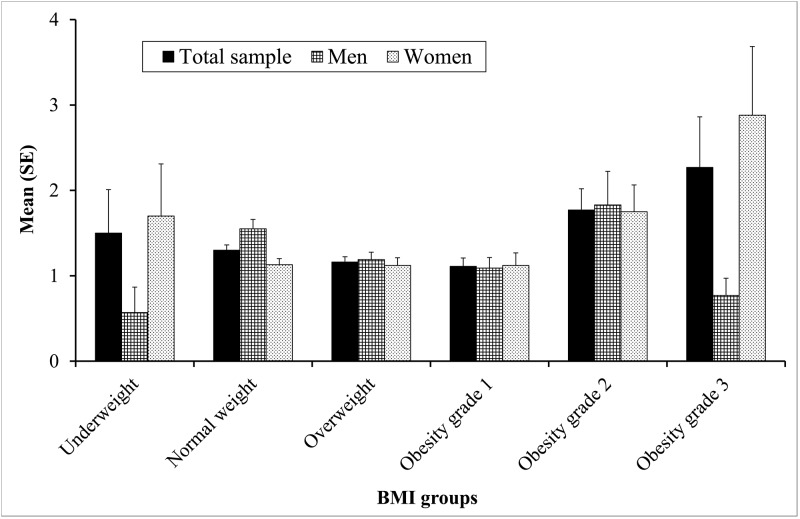
The study aimed at evaluating the psychometric properties of the German version of the Self- Harm Inventory (SHI) and examining the lifetime prevalence and correlates of self-harm in a representative German population sample (N = 2,507; age mean = 48.79, SD = 18.11; range 14 to 94 years; 55.5% women) using the SHI. All participants answered the German SHI, the short form of the Barratt Impulsiveness Scale (BIS-15), the ultra-brief Patient Health Questionnaire for Depression and Anxiety (PHQ-4), and provided sociodemographic information. The one-factorial structure of the SHI was replicated using a confirmatory factor analysis. Internal consistency coefficients were sufficient and in line with previous studies. Almost half of the sample (49%) acknowledged at least one self-harming behavior over the life-span, most frequently indirect forms of self-harm. The rate of participants who engaged in at least one SHI behavior was higher among men than women (51.6% vs. 46.9%, respectively, χ2 = 5.38, p = 0.020). Higher SHI scores were related to younger age, male gender, living alone, more symptoms of anxiety and depression (PHQ-4), higher impulsivity scores (BIS-15), and suffering from obesity grade 2. Women engaged more often in discreet forms of self-harm than men, e.g., preventing wounds from healing, exercising an injury, starving, and abusing laxatives. In terms of other indirect self-harming behaviors, men admitted more often driving recklessly, being promiscuous and losing a job on purpose, while women reported more frequently engaging in emotionally abusive relationships. With respect to direct self-harm, women were more likely to endorse suicide attempts and cutting, while men admitted more often head-banging. The findings suggest that self-harm constitutes a common problem. Future longitudinal studies are required to examine the natural course, sociodemographic and psychopathological risk factors, as well as possible time-trends of self-harming behaviors in more depth.
该研究旨在评估德文版自伤量表(SHI)的心理测量特性,并使用SHI调查德国代表性人群样本(N = 2507;平均年龄 = 48.79,标准差 = 18.11;年龄范围14至94岁;女性占55.5%)中自伤行为的终生患病率及其相关因素。所有参与者均回答了德文版SHI、巴雷特冲动性量表简版(BIS - 15)、超简短抑郁与焦虑患者健康问卷(PHQ - 4),并提供了社会人口学信息。通过验证性因素分析重现了SHI的单因素结构。内部一致性系数充足且与先前研究一致。几乎一半的样本(49%)承认在一生中至少有过一次自伤行为,最常见的是间接自伤形式。从事至少一种SHI行为的参与者比例男性高于女性(分别为51.6%和46.9%,χ2 = 5.38,p = 0.020)。较高的SHI得分与年龄较小、男性、独居、更多焦虑和抑郁症状(PHQ - 4)、较高的冲动性得分(BIS - 15)以及患有2级肥胖症有关。女性比男性更常采用隐秘的自伤形式,例如阻止伤口愈合、加重损伤、节食和滥用泻药。在其他间接自伤行为方面,男性更常承认鲁莽驾驶、行为放荡和故意失业,而女性更常报告陷入情感虐待关系。在直接自伤方面,女性更倾向于认可自杀未遂和割伤行为,而男性更常承认撞头行为。研究结果表明自伤是一个普遍存在的问题。未来需要进行纵向研究,以更深入地考察自伤行为的自然病程、社会人口学和心理病理学风险因素以及可能的时间趋势。