Bansal Sanjiv Kumar, Agarwal Sarita, Daga Mridul Kumar
Department of Biochemistry, SGT Medical College, Hospital and Research Institute, Budhera, Gurgaon, Haryana, India.
Department of Biochemistry, Maulana Azad Medical College, New Delhi, India.
J Lab Physicians. 2016 Jul-Dec;8(2):77-84. doi: 10.4103/0974-2727.180786.
The high prevalence, severity, and prematurity of coronary artery disease (CAD) in the Indian population cannot be completely explained by the conventional lipid parameters and the existing lipid indices.
To calculate newly defined advanced atherogenic index (AAI) in premature CAD patients and compare it between cases and controls and Correlate its values with the existing indices.
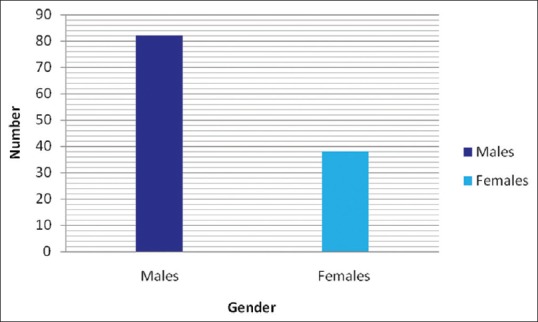
One hundred and twenty premature CAD patients and an equal number of age and sex matched healthy individuals were included in this study. Lipid profile and nonconventional lipid parameters like oxidized Low density lipoprotein (OX LDL), small dense LDL (SD LDL), lipoprotein (a) apolipoprotein B (Apo B), and apolipoprotein A1 (Apo A1) were estimated and their values were used to define AAI and existing lipid indices like AI, lipid tetrad index (LTI) and lipid pentad index (LPI).
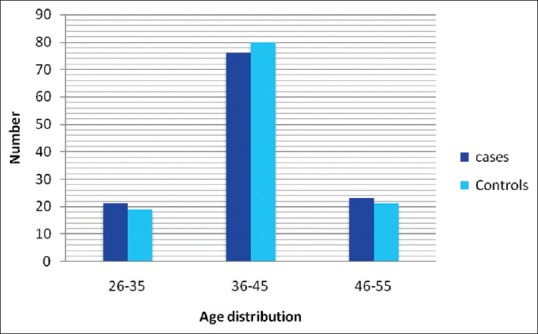
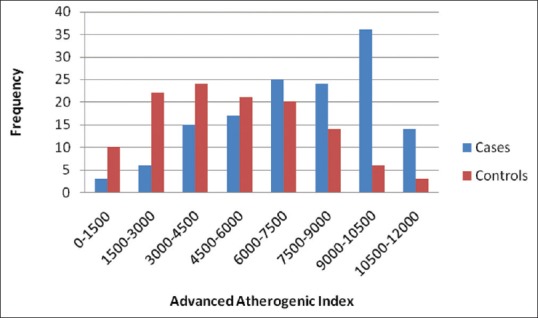
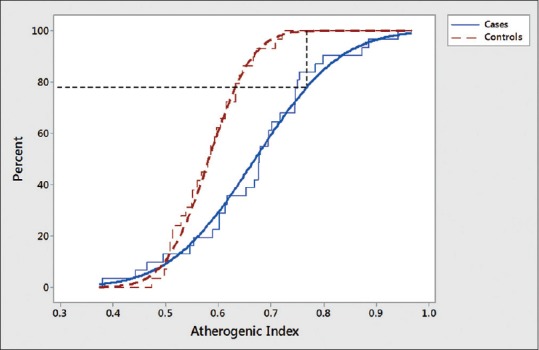
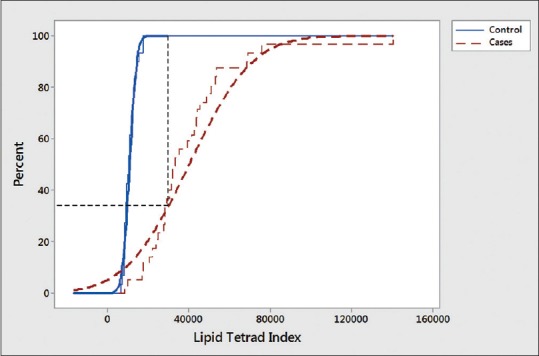
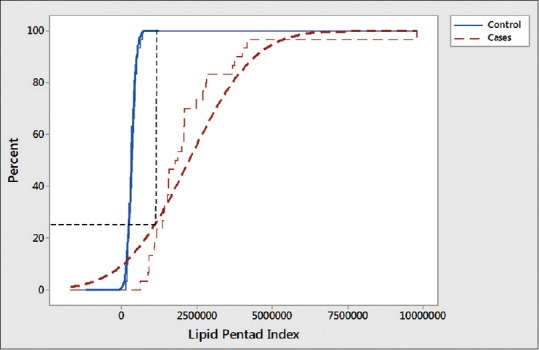
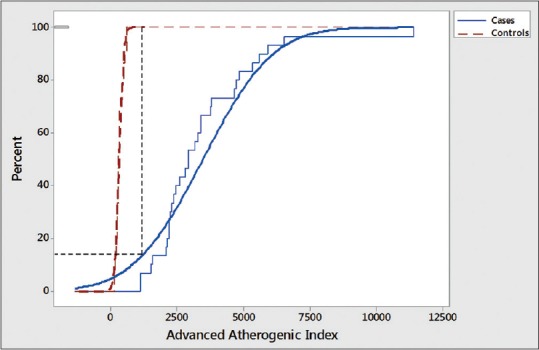
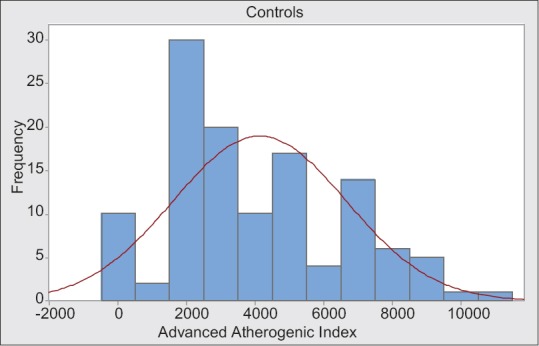
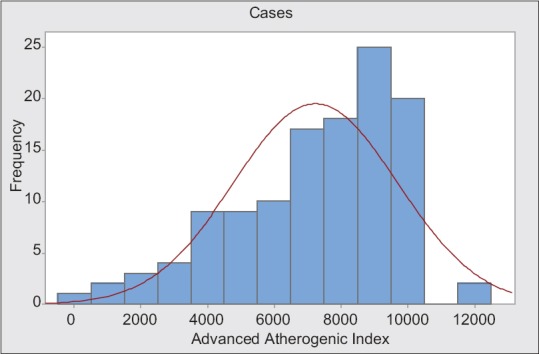
The mean age of cases and controls was 37.29 + 4.50 and 36.13 + 3.53 years, respectively. The value of AAI was highly significant in cases (3461.22 ± 45.20) as compared to controls (305.84 ± 21.80). AAI has shown better statistical significance and correlation (P < 0.0001, r = 0.737) as compared to the earlier indices such as AI (P < 0.01, r = 0.52), LTI (P < 0.001, r = 0.677) and LPI (P < 0.001, r = 0.622) in premature CAD. Kolmogorov D statistic and cumulative distribution function plot has shown that AAI can discriminate cases and controls more accurately as compared to the earlier indices.
Statistically AAI appears to be a better marker of consolidated lipid risk in premature CAD patients as compared to the earlier indices.
印度人群中冠状动脉疾病(CAD)的高患病率、严重性和发病早熟现象,无法完全用传统脂质参数和现有脂质指数来解释。
计算早发CAD患者中新定义的晚期致动脉粥样硬化指数(AAI),并在病例组和对照组之间进行比较,同时将其值与现有指数进行相关性分析。
本研究纳入了120例早发CAD患者以及同等数量年龄和性别匹配的健康个体。评估了血脂谱以及非传统脂质参数,如氧化型低密度脂蛋白(OX LDL)、小而密低密度脂蛋白(SD LDL)、脂蛋白(a)、载脂蛋白B(Apo B)和载脂蛋白A1(Apo A1),并将其值用于定义AAI以及现有脂质指数,如动脉粥样硬化指数(AI)、脂质四分位数指数(LTI)和脂质五分位数指数(LPI)。
病例组和对照组的平均年龄分别为37.29 + 4.50岁和36.13 + 3.53岁。与对照组(305.84 ± 21.80)相比,AAI在病例组中的值(3461.22 ± 45.20)具有高度显著性。与早期指数如AI(P < 0.01,r = 0.52)、LTI(P < 0.001,r = 0.677)和LPI(P < 0.001,r = 0.622)相比,AAI在早发CAD中显示出更好的统计学显著性和相关性(P < 0.0001,r = 0.737)。Kolmogorov D统计量和累积分布函数图表明,与早期指数相比,AAI能够更准确地区分病例组和对照组。
从统计学角度来看,与早期指数相比,AAI似乎是早发CAD患者综合脂质风险的更好标志物。