Choi Young Bae, Yi Eun Sang, Lee Ji Won, Yoo Keon Hee, Sung Ki Woong, Koo Hong Hoe
Department of Pediatrics, Chung-Ang University Hospital, Seoul, Korea .
Department of Pediatrics, Samsung Medical Center, Sungkyunkwan University School of Medicine, Seoul, Korea .
J Korean Med Sci. 2016 Jul;31(7):1055-62. doi: 10.3346/jkms.2016.31.7.1055. Epub 2016 May 16.
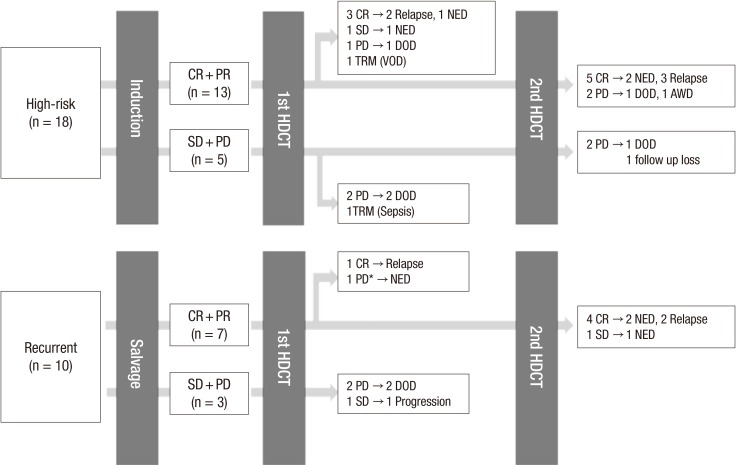
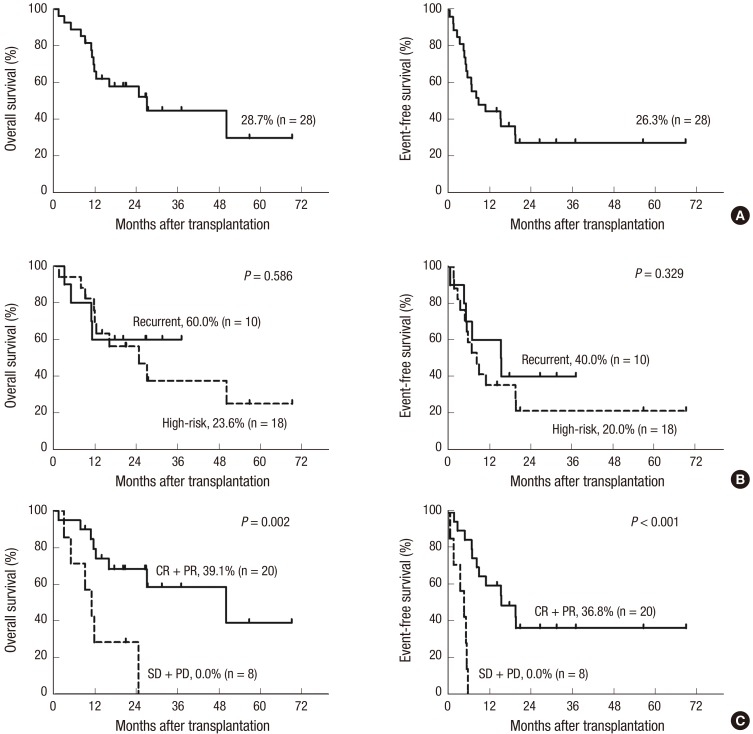
Despite increasing evidence that high-dose chemotherapy and autologous stem cell transplantation (HDCT/auto-SCT) might improve the survival of patients with high-risk or recurrent solid tumors, therapy effectiveness for bone and soft tissue sarcoma treatment remains unclear. This study retrospectively investigated the feasibility and effectiveness of HDCT/auto-SCT for high-risk or recurrent bone and soft tissue sarcoma. A total of 28 patients (18 high-risk and 10 recurrent) underwent single or tandem HDCT/auto-SCT between October 2004 and September 2014. During follow-up of a median 15.3 months, 18 patients exhibited disease progression and 2 died of treatment-related toxicities (1 veno-occlusive disease and 1 sepsis). Overall, 8 patients remained alive and progression-free. The 3-year overall survival (OS) and event-free survival (EFS) rates for all 28 patients were 28.7% and 26.3%, respectively. In the subgroup analysis, OS and EFS rates were higher in patients with complete or partial remission prior to HDCT/auto-SCT than in those with worse responses (OS, 39.1% vs. 0.0%, P = 0.002; EFS, 36.8% vs. 0.0%, P < 0.001). Therefore, careful selection of patients who can benefit from HDCT/auto-SCT and maximal effort to reduce tumor burden prior to treatment will be important to achieve favorable outcomes in patients with high-risk or recurrent bone and soft tissue sarcomas.
尽管越来越多的证据表明,高剂量化疗和自体干细胞移植(HDCT/auto-SCT)可能会提高高危或复发性实体瘤患者的生存率,但对于骨肉瘤和软组织肉瘤治疗的有效性仍不明确。本研究回顾性调查了HDCT/auto-SCT治疗高危或复发性骨肉瘤和软组织肉瘤的可行性和有效性。2004年10月至2014年9月期间,共有28例患者(18例高危和10例复发)接受了单次或串联HDCT/auto-SCT。在中位15.3个月的随访期间,18例患者出现疾病进展,2例死于治疗相关毒性(1例静脉闭塞性疾病和1例败血症)。总体而言,8例患者存活且无疾病进展。28例患者的3年总生存率(OS)和无事件生存率(EFS)分别为28.7%和26.3%。在亚组分析中,HDCT/auto-SCT前完全或部分缓解的患者的OS和EFS率高于反应较差的患者(OS,39.1%对0.0%,P = 0.002;EFS,36.8%对0.0%,P < 0.001)。因此,仔细选择能够从HDCT/auto-SCT中获益的患者,并在治疗前最大程度地努力减轻肿瘤负荷,对于高危或复发性骨肉瘤和软组织肉瘤患者取得良好预后至关重要。