Liu Ying, Sun Baocun, Liu Tieju, Zhao Xiulan, Wang Xudong, Li Yanlei, Meng Jie, Gu Qiang, Liu Fang, Dong Xueyi, Liu Peimei, Sun Ran, Zhao Nan
Department of Pathology, General Hospital of Tianjin Medical University, Tianjin, People's Republic of China; Department of Pathology, Tianjin Medical University, Tianjin, People's Republic of China.
Department of Pathology, General Hospital of Tianjin Medical University, Tianjin, People's Republic of China; Department of Pathology, Tianjin Medical University, Tianjin, People's Republic of China; Department of Pathology, Cancer Hospital of Tianjin Medical University, Tianjin, People's Republic of China.
Onco Targets Ther. 2016 Jun 13;9:3473-84. doi: 10.2147/OTT.S93015. eCollection 2016.
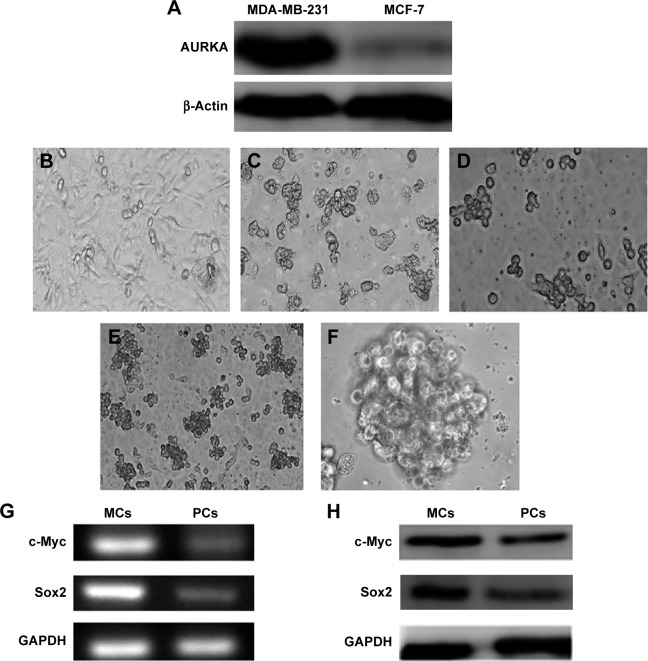
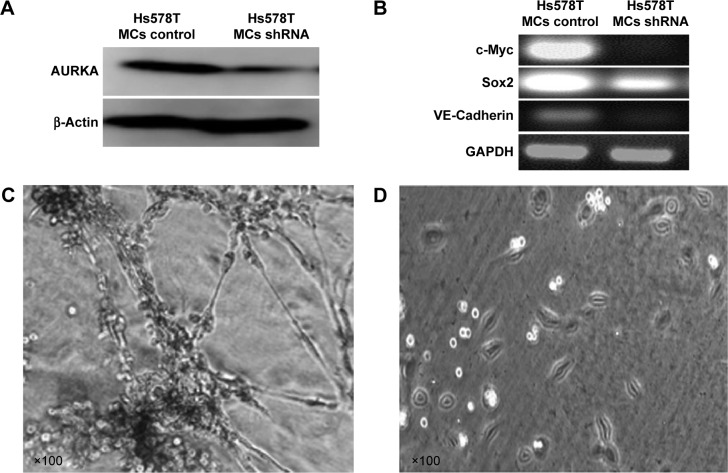
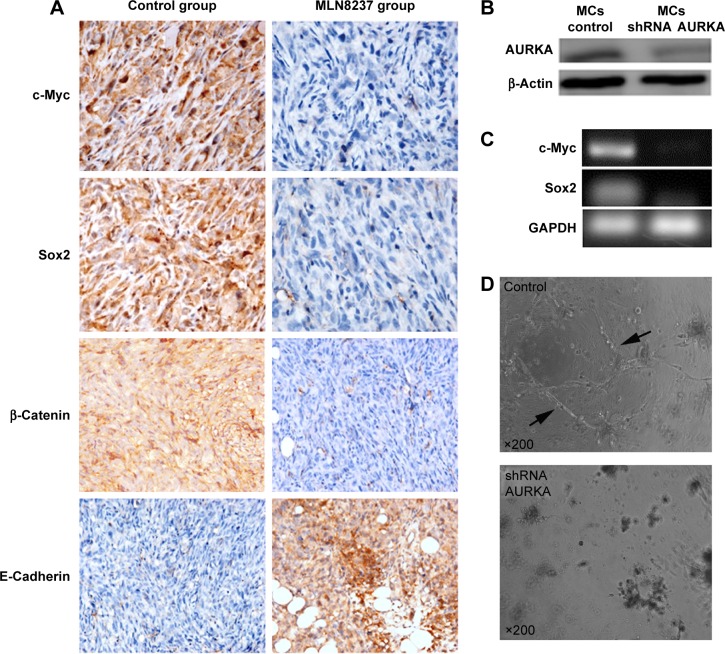
Tumor cell vasculogenic mimicry (VM), a newly defined pattern of tumor blood supply, signifies the functional plasticity of aggressive cancer cells forming vascular networks. VM and cancer stem cells (CSCs) have been shown to be associated with tumor growth, local invasion, and distant metastasis. In our previous study, CSCs in triple-negative breast cancer were potential to participate in VM formation. In this study, breast CSCs were isolated from the triple-negative breast cancer cell line MDA-MB-231 by using mammosphere culture. Western blotting and reverse transcription polymerase chain reaction showed that mammosphere cells displayed an increased expression of AURKA protein kinase and stem cell marker c-myc and sox2. The VM formation by mammosphere cells was inhibited by AURKA knockdown or the addition of AURKA inhibitor MLN8237. In the meantime, MLN8237 induced the increased E-cadherin and decreased c-myc, sox2, and β-catenin expressions. The function of AURKA in VM formation was further confirmed using a xenograft-murine model. The results suggested that AURKA protein kinase is involved in VM formation of CSCs and may become a new treatment target in suppressing VM and metastasis of breast cancer.
肿瘤细胞血管生成拟态(VM)是一种新定义的肿瘤血液供应模式,它标志着侵袭性癌细胞形成血管网络的功能可塑性。VM与癌症干细胞(CSCs)已被证明与肿瘤生长、局部侵袭和远处转移有关。在我们之前的研究中,三阴性乳腺癌中的CSCs有参与VM形成的潜力。在本研究中,通过使用乳腺球培养从三阴性乳腺癌细胞系MDA-MB-231中分离出乳腺CSCs。蛋白质免疫印迹法和逆转录聚合酶链反应表明,乳腺球细胞中极光激酶A(AURKA)蛋白激酶、干细胞标志物c-myc和sox2的表达增加。通过敲低AURKA或添加AURKA抑制剂MLN8237可抑制乳腺球细胞的VM形成。同时,MLN8237诱导E-钙黏蛋白表达增加,c-myc、sox2和β-连环蛋白表达降低。使用异种移植小鼠模型进一步证实了AURKA在VM形成中的作用。结果表明,AURKA蛋白激酶参与了CSCs的VM形成,可能成为抑制乳腺癌VM和转移的新治疗靶点。