Andonegui-Elguera Marco A, Alfaro-Mora Yair, Cáceres-Gutiérrez Rodrigo, Caro-Sánchez Claudia Haydee Sarai, Herrera Luis A, Díaz-Chávez José
Unidad de Investigación Biomédica en Cáncer, Instituto Nacional de Cancerología-Instituto de Investigaciones Biomédicas, UNAM, Mexico City, Mexico.
Departamento de Genética y Biología Molecular, Centro de Investigación y de Estudios Avanzados del IPN, Mexico City, Mexico.
Front Oncol. 2020 Feb 27;10:220. doi: 10.3389/fonc.2020.00220. eCollection 2020.
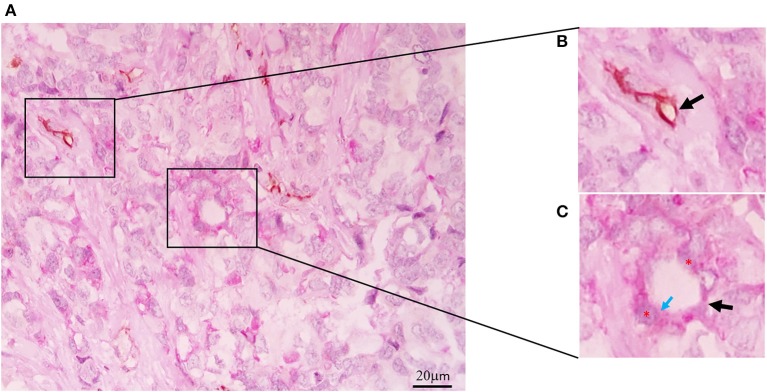
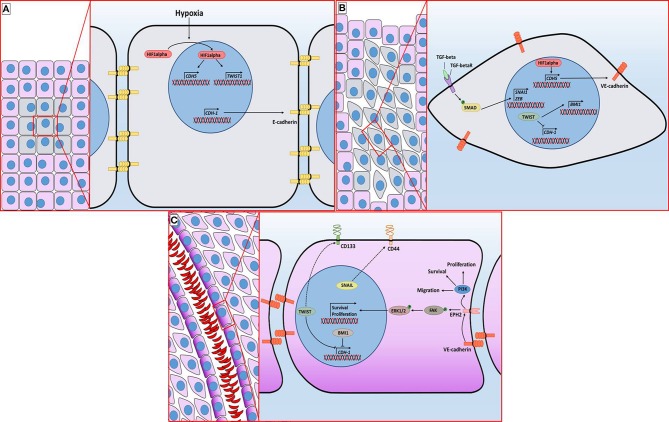
Vasculogenic mimicry (VM) is the formation of vascular channels lacking endothelial cells. These channels are lined by tumor cells with cancer stem cell features, positive for periodic acid-Schiff, and negative for CD31 staining. The term VM was introduced by Maniotis et al. (1), who reported this phenomenon in highly aggressive uveal melanomas; since then, VM has been associated with poor prognosis, tumor aggressiveness, metastasis, and drug resistance in several tumors, including breast cancer. It is proposed that VM and angiogenesis (the formation of blood vessels from the established vasculature by endothelial cells, which is observed in several tumors) rely on some common mechanisms. Furthermore, it is also suggested that VM could constitute a means to circumvent anti-angiogenic treatment in cancer. Therefore, it is important to determinant the factors that dictate the onset of VM. In this review, we describe the current understanding of VM formation in breast cancer, including specific signaling pathways, and cancer stem cells. In addition, we discuss the clinical significance of VM in prognosis and new opportunities of VM as a target for breast cancer therapy.
血管生成拟态(VM)是指缺乏内皮细胞的血管通道的形成。这些通道由具有癌症干细胞特征的肿瘤细胞排列,过碘酸希夫染色呈阳性,而CD31染色呈阴性。“VM”这一术语由马尼奥蒂斯等人提出,他们在高度侵袭性的葡萄膜黑色素瘤中报道了这一现象;从那时起,VM已与包括乳腺癌在内的几种肿瘤的预后不良、肿瘤侵袭性、转移和耐药性相关联。有人提出,VM和血管生成(内皮细胞从已有的脉管系统形成血管,这在几种肿瘤中都有观察到)依赖于一些共同机制。此外,也有人认为VM可能构成一种在癌症中规避抗血管生成治疗的手段。因此,确定决定VM发生的因素很重要。在这篇综述中,我们描述了目前对乳腺癌中VM形成的理解,包括特定的信号通路和癌症干细胞。此外,我们讨论了VM在预后方面的临床意义以及VM作为乳腺癌治疗靶点的新机遇。