Abdel-Salam Omar M E, El-Sayed El-Shamarka Marawa, Salem Neveen A, El-Din M Gaafar Alaa
National Research Centre, Cairo, Department of Toxicology and Narcotics.
National Research Centre, Cairo, Department of Photochemistry.
EXCLI J. 2012 Feb 24;11:45-58. eCollection 2012.
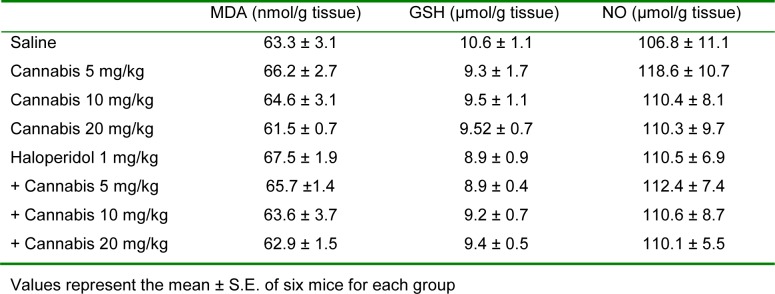
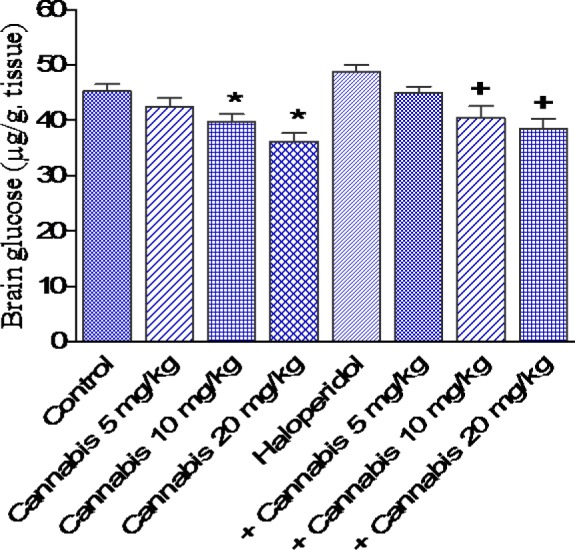
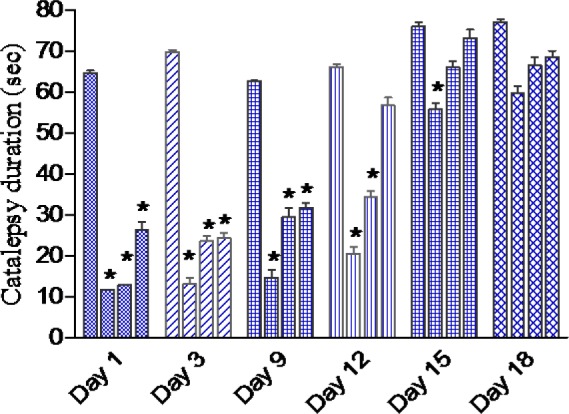
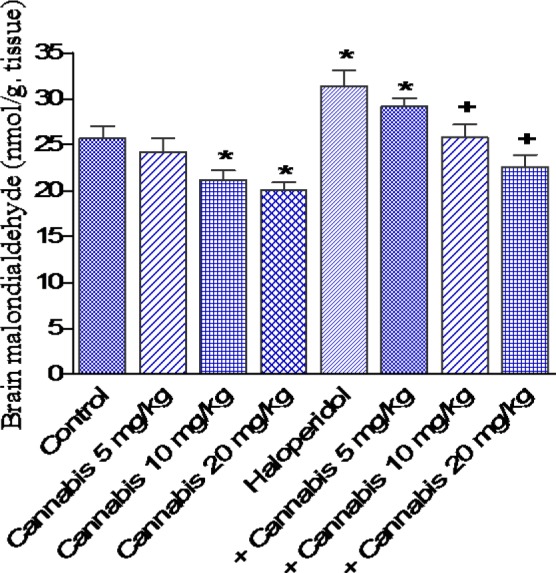
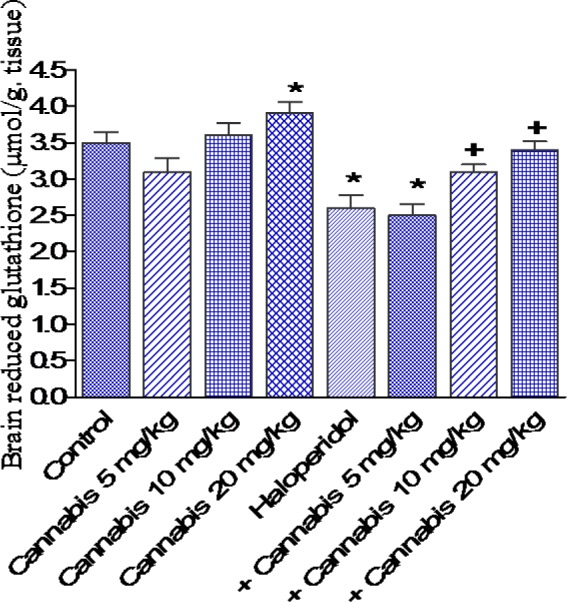
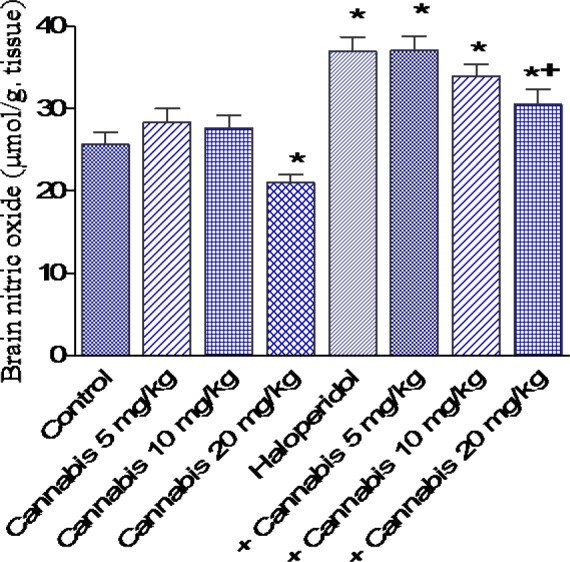
Haloperidol is a classic antipsychotic drug known for its propensity to cause extrapyramidal symptoms due to blockade of dopamine D2 receptors in the striatum. Interest in medicinal uses of cannabis is growing. Cannabis sativa has been suggested as a possible adjunctive in treatment of Parkinson's disease. The present study aimed to investigate the effect of repeated administration of an extract of Cannabis sativa on catalepsy and brain oxidative stress induced by haloperidol administration in mice. Cannabis extract was given by subcutaneous route at 5, 10 or 20 mg/kg (expressed as Δ(9)-tetrahydrocannabinol) once daily for 18 days and the effect on haloperidol (1 mg/kg, i.p.)-induced catalepsy was examined at selected time intervals using the bar test. Mice were euthanized 18 days after starting cannabis injection when biochemical assays were carried out. Malondialdehyde (MDA), reduced glutathione (GSH) and nitric oxide (the concentrations of nitrite/nitrate) were determined in brain and liver. In saline-treated mice, no catalepsy was observed at doses of cannabis up to 20 mg/kg. Mice treated with haloperidol at the dose of 1 mg/kg, exhibited significant cataleptic response. Mice treated with cannabis and haloperidol showed significant decrease in catalepsy duration, compared with the haloperidol only treated group. This decrease in catalepsy duration was evident on days 1-12 after starting cannabis injection. Later the effect of cannabis was not apparent. The administration of only cannabis (10 or 20 mg/kg) decreased brain MDA by 17.5 and 21.8 %, respectively. The level of nitric oxide decreased by 18 % after cannabis at 20 mg/kg. Glucose in brain decreased by 20.1 % after 20 mg/kg of cannabis extract. The administration of only haloperidol increased MDA (22.2 %), decreased GSH (25.7 %) and increased brain nitric oxide by 44.1 %. The administration of cannabis (10 or 20 mg/kg) to haloperidol-treated mice resulted in a significant decrease in brain MDA and nitric oxide as well as a significant increase in GSH and glucose compared with the haloperidol-control group. Cannabis had no significant effects on liver MDA, GSH, nitric oxide in saline or haloperidol-treated mice. It is concluded that cannabis improves catalepsy induced by haloperidol though the effect is not maintained on repeated cannabis administration. Cannabis alters the oxidative status of the brain in favor of reducing lipid peroxidation, but reduces brain glucose, which would impair brain energetics.
氟哌啶醇是一种经典的抗精神病药物,因其阻断纹状体中的多巴胺D2受体而易于引起锥体外系症状而闻名。对大麻药用价值的兴趣正在增加。有人提出大麻可能是治疗帕金森病的一种辅助药物。本研究旨在调查重复给予大麻提取物对氟哌啶醇诱导的小鼠僵住症和脑氧化应激的影响。大麻提取物通过皮下途径以5、10或20mg/kg(以Δ(9)-四氢大麻酚表示)的剂量每日给药一次,持续18天,并在选定的时间间隔使用杆式试验检查对氟哌啶醇(1mg/kg,腹腔注射)诱导的僵住症的影响。在开始注射大麻18天后对小鼠实施安乐死并进行生化测定。测定脑和肝脏中的丙二醛(MDA)、还原型谷胱甘肽(GSH)和一氧化氮(亚硝酸盐/硝酸盐的浓度)。在盐水处理的小鼠中,给予高达20mg/kg剂量的大麻时未观察到僵住症。用1mg/kg剂量的氟哌啶醇处理的小鼠表现出明显的僵住反应。与仅用氟哌啶醇处理的组相比,用大麻和氟哌啶醇处理的小鼠僵住症持续时间显著缩短。这种僵住症持续时间的缩短在开始注射大麻后的第1至12天很明显。后来大麻的作用不明显。仅给予大麻(10或20mg/kg)分别使脑MDA降低17.5%和21.8%。给予20mg/kg大麻后一氧化氮水平降低18%。给予20mg/kg大麻提取物后脑中葡萄糖降低20.1%。仅给予氟哌啶醇会使MDA增加(22.2%),使GSH降低(25.7%),并使脑一氧化氮增加44.1%。与氟哌啶醇对照组相比,给用氟哌啶醇处理的小鼠给予大麻(10或20mg/kg)会使脑MDA和一氧化氮显著降低,同时使GSH和葡萄糖显著增加。大麻对盐水或氟哌啶醇处理的小鼠的肝脏MDA、GSH、一氧化氮没有显著影响。结论是大麻可改善氟哌啶醇诱导的僵住症,尽管重复给予大麻时这种作用不能持续。大麻改变脑的氧化状态,有利于减少脂质过氧化,但会降低脑葡萄糖水平,这会损害脑能量代谢。