Pineda Mari-Carmen, Lorente Beatriz, López-Legentil Susanna, Palacín Creu, Turon Xavier
Department of Animal Biology and Biodiversity Research Institute (IRBIO), University of Barcelona, Barcelona, Spain; Sustainable Coastal Ecosystems & Industry in Tropical Australia, Australian Institute of Marine Science, Townsville, Queensland, Australia.
Department of Animal Biology and Biodiversity Research Institute (IRBIO), University of Barcelona , Barcelona , Spain.
PeerJ. 2016 Jun 23;4:e2158. doi: 10.7717/peerj.2158. eCollection 2016.
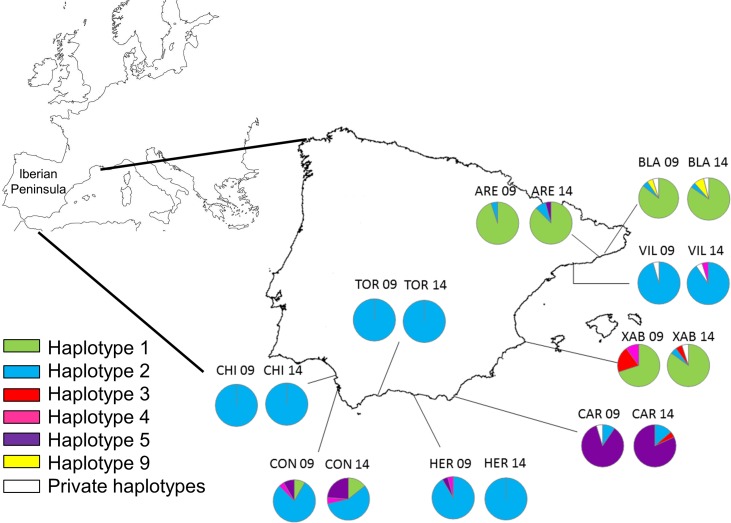
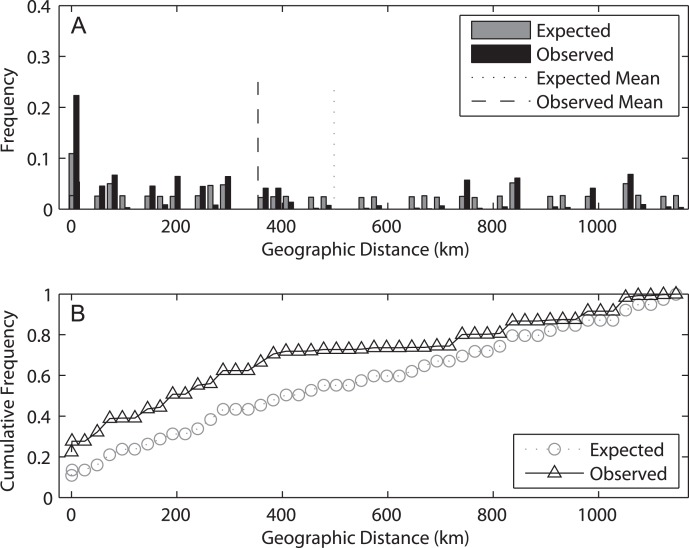
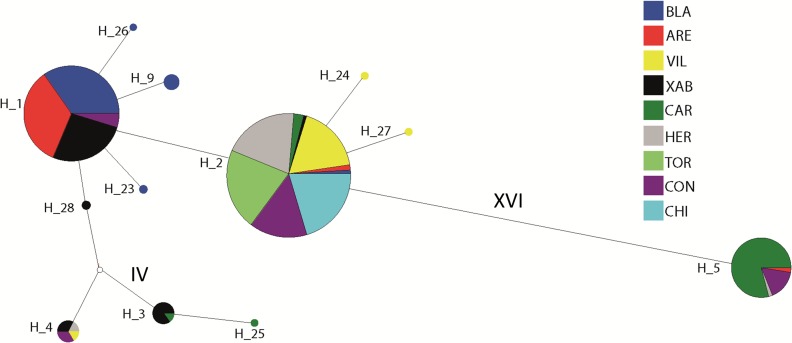
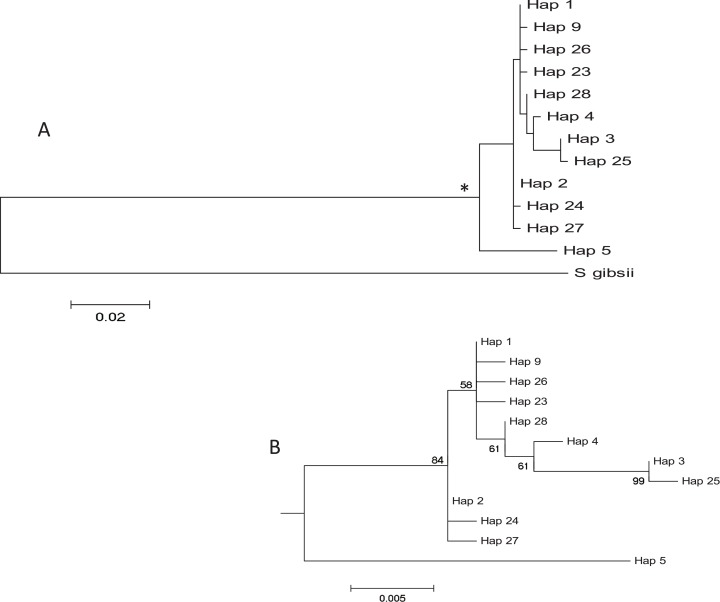
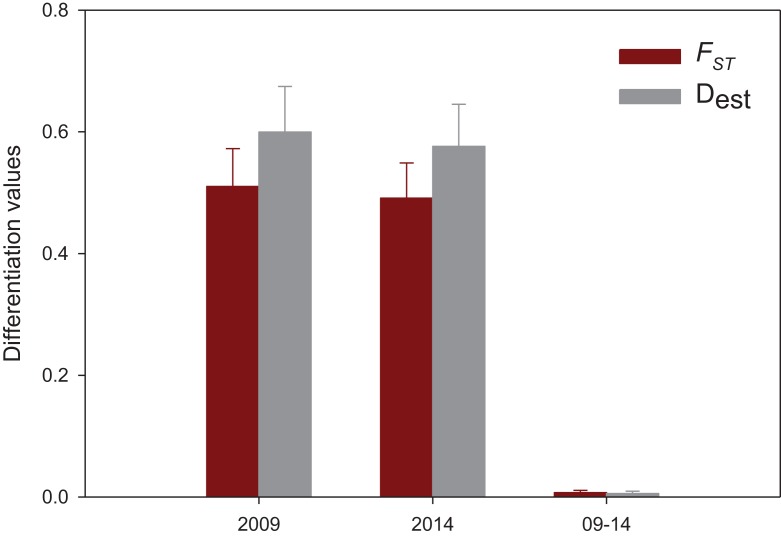
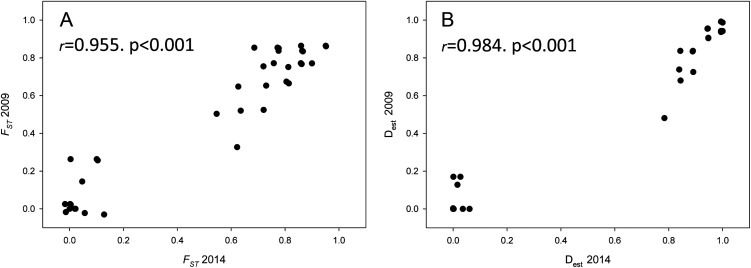
Spatio-temporal changes in genetic structure among populations provide crucial information on the dynamics of secondary spread for introduced marine species. However, temporal components have rarely been taken into consideration when studying the population genetics of non-indigenous species. This study analysed the genetic structure of Styela plicata, a solitary ascidian introduced in harbours and marinas of tropical and temperate waters, across spatial and temporal scales. A fragment of the mitochondrial gene Cytochrome Oxidase subunit I (COI) was sequenced from 395 individuals collected at 9 harbours along the NW Mediterranean coast and adjacent Atlantic waters (> 1,200 km range) at two time points 5 years apart (2009 and 2014). The levels of gene diversity were relatively low for all 9 locations in both years. Analyses of genetic differentiation and distribution of molecular variance revealed strong genetic structure, with significant differences among many populations, but no significant differences among years. A weak and marginally significant correlation between geographic distance and gene differentiation was found. Our results revealed spatial structure and temporal genetic homogeneity in S. plicata, suggesting a limited role of recurrent, vessel-mediated transport of organisms among small to medium-size harbours. Our study area is representative of many highly urbanized coasts with dense harbours. In these environments, the episodic chance arrival of colonisers appears to determine the genetic structure of harbour populations and the genetic composition of these early colonising individuals persists in the respective harbours, at least over moderate time frames (five years) that encompass ca. 20 generations of S. plicata.
种群间遗传结构的时空变化为外来海洋物种的二次扩散动态提供了关键信息。然而,在研究非本土物种的种群遗传学过程中,时间因素很少被考虑在内。本研究分析了皱瘤海鞘(Styela plicata)的遗传结构,该物种是一种独居海鞘,已被引入热带和温带水域的港口及游艇停靠区,研究跨越了空间和时间尺度。对线粒体基因细胞色素氧化酶亚基I(COI)的一个片段进行了测序,样本来自沿地中海西北海岸和邻近大西洋水域(范围超过1200公里)的9个港口在两个时间点(相隔5年,分别为2009年和2014年)采集的395个个体。两年中所有9个地点的基因多样性水平都相对较低。遗传分化分析和分子方差分布显示出很强的遗传结构,许多种群之间存在显著差异,但年份之间没有显著差异。地理距离与基因分化之间存在微弱且边缘显著的相关性。我们的研究结果揭示了皱瘤海鞘的空间结构和时间遗传同质性,表明在中小型港口之间,生物通过船只反复介导的运输作用有限。我们的研究区域代表了许多港口密集的高度城市化海岸。在这些环境中,殖民者偶然的间歇性到来似乎决定了港口种群的遗传结构,并且这些早期定殖个体的遗传组成在各自港口持续存在,至少在涵盖约20代皱瘤海鞘的适度时间框架(五年)内如此。