Vikrant Sanjay, Parashar Anupam
Department of Nephrology, Indira Gandhi Medical College, Shimla, Himachal Pradesh, India.
Department of Community Medicine, Indira Gandhi Medical College, Shimla, Himachal Pradesh, India.
Indian J Endocrinol Metab. 2016 Jul-Aug;20(4):460-7. doi: 10.4103/2230-8210.183457.
Disordered mineral metabolism is common complications of chronic kidney disease (CKD). However, there are limited data on the pattern of these disturbances in Indian CKD population.
This was a prospective observational study of CKD-mineral and bone disorder (CKD-MBD) over a period of 3 years. The biochemical markers of CKD-MBD, namely, calcium, phosphorus, alkaline phosphatase, intact parathyroid hormone (iPTH), and 25-hydoxyvitamin Vitamin D3 (25OHD), were measured in newly diagnosed CKD Stage 3-5 and prevalent CKD Stage 5D adult patients.
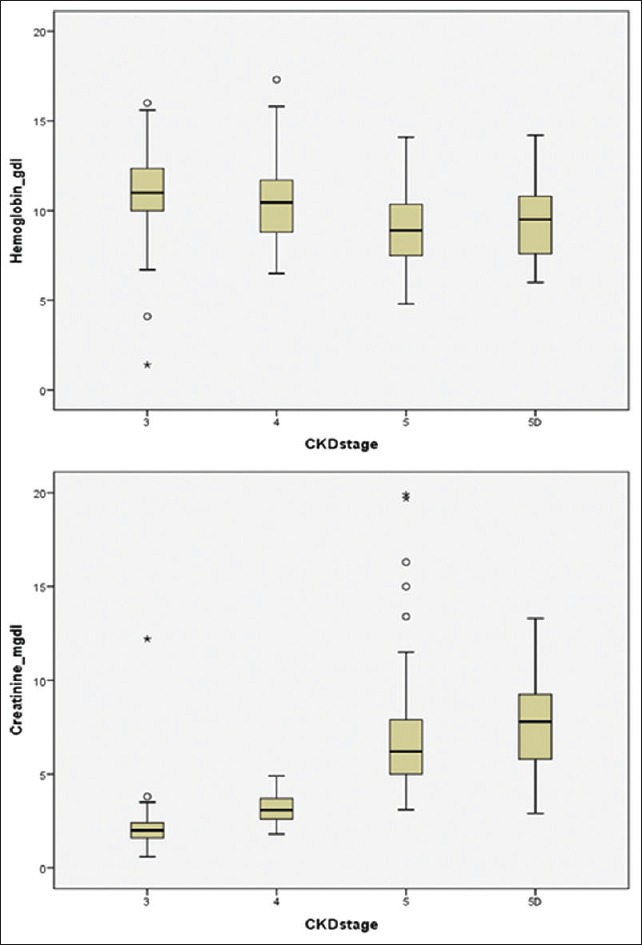
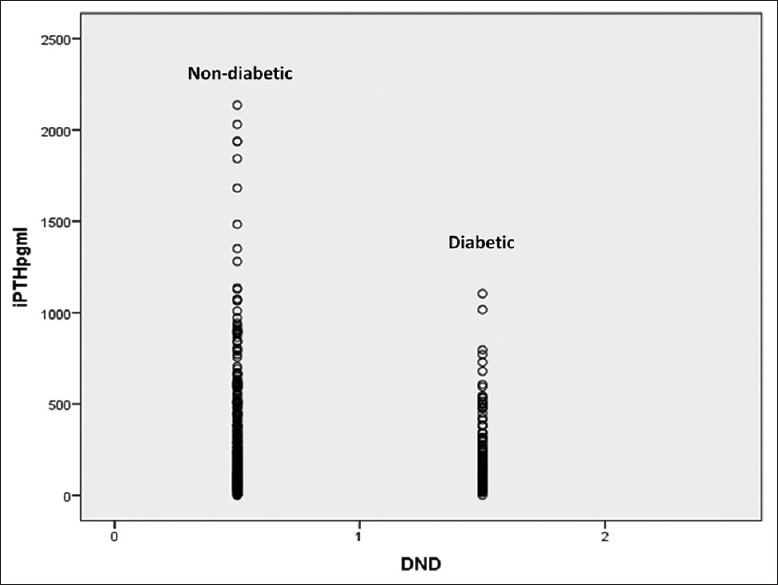
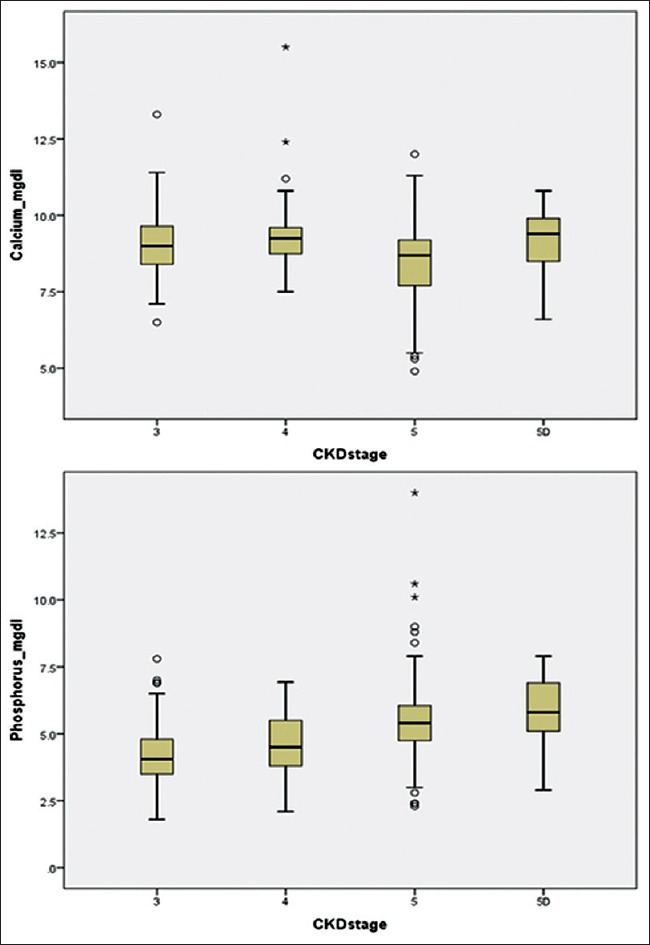
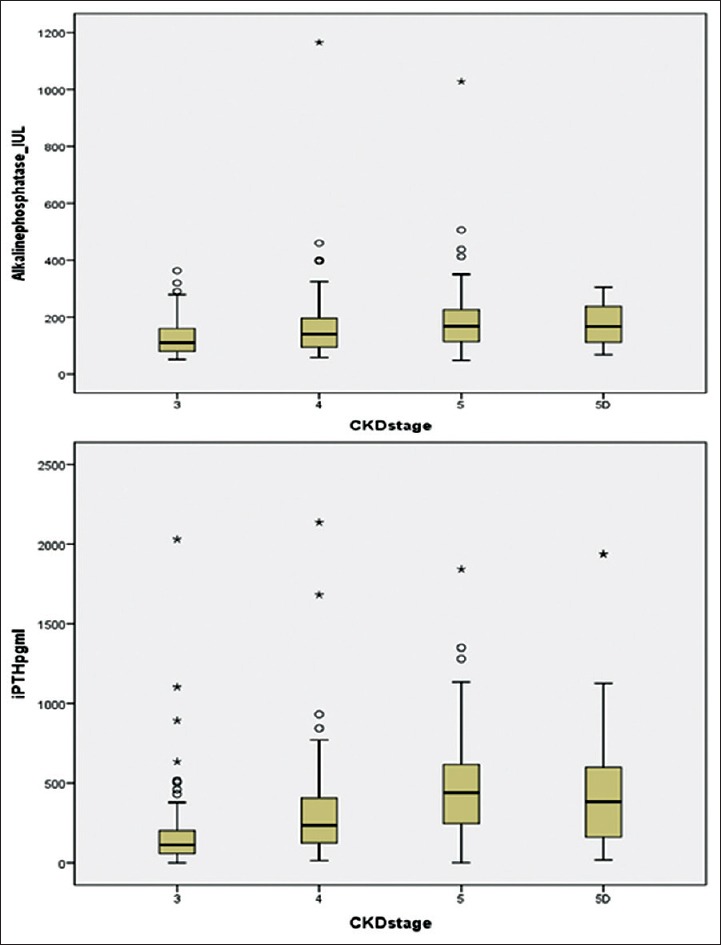
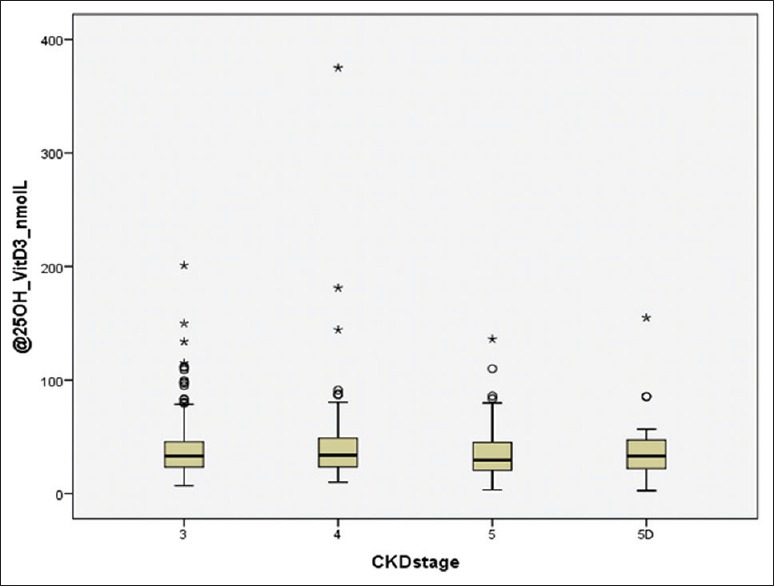
A total of 462 patients of CKD Stage 3-5D were studied. The frequency of various biochemical abnormalities was hypocalcemia (23.8%), hypercalcemia (5.4%), hypophosphatemia (2.8%), hyperphosphatemia (55.4%), raised alkaline phosphatase (56.9%), secondary hyperparathyroidism (82.7%), and hypoparathyroidism (1.5%). 25OHD was done in 335 (72.5%) patients and 90.4% were found to have Vitamin D deficiency. About 70.6% of the patients had iPTH levels were above kidney disease outcomes quality initiative (KDOQI) target range. Nondiabetic CKD as compared to diabetic CKD had a higher alkaline phosphatase (P = 0.016), a higher iPTH (P = 0.001) a higher proportion of patients with iPTH above KDOQI target range (P = 0.09), and an elevated alkaline phosphatase (P = 0.004). The 25OHD levels were suggestive of severe Vitamin D deficiency in 33.7%, Vitamin D deficiency in 45.4%, and Vitamin D insufficiency in 11.3% patients. There was a significant positive correlation between iPTH with alkaline phosphatase (r = 0.572, P = 0.001), creatinine (r = 0.424, P = 0.001), and phosphorus (r = 0.241, P = 0.001) and a significant negative correlation with hemoglobin (r = -0.325, 0.001), age (r = -0.169, P = 0.002), and 25OHD (r = -0.126, P = 0.021). On multivariate logistic regression analysis, an elevated alkaline phosphatase was a significant predictor of hyperparathyroidism (odds ratio 9.7, 95% confidence interval 4.9-19.2, P = 0.001).
There was a high prevalence of CKD-MBD in Indian CKD patients. CKD-MBD is more common and more severe and has an early onset as compared to the western populations.
矿物质代谢紊乱是慢性肾脏病(CKD)常见的并发症。然而,关于印度CKD患者中这些紊乱模式的数据有限。
这是一项为期3年的CKD - 矿物质和骨代谢紊乱(CKD - MBD)前瞻性观察研究。在新诊断的CKD 3 - 5期和CKD 5D期成年患者中,测量了CKD - MBD的生化标志物,即钙、磷、碱性磷酸酶、全段甲状旁腺激素(iPTH)和25 - 羟维生素D3(25OHD)。
共研究了CKD 3 - 5D期的462例患者。各种生化异常的发生率为低钙血症(23.8%)、高钙血症(5.4%)、低磷血症(2.8%)、高磷血症(55.4%)、碱性磷酸酶升高(56.9%)、继发性甲状旁腺功能亢进(82.7%)和甲状旁腺功能减退(1.5%)。335例(72.5%)患者检测了25OHD,发现90.4%的患者存在维生素D缺乏。约70.6%的患者iPTH水平高于肾脏病预后质量倡议(KDOQI)目标范围。与糖尿病CKD相比,非糖尿病CKD患者碱性磷酸酶水平更高(P = 0.016)、iPTH水平更高(P = 0.001)、iPTH高于KDOQI目标范围的患者比例更高(P = 0.09)以及碱性磷酸酶升高(P = 0.004)。25OHD水平提示33.7%的患者为严重维生素D缺乏,45.4%为维生素D缺乏,11.3%为维生素D不足。iPTH与碱性磷酸酶(r = 0.572,P = 0.001)、肌酐(r = 0.424,P = 0.001)和磷(r = 0.241,P = 0.001)呈显著正相关,与血红蛋白(r = -0.325,P = 0.001)、年龄(r = -0.169,P = 0.002)和25OHD(r = -0.126,P = 0.021)呈显著负相关。多因素逻辑回归分析显示,碱性磷酸酶升高是甲状旁腺功能亢进的显著预测因素(比值比9.7,95%置信区间4.9 - 19.2,P = 0.001)。
印度CKD患者中CKD - MBD的患病率较高。与西方人群相比,CKD - MBD更常见、更严重且发病更早。