Mukohyama Junko, Iwakiri Dai, Zen Yoh, Mukohara Toru, Minami Hironobu, Kakeji Yoshihiro, Shimono Yohei
Division of Molecular and Cellular Biology, Kobe University Graduate School of Medicine, Kobe, Japan.
Division of Gastrointestinal Surgery, Kobe University Graduate School of Medicine, Kobe, Japan.
Oncotarget. 2016 Aug 2;7(31):50150-50160. doi: 10.18632/oncotarget.10322.
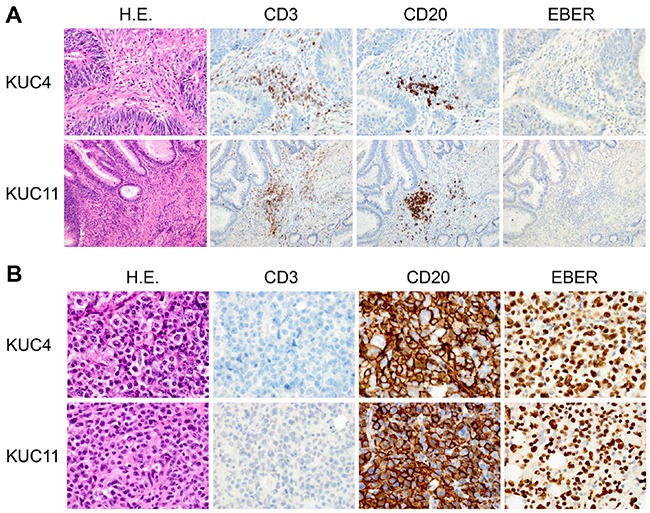
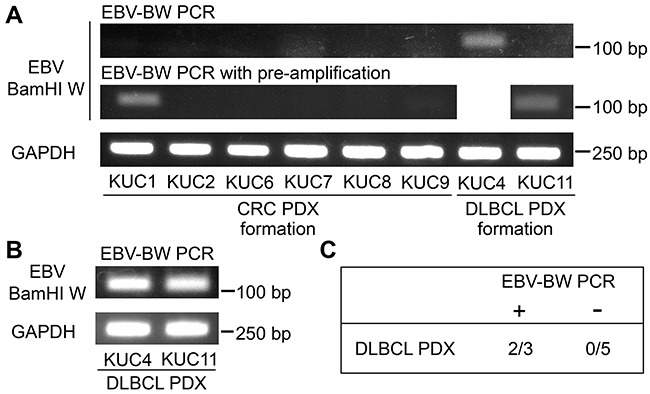
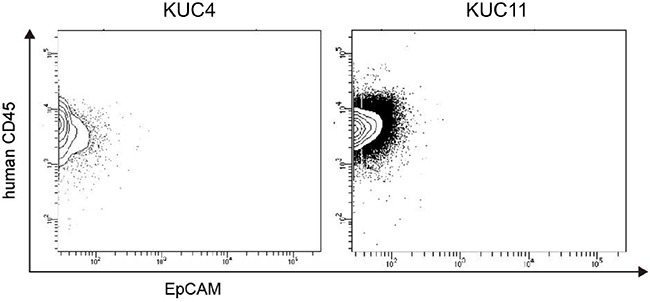
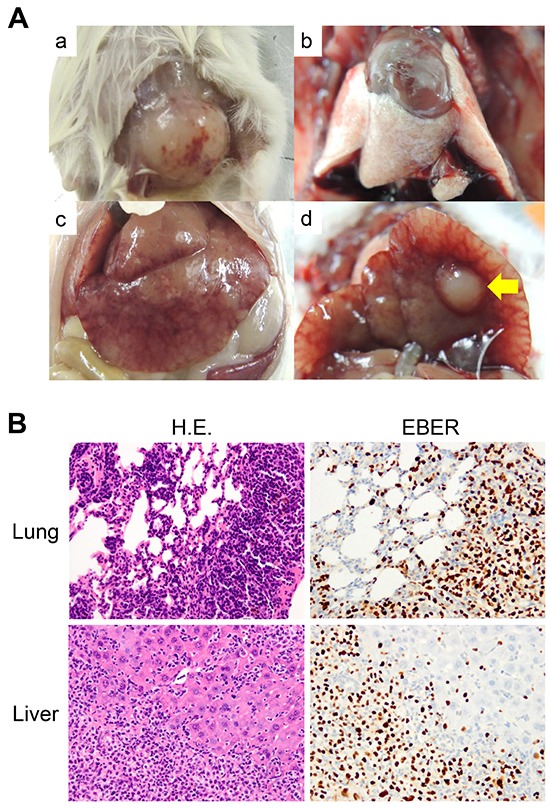
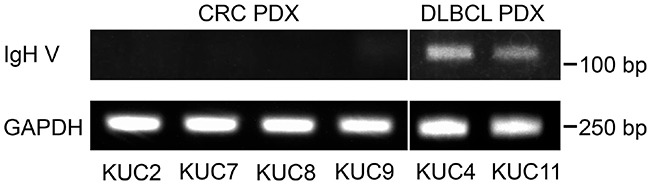
Establishment of patient-derived tumor xenografts (PDXs) is hampered by lymphomagenesis mostly caused by the latently-infected Epstein-Barr virus (EBV) contained in patient cancer tissues. However, the character of patient tissues that result in lymphomagenesis after xenotransplantation is not elucidated. In this study, we analyzed the patient colorectal cancer (CRC) tissues and the PDXs established by their xenotransplantation. We found that 2 of 9 (22%) PDX tumors were EBV-associated human diffuse large B cell lymphoma which was formed by clonal proliferation of human B-cell lymphocytes, were strongly positive for EBER-ISH, and were classified as type III latency. Expression of EBV genes and RNAs, such as EBNAs, LMP1, EBER and EBV-associated microRNAs in patient CRC tissues were unlikely to be associated with lymphomagenesis in PDXs. In contrast, the positive PCR-based amplification of BamHI W region, a major internal repeat in EBV genome, in the patient CRC tissues was correlated with lymphomagenesis in PDXs. These results suggest that the detection of the EBV BamHI W region in the patient surgical specimens will be an effective way to predict the risk of lymphomagenesis in PDXs before xenotransplantation.
患者来源的肿瘤异种移植(PDX)的建立受到淋巴瘤发生的阻碍,这主要是由患者癌组织中潜伏感染的爱泼斯坦-巴尔病毒(EBV)引起的。然而,导致异种移植后发生淋巴瘤的患者组织特征尚未阐明。在本研究中,我们分析了患者的结直肠癌(CRC)组织及其通过异种移植建立的PDX。我们发现,9个PDX肿瘤中有2个(22%)是EBV相关的人类弥漫性大B细胞淋巴瘤,由人类B淋巴细胞的克隆增殖形成,EBER原位杂交呈强阳性,并被归类为III型潜伏。患者CRC组织中EBV基因和RNA(如EBNAs、LMP1、EBER和EBV相关的微小RNA)的表达不太可能与PDX中的淋巴瘤发生相关。相反,患者CRC组织中EBV基因组主要内部重复序列BamHI W区域基于PCR的阳性扩增与PDX中的淋巴瘤发生相关。这些结果表明,在患者手术标本中检测EBV BamHI W区域将是在异种移植前预测PDX中淋巴瘤发生风险的有效方法。