Wilson Adam D, Bravo Adrian J, Pearson Matthew R, Witkiewitz Katie
Department of Psychology, Center on Alcoholism, Substance Abuse and Addictions, University of New Mexico, Albuquerque, NM, USA.
Department of Psychology, Old Dominion University, Norfolk, VA, USA.
Addiction. 2016 Dec;111(12):2145-2154. doi: 10.1111/add.13518. Epub 2016 Aug 24.
To estimate differences in post-treatment psychosocial functioning among treatment 'failures' (i.e. heavy drinkers, defined as 4+/5+ drinks for women/men) from two large multi-site clinical trials and to compare these levels of functioning to those of the purported treatment 'successes' (i.e. non-heavy drinkers).
Separate latent profile analyses of data from two of the largest alcohol clinical trials conducted in the United States, COMBINE (Combined Pharmacotherapies and Behavioral Interventions) and Project MATCH (Matching Alcoholism Treatments to Client Heterogeneity), comparing psychosocial outcomes across derived classes of heterogeneous treatment responders.
Eleven US academic sites in COMBINE, 27 US treatment sites local to nine research sites in Project MATCH.
A total of 962 individuals in COMBINE (69% male, 77% white, mean age: 44 years) treated January 2001 to January 2004 and 1528 individuals in Project MATCH (75% male, 80% white, mean age: 40 years) treated April 1991 to September 1994.
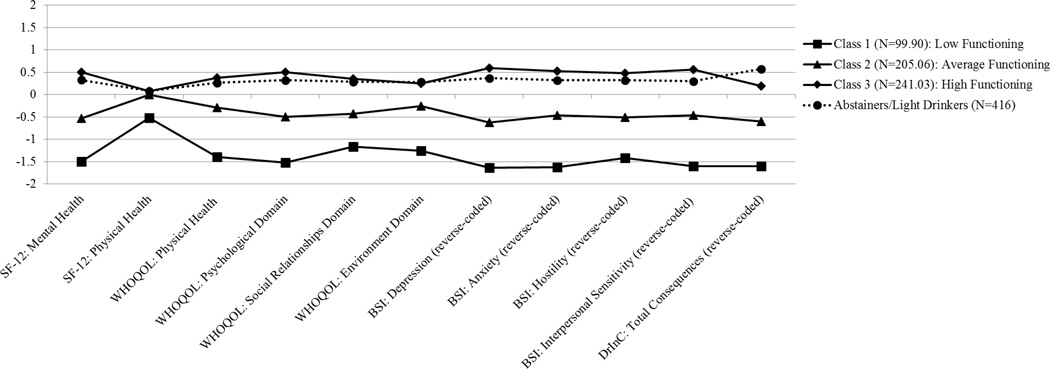
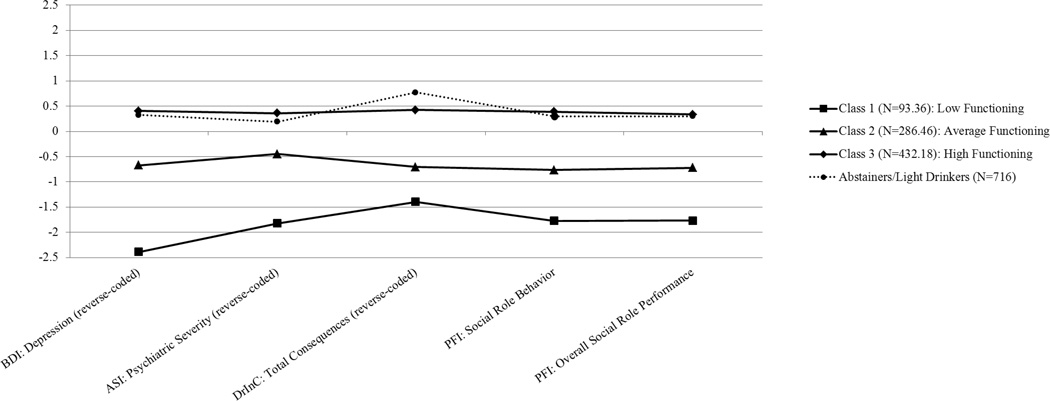
In COMBINE, we analyzed health, quality of life, mental health symptoms and alcohol consequences 12 months post-baseline. In Project MATCH, we examined social functioning, mental health symptoms and alcohol consequences 15 months post-baseline.
Latent profile analysis of measures of functioning in both samples supported a three-profile solution for the group of treatment 'failures', characterized by high-, average- and low-functioning individuals. The high-functioning treatment 'failures' generally performed better across measures of psychosocial functioning at follow-up than participants designated treatment 'successes' by virtue of being abstainers or light drinkers.
Current United States Food and Drug Administration guidance to use heavy drinking as indicative of treatment 'failure' fails to take into account substantial psychosocial improvements made by individuals who continue occasionally to drink heavily post-treatment.
评估两项大型多中心临床试验中治疗“失败者”(即重度饮酒者,女性定义为每日饮酒4杯及以上,男性定义为每日饮酒5杯及以上)治疗后心理社会功能的差异,并将这些功能水平与所谓的治疗“成功者”(即非重度饮酒者)进行比较。
对美国进行的两项最大规模酒精临床试验——综合疗法(联合药物治疗与行为干预)和匹配计划(将酒精成瘾治疗与患者异质性相匹配)的数据进行单独的潜在类别分析,比较不同类型的异质性治疗反应者的心理社会结局。
综合疗法试验在美国的11个学术场所进行,匹配计划试验在美国9个研究场所的27个治疗场所进行。
综合疗法试验共有962名参与者(69%为男性,77%为白人,平均年龄44岁),于2001年1月至2004年1月接受治疗;匹配计划试验有1528名参与者(75%为男性,80%为白人,平均年龄40岁),于1991年4月至1994年9月接受治疗。
在综合疗法试验中,我们分析了基线后12个月的健康状况、生活质量、心理健康症状和酒精相关后果。在匹配计划试验中,我们考察了基线后15个月的社会功能、心理健康症状和酒精相关后果。
对两个样本中功能指标的潜在类别分析支持将治疗“失败者”群体分为三种类型的解决方案,其特征为功能高、中、低的个体。功能高的治疗“失败者”在随访时的心理社会功能各项指标上总体表现优于那些因戒酒或轻度饮酒而被认定为治疗“成功者”的参与者。
美国食品药品监督管理局目前使用重度饮酒作为治疗“失败”指标的指导意见,没有考虑到那些治疗后仍偶尔重度饮酒的个体在心理社会方面取得的显著改善。