Wang Jianzong, Hu Duanming, Tang Wen, Hu Chuanyin, Lu Qin, Li Juan, Zhu Jianhong, Xu Liming, Sui Zhenyu, Qian Mingjie, Wang Shaofeng, Yin Guojian
Department of Gastroenterology, the Second Affiliated Hospital of Soochow University, Suzhou, Jiangsu Province, People's Republic of China.
Medicine (Baltimore). 2016 Jun;95(26):e3603. doi: 10.1097/MD.0000000000003603.
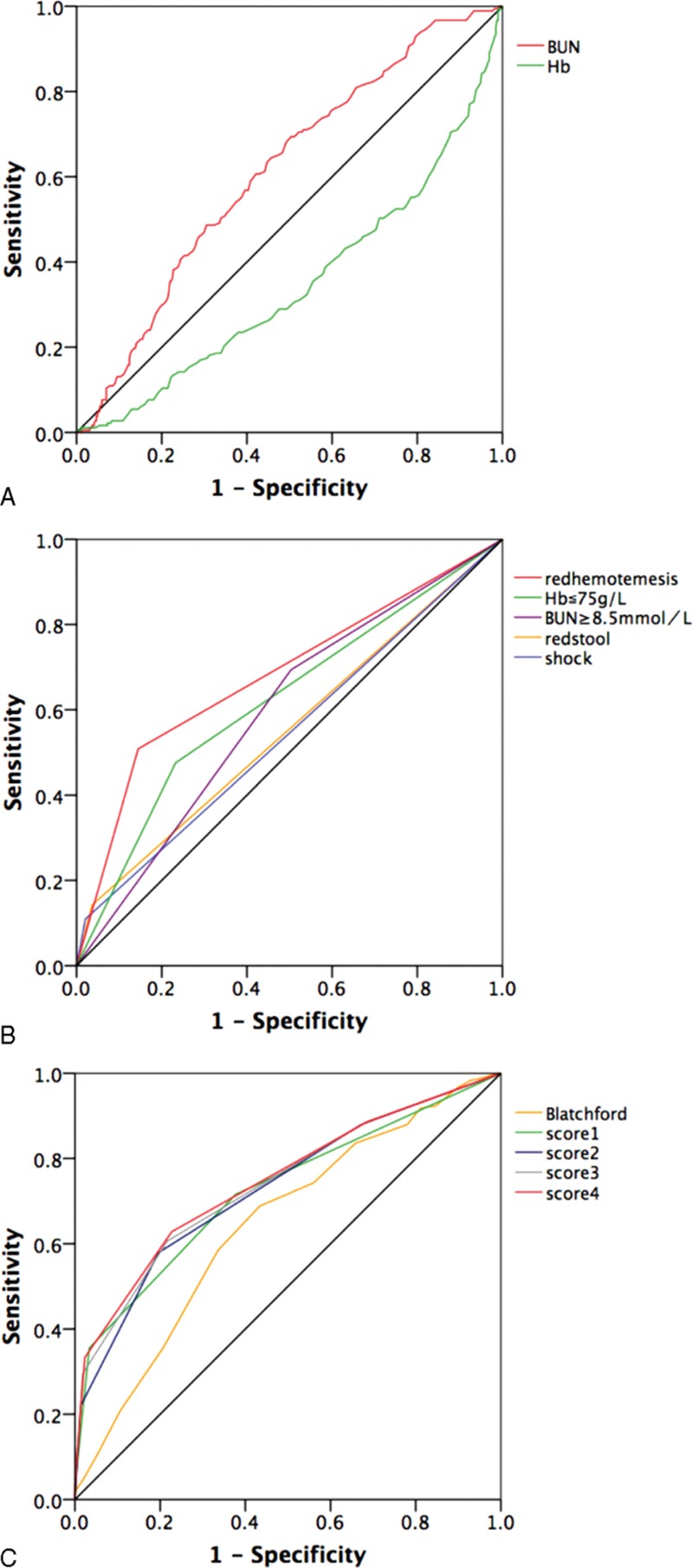
The goal of this study is to evaluate how to predict high-risk nonvariceal upper gastrointestinal bleeding (NVUGIB) pre-endoscopically. A total of 569 NVUGIB patients between Match 2011 and January 2015 were retrospectively studied. The clinical characteristics and laboratory data were statistically analyzed. The severity of NVUGIB was based on high-risk NVUGIB (Forrest I-IIb), and low-risk NVUGIB (Forrest IIc and III). By logistic regression and receiver-operating characteristic curve, simple risk score systems were derived which predicted patients' risks of potentially needing endoscopic intervention to control bleeding. Risk score systems combined of patients' serum hemoglobin (Hb) ≤75 g/L, red hematemesis, red stool, shock, and blood urine nitrogen ≥8.5 mmol/L within 24 hours after admission were derived. As for each one of these clinical signs, the relatively high specificity was 97.9% for shock, 96.4% for red stool, 85.5% for red hematemesis, 76.7% for Hb ≤75 g/L, and the sensitivity was 50.8% for red hematemesis, 47.5% for Hb ≤75 g/L, 14.2% for red stool, and 10.9% for shock. When these 5 clinical signs were presented as a risk score system, the highest area of receiver-operating characteristic curve was 0.746, with sensitivity 0.675 and specificity 0.733, which discriminated well with high-risk NVUGIB. These simple risk factors identified patients with high-risk NVUGIB of needing treatment to manage their bleeding pre-endoscopically. Further validation in the clinic was required.
本研究的目的是评估如何在进行内镜检查前预测高危非静脉曲张性上消化道出血(NVUGIB)。对2011年3月至2015年1月期间的569例NVUGIB患者进行了回顾性研究。对临床特征和实验室数据进行了统计分析。NVUGIB的严重程度基于高危NVUGIB(福里斯特I-IIb)和低危NVUGIB(福里斯特IIc和III)。通过逻辑回归和受试者工作特征曲线,得出了简单的风险评分系统,该系统可预测患者可能需要内镜干预以控制出血的风险。得出了入院后24小时内患者血清血红蛋白(Hb)≤75 g/L、呕血、便血、休克和血尿素氮≥8.5 mmol/L的风险评分系统。对于这些临床体征中的每一项,休克的相对高特异性为97.9%,便血为96.4%,呕血为85.5%,Hb≤75 g/L为76.7%,呕血的敏感性为50.8%,Hb≤75 g/L为47.5%,便血为14.2%,休克为10.9%。当将这5项临床体征作为一个风险评分系统时,受试者工作特征曲线的最高面积为0.746,敏感性为0.675,特异性为0.733,对高危NVUGIB有良好的区分度。这些简单的风险因素可识别出需要在进行内镜检查前接受治疗以控制出血的高危NVUGIB患者。需要在临床中进一步验证。