Zhu Peixuan, Stanton Melissa L, Castle Erik P, Joseph Richard W, Adams Daniel L, Li Shuhong, Amstutz Platte, Tang Cha-Mei, Ho Thai H
Creatv MicroTech, Inc., 11609 Lake Potomac Drive, Potomac, MD, 20854, USA.
Department of Laboratory Medicine and Pathology, Mayo Clinic, 13400 East Shea Blvd, Scottsdale, AZ, 85259, USA.
J Transl Med. 2016 Jul 2;14(1):198. doi: 10.1186/s12967-016-0953-2.
Cryopreserved peripheral blood mononuclear cells (PBMCs) are commonly collected in biobanks. However, little data exist regarding the preservation of tumor-associated cells in cryopreserved collections. The objective of this study was to determine the feasibility of using the CellSieve™ microfiltration assay for the isolation of circulating tumor cells (CTCs) and circulating cancer-associated macrophage-like cells (CAMLs) from cryopreserved PBMC samples.
Blood samples spiked with breast (MCF-7), prostate (PC-3), and renal (786-O) cancer cell lines were used to establish analytical accuracy, efficiency, and reproducibility after cryopreservation. The spiked samples were processed through Ficoll separation, and cryopreservation was followed by thawing and microfiltration.
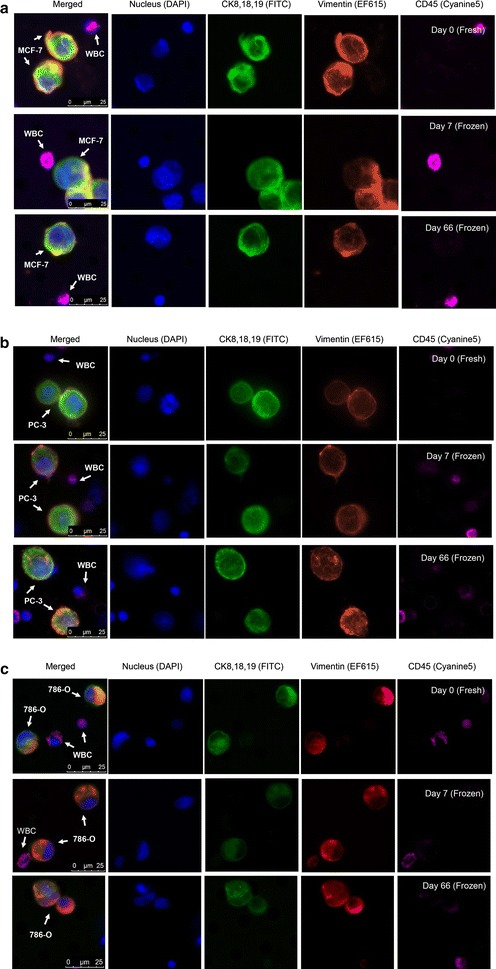
MCF-7 cells were successfully retrieved with recovery efficiencies of 90.5 % without cryopreservation and 87.8 and 89.0 %, respectively, on day 7 and day 66 following cryopreservation. The corresponding recovery efficiencies of PC-3 cells were 83.3 % without cryopreservation and 85.3 and 84.7 %, respectively, after cryopreservation. Recovery efficiencies of 786-O cells were 92.7 % without cryopreservation, and 82.7 and 81.3 %, respectively, after cryopreservation. The recovered cells retained the morphologic characteristics and immunohistochemical markers that had been observed before freezing. The protocols were further validated by quantitation of CAMLs in blood samples from two patients with renal cell carcinoma (RCC). The recovery rates of CTCs and CAMLs from cryopreserved samples were not statistically significant different (P > 0.05) from matched fresh samples.
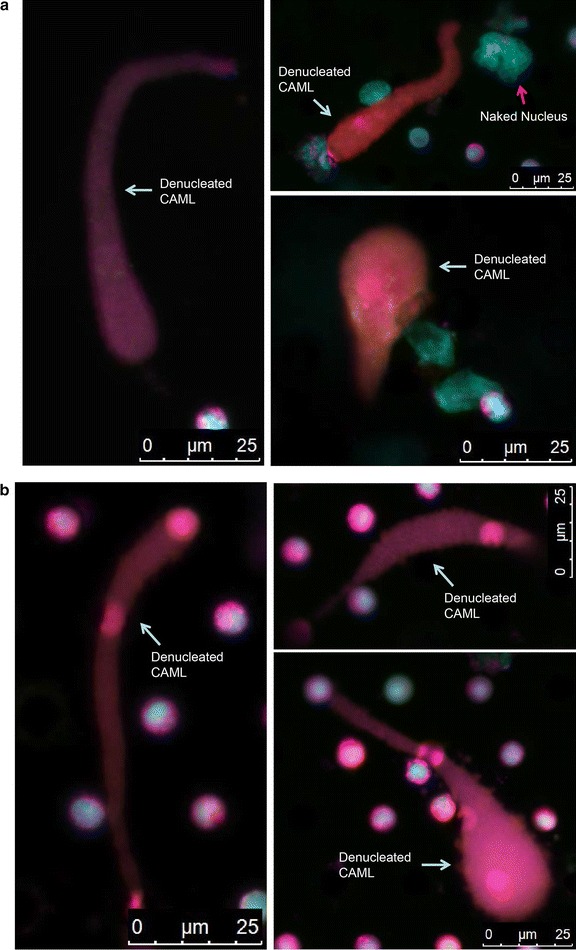
To our knowledge, this is the first report that CAMLs could be cryopreserved and analyzed after thawing with microfiltration technology. The application of microfiltration technology to cryopreserved samples will enable much greater retrospective study of cancer patients in relation to long-term outcomes.
冷冻保存的外周血单个核细胞(PBMC)通常收集于生物样本库中。然而,关于冷冻保存样本中肿瘤相关细胞的保存情况,相关数据较少。本研究的目的是确定使用CellSieve™微滤分析法从冷冻保存的PBMC样本中分离循环肿瘤细胞(CTC)和循环癌相关巨噬细胞样细胞(CAML)的可行性。
使用添加了乳腺癌(MCF-7)、前列腺癌(PC-3)和肾癌(786-O)细胞系的血样,在冷冻保存后确定分析准确性、效率和可重复性。加样后的样本经Ficoll分离处理,冷冻保存后进行解冻和微滤。
MCF-7细胞在未冷冻保存时成功回收率为90.5%,冷冻保存后第7天和第66天的回收率分别为87.8%和89.0%。PC-3细胞在未冷冻保存时的相应回收率为83.3%,冷冻保存后的回收率分别为85.3%和84.7%。786-O细胞在未冷冻保存时的回收率为92.7%,冷冻保存后的回收率分别为82.7%和81.3%。回收的细胞保留了冷冻前观察到的形态学特征和免疫组化标记。通过对两名肾细胞癌(RCC)患者血样中CAML的定量分析,进一步验证了该方案。冷冻保存样本中CTC和CAML的回收率与匹配的新鲜样本相比,差异无统计学意义(P>0.05)。
据我们所知,这是首篇关于CAML可通过微滤技术冷冻保存并解冻后进行分析的报道。微滤技术应用于冷冻保存样本将使对癌症患者长期预后的回顾性研究更加深入。