Bennett Jean, Wellman Jennifer, Marshall Kathleen A, McCague Sarah, Ashtari Manzar, DiStefano-Pappas Julie, Elci Okan U, Chung Daniel C, Sun Junwei, Wright J Fraser, Cross Dominique R, Aravand Puya, Cyckowski Laura L, Bennicelli Jeannette L, Mingozzi Federico, Auricchio Alberto, Pierce Eric A, Ruggiero Jason, Leroy Bart P, Simonelli Francesca, High Katherine A, Maguire Albert M
Center for Advanced Retinal and Ocular Therapeutics, Scheie Eye Institute, University of Pennsylvania, Philadelphia, PA, USA; F M Kirby Center for Molecular Ophthalmology, Scheie Eye Institute, University of Pennsylvania, Philadelphia, PA, USA; Center for Cellular and Molecular Therapeutics, The Children's Hospital of Philadelphia, Philadelphia, PA, USA.
Center for Cellular and Molecular Therapeutics, The Children's Hospital of Philadelphia, Philadelphia, PA, USA; Spark Therapeutics, Philadelphia, PA, USA.
Lancet. 2016 Aug 13;388(10045):661-72. doi: 10.1016/S0140-6736(16)30371-3. Epub 2016 Jun 30.
Safety and efficacy have been shown in a phase 1 dose-escalation study involving a unilateral subretinal injection of a recombinant adeno-associated virus (AAV) vector containing the RPE65 gene (AAV2-hRPE65v2) in individuals with inherited retinal dystrophy caused by RPE65 mutations. This finding, along with the bilateral nature of the disease and intended use in treatment, prompted us to determine the safety of administration of AAV2-hRPE65v2 to the contralateral eye in patients enrolled in the phase 1 study.
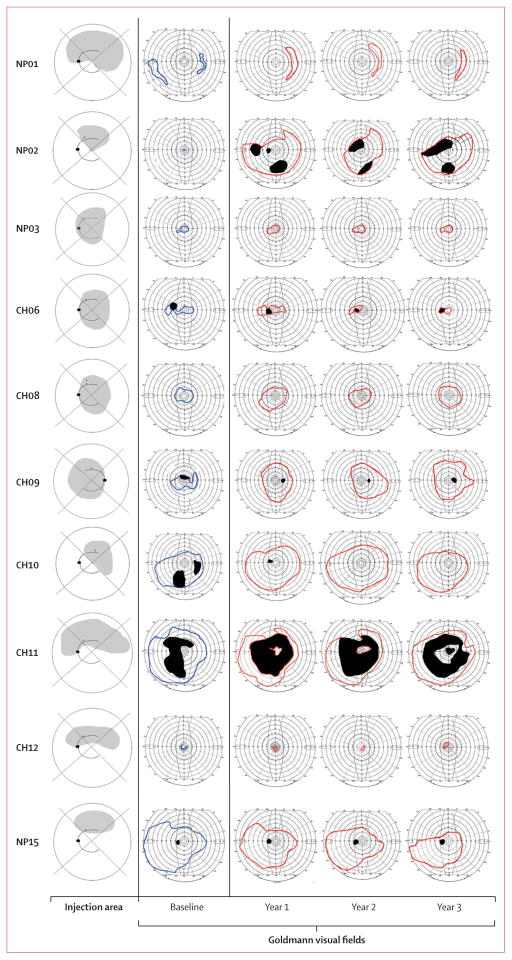
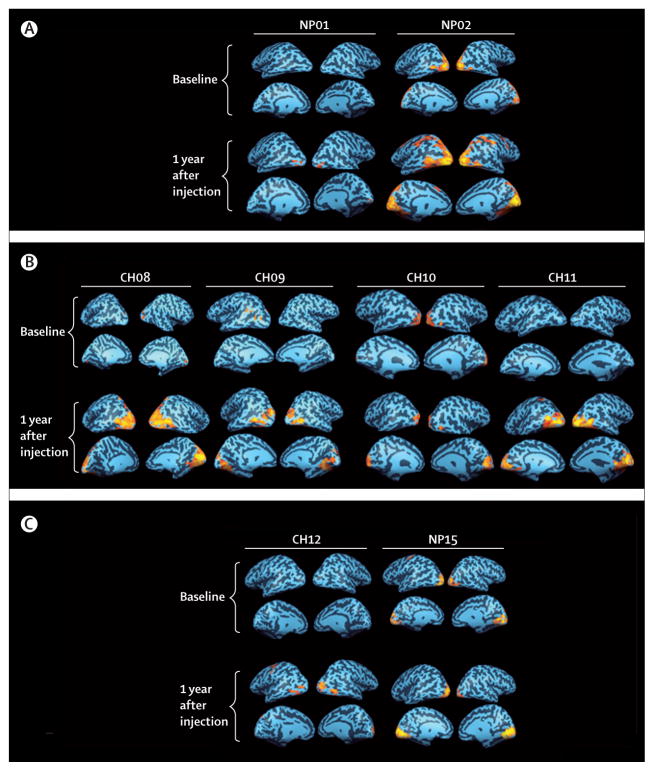
In this follow-on phase 1 trial, one dose of AAV2-hRPE65v2 (1.5 × 10(11) vector genomes) in a total volume of 300 μL was subretinally injected into the contralateral, previously uninjected, eyes of 11 children and adults (aged 11-46 years at second administration) with inherited retinal dystrophy caused by RPE65 mutations, 1.71-4.58 years after the initial subretinal injection. We assessed safety, immune response, retinal and visual function, functional vision, and activation of the visual cortex from baseline until 3 year follow-up, with observations ongoing. This study is registered with ClinicalTrials.gov, number NCT01208389.
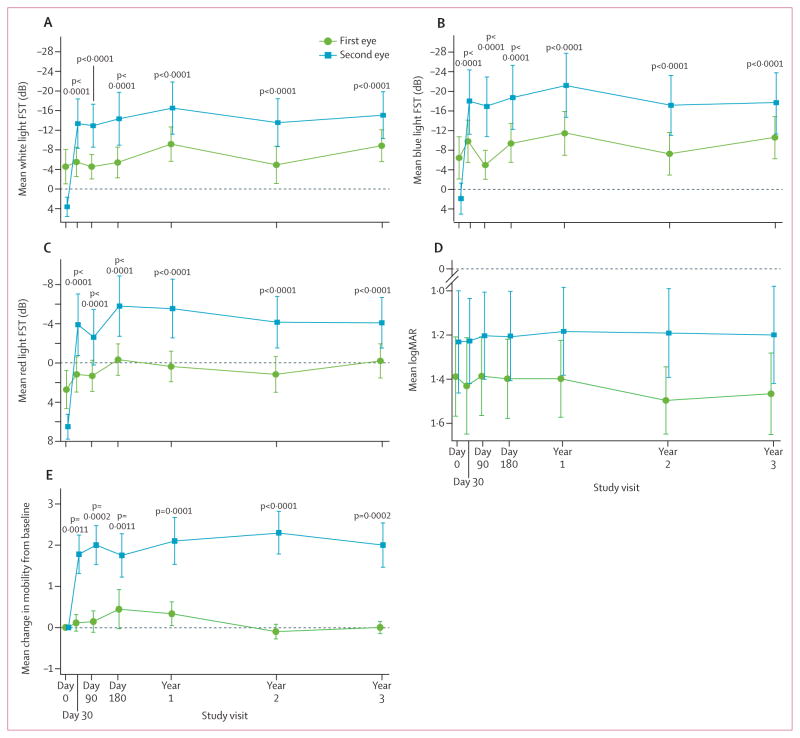
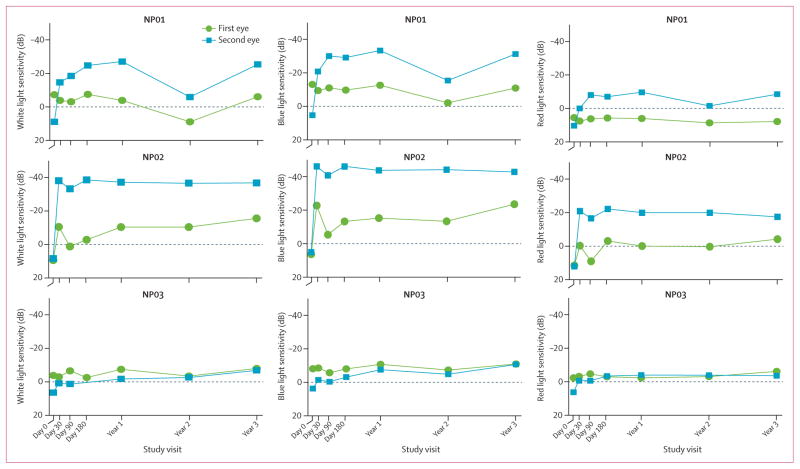
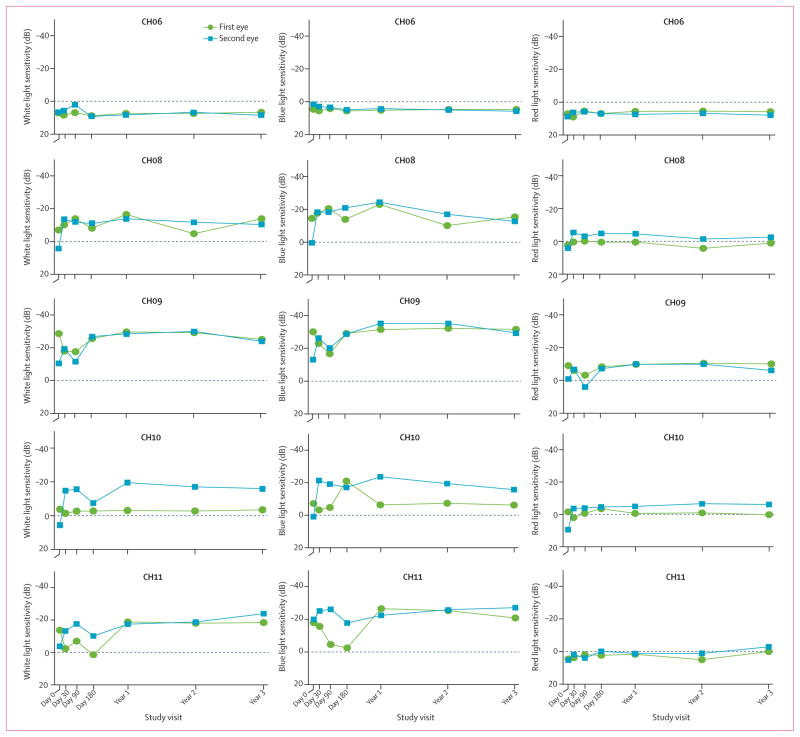
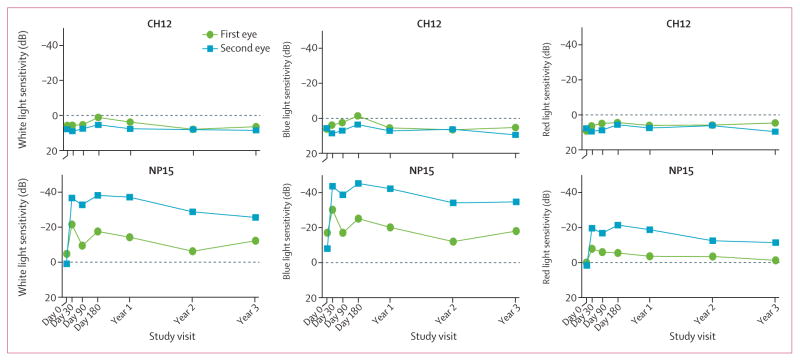
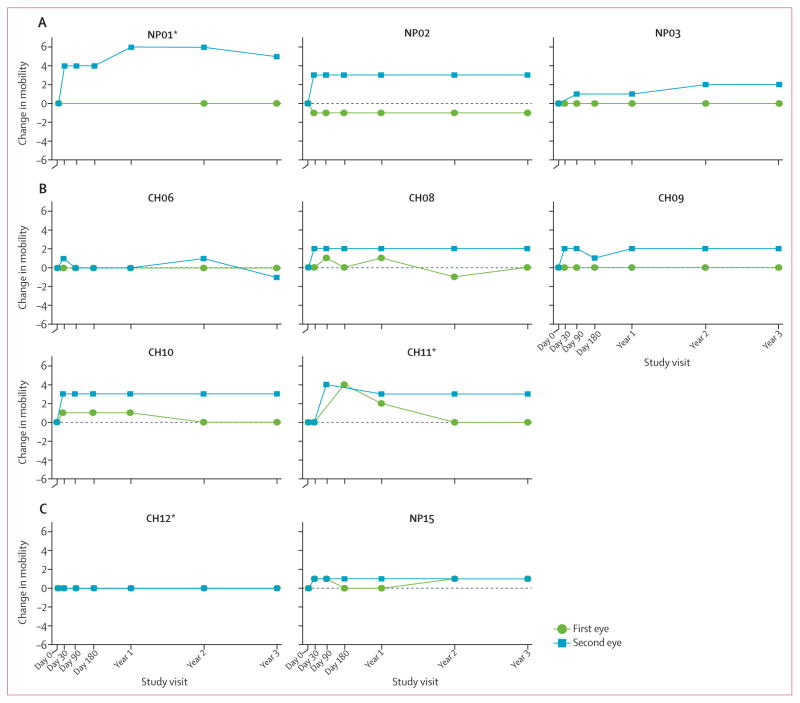
No adverse events related to the AAV were reported, and those related to the procedure were mostly mild (dellen formation in three patients and cataracts in two). One patient developed bacterial endophthalmitis and was excluded from analyses. We noted improvements in efficacy outcomes in most patients without significant immunogenicity. Compared with baseline, pooled analysis of ten participants showed improvements in mean mobility and full-field light sensitivity in the injected eye by day 30 that persisted to year 3 (mobility p=0.0003, white light full-field sensitivity p<0.0001), but no significant change was seen in the previously injected eyes over the same time period (mobility p=0.7398, white light full-field sensitivity p=0.6709). Changes in visual acuity from baseline to year 3 were not significant in pooled analysis in the second eyes or the previously injected eyes (p>0.49 for all time-points compared with baseline).
To our knowledge, AAV2-hRPE65v2 is the first successful gene therapy administered to the contralateral eye. The results highlight the use of several outcome measures and help to delineate the variables that contribute to maximal benefit from gene augmentation therapy in this disease.
Center for Cellular and Molecular Therapeutics at The Children's Hospital of Philadelphia, Spark Therapeutics, US National Institutes of Health, Foundation Fighting Blindness, Institute for Translational Medicine and Therapeutics, Research to Prevent Blindness, Center for Advanced Retinal and Ocular Therapeutics, Mackall Foundation Trust, F M Kirby Foundation, and The Research Foundation-Flanders.
在一项1期剂量递增研究中,已证明向因RPE65突变导致遗传性视网膜营养不良的个体单侧视网膜下注射含RPE65基因的重组腺相关病毒(AAV)载体(AAV2-hRPE65v2)具有安全性和有效性。这一发现,连同该疾病的双侧性以及治疗的预期用途,促使我们确定在1期研究中入组的患者对侧眼给予AAV2-hRPE65v2的安全性。
在这项后续的1期试验中,将一剂AAV2-hRPE65v2(1.5×10¹¹载体基因组),总体积300μL,视网膜下注射到11名儿童和成人(第二次给药时年龄为11 - 46岁)因RPE65突变导致遗传性视网膜营养不良的对侧、先前未注射的眼中,首次视网膜下注射后1.71 - 4.58年。我们评估了从基线到3年随访期间的安全性、免疫反应、视网膜和视觉功能、功能性视力以及视觉皮层的激活情况,观察仍在进行中。本研究已在ClinicalTrials.gov注册,编号为NCT01208389。
未报告与AAV相关的不良事件,与手术相关的不良事件大多为轻度(3例患者出现视网膜浅脱离,2例患者出现白内障)。1例患者发生细菌性眼内炎并被排除在分析之外。我们注意到大多数患者的疗效指标有所改善,且无明显免疫原性。与基线相比,对10名参与者的汇总分析显示,注射眼在第30天时平均移动性和全视野光敏感度有所改善,并持续至第3年(移动性p = 0.0003,白光全视野敏感度p < 0.0001),但在同一时期,先前注射的眼睛未观察到显著变化(移动性p = 0.7398,白光全视野敏感度p = 0.6709)。在汇总分析中,第二只眼和先前注射的眼睛从基线到第3年的视力变化均不显著(与基线相比,所有时间点p>0.49)。
据我们所知,AAV2-hRPE65v2是首次成功应用于对侧眼的基因疗法。这些结果突出了多种结局指标的应用,并有助于明确在该疾病中基因增强疗法实现最大获益的相关变量。
费城儿童医院细胞与分子治疗中心、Spark Therapeutics公司、美国国立卫生研究院、抗击失明基金会、转化医学与治疗学研究所、预防失明研究、高级视网膜与眼治疗中心、Mackall基金会信托、F M Kirby基金会以及弗拉芒研究基金会。