Maciejewski Hugo, Bourdin Muriel, Féasson Léonard, Dubouchaud Hervé, Denis Christian, Freund Hubert, Messonnier Laurent A
Inter-University Laboratory of Human Movement Biology, University of Savoy Mont BlancLe Bourget-du-Lac, France; French Rowing FederationNogent-sur-Marne, France.
IFSTTAR, LBMC UMR_T9406, Claude Bernard University Lyon 1 Oullins, France.
Front Physiol. 2016 Jun 10;7:223. doi: 10.3389/fphys.2016.00223. eCollection 2016.
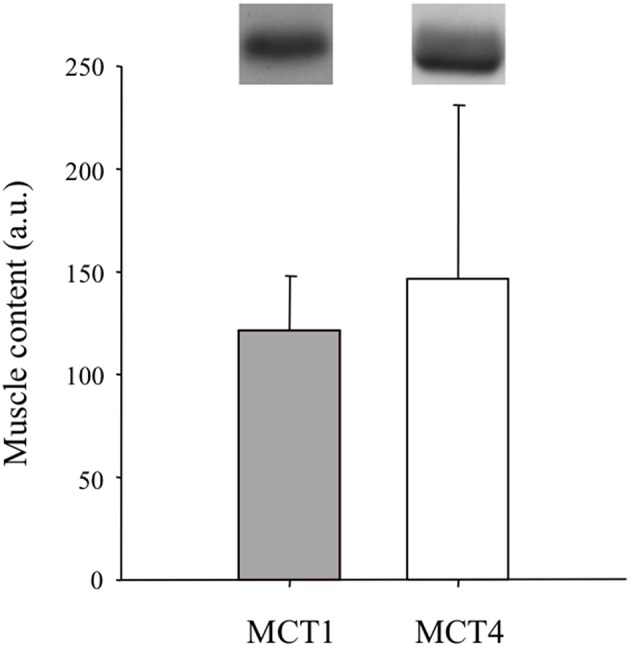
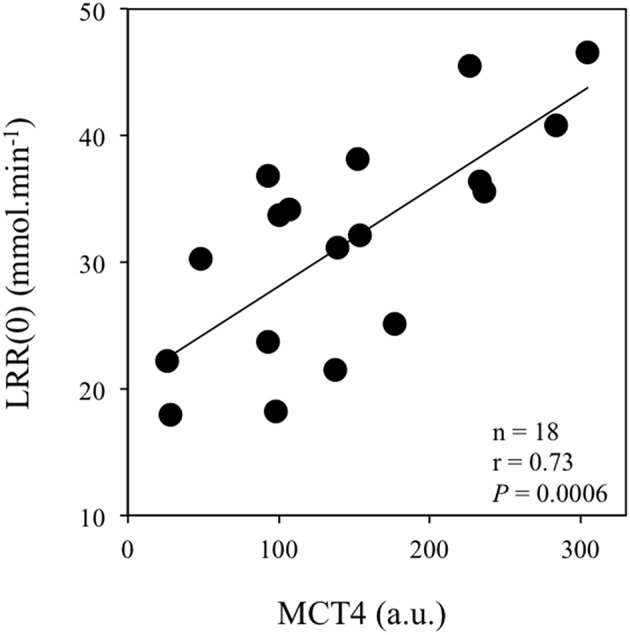
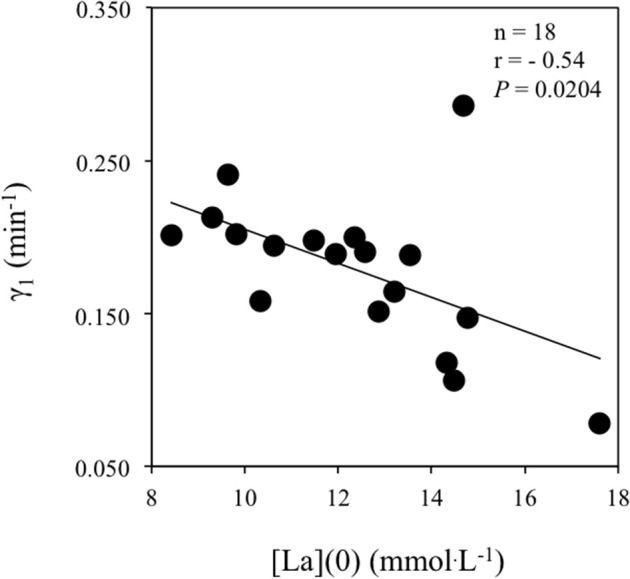
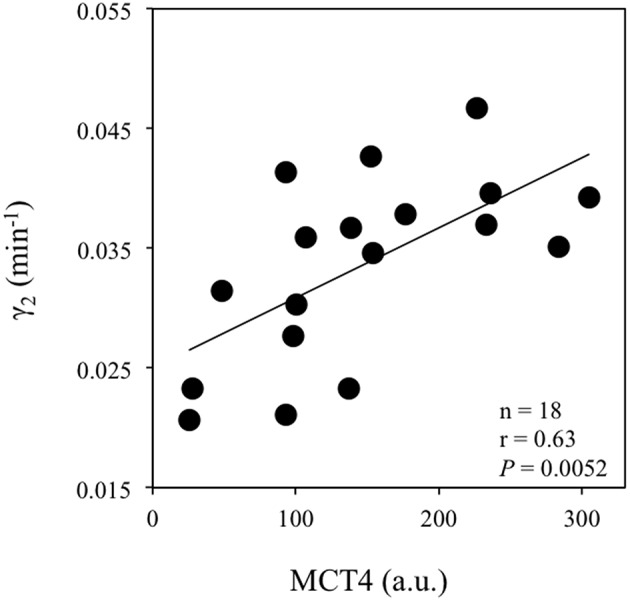
The purpose of this study was to test if the lactate exchange (γ1) and removal (γ2) abilities during recovery following short all-out supramaximal exercise correlate with the muscle content of MCT1 and MCT4, the two isoforms of the monocarboxylate transporters family involved in lactate and H(+) co-transport in skeletal muscle. Eighteen lightweight rowers completed a 3-min all-out exercise on rowing ergometer. Blood lactate samples were collected during the subsequent passive recovery to assess an individual blood lactate curve (IBLC). IBLC were fitted to the bi-exponential time function: La(t) = La + A1(1 - [Formula: see text]) + A2(1 - [Formula: see text]) where La is the blood lactate concentration at exercise completion and the velocity constants γ1 and γ2 denote the lactate exchange and removal abilities, respectively. An application of the bi-compartmental model of lactate distribution space allowed estimation of the lactate removal rate at exercise completion [LRR(0)]. Biopsy of the right vastus lateralis was taken at rest to measure muscle MCT1 and MCT4 content. Fiber type distribution, activity of key enzymes and capillary density (CD) were also assessed. γ1 was correlated with La (r = -0.54, P < 0.05) but not with MCT1, MCT4 or CD. γ2 and LRR(0) were correlated with MCT4 (r = 0.63, P < 0.01 and r = 0.73, P < 0.001, respectively) but not with MCT1 or cytochrome c oxidase activity. These findings suggest that the lactate exchange ability is highly dependent on the milieu so that the importance of the muscle MCT1 and MCT4 content in γ1 was hidden in the present study. Our results also suggest that during recovery following all-out supramaximal exercise in well-trained rowers, MCT4 might play a significant role in the distribution and delivery of lactate for its subsequent removal.
本研究的目的是测试在短时间全力超最大运动后的恢复过程中,乳酸交换(γ1)和清除(γ2)能力是否与单羧酸转运蛋白家族的两种亚型MCT1和MCT4的肌肉含量相关,这两种亚型参与骨骼肌中乳酸和H(+)的协同转运。18名轻量级赛艇运动员在赛艇测功仪上完成了3分钟的全力运动。在随后的被动恢复过程中采集血乳酸样本,以评估个体血乳酸曲线(IBLC)。将IBLC拟合到双指数时间函数:La(t) = La + A1(1 - [公式:见原文]) + A2(1 - [公式:见原文]),其中La是运动结束时的血乳酸浓度,速度常数γ1和γ2分别表示乳酸交换和清除能力。乳酸分布空间的双室模型的应用允许估计运动结束时的乳酸清除率[LRR(0)]。在休息时取右侧股外侧肌活检样本,以测量肌肉MCT1和MCT4含量。还评估了纤维类型分布、关键酶活性和毛细血管密度(CD)。γ1与La相关(r = -0.54,P < 0.05),但与MCT1、MCT4或CD无关。γ2和LRR(0)与MCT4相关(分别为r = 0.63,P < 0.01和r = 0.73,P < 0.001),但与MCT1或细胞色素c氧化酶活性无关。这些发现表明,乳酸交换能力高度依赖于环境,因此在本研究中肌肉MCT1和MCT4含量在γ1中的重要性被掩盖了。我们的结果还表明,在训练有素的赛艇运动员进行全力超最大运动后的恢复过程中,MCT4可能在乳酸的分布和输送及其随后的清除中发挥重要作用。