Stribny Jiri, Querol Amparo, Pérez-Torrado Roberto
Food Biotechnology Department, Instituto de Agroquímica y Tecnología de Alimentos - Consejo Superior de Investigaciones Científicas, Valencia Spain.
Front Microbiol. 2016 Jun 7;7:897. doi: 10.3389/fmicb.2016.00897. eCollection 2016.
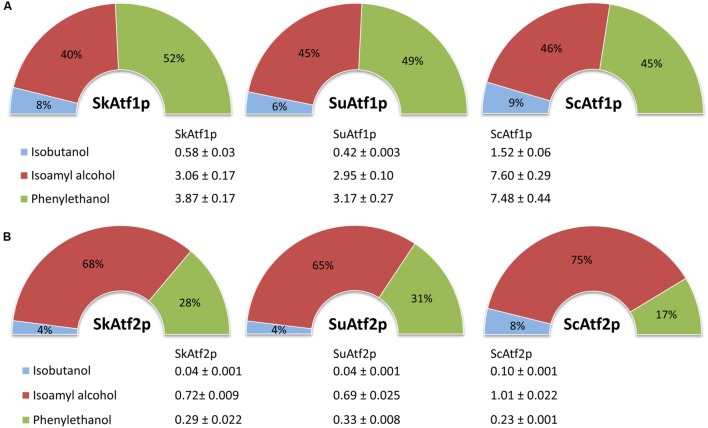
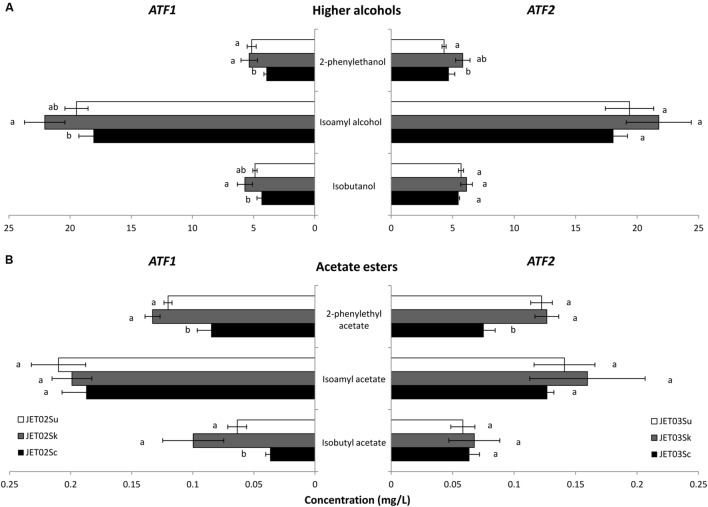
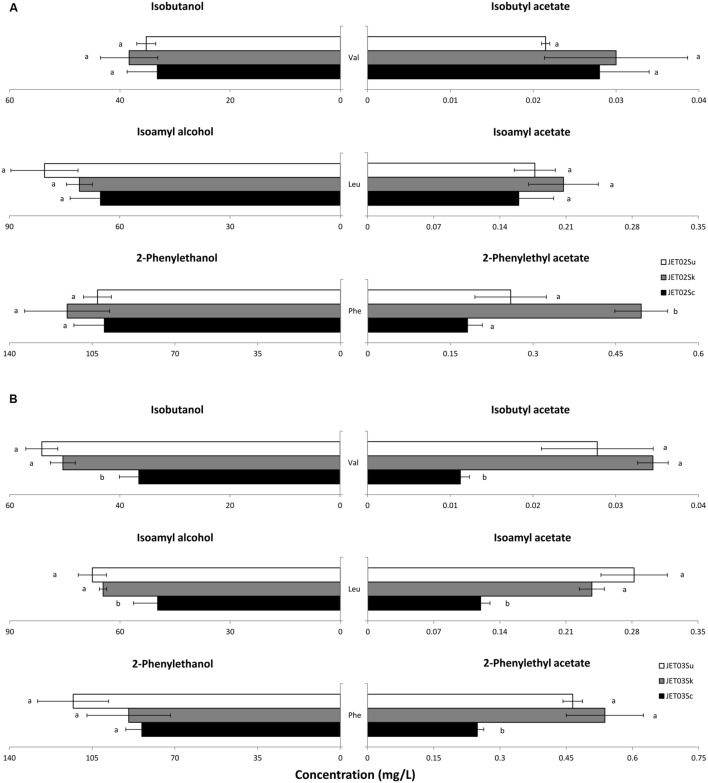
Higher alcohols and acetate esters belong to the most important yeast secondary metabolites that significantly contribute to the overall flavor and aroma profile of fermented products. In Saccharomyces cerevisiae, esterification of higher alcohols is catalyzed mainly by the alcohol acetyltransferases encoded by genes ATF1 and ATF2. Previous investigation has shown other Saccharomyces species, e.g., S. kudriavzevii and S. uvarum, to vary in aroma-active higher alcohols and acetate esters formation when compared to S. cerevisiae. Here, we aimed to analyze the enzymes encoded by the ATF1 and ATF2 genes from S. kudriavzevii (SkATF1, SkATF2) and S. uvarum (SuATF1, SuATF2). The heterologous expression of the individual ATF1 and ATF2 genes in a host S. cerevisiae resulted in the enhanced production of several higher alcohols and acetate esters. Particularly, an increase of 2-phenylethyl acetate production by the strains that harbored ATF1 and ATF2 genes from S. kudriavzevii and S. uvarum was observed. When grown with individual amino acids as the nitrogen source, the strain that harbored SkATF1 showed particularly high 2-phenylethyl acetate production and the strains with introduced SkATF2 or SuATF2 revealed increased production of isobutyl acetate, isoamyl acetate, and 2-phenylethyl acetate compared to the reference strains with endogenous ATF genes. The alcohol acetyltransferase activities of the individual Atf1 and Atf2 enzymes measured in the cell extracts of the S. cerevisiae atf1 atf2 iah1 triple-null strain were detected for all the measured substrates. This indicated that S. kudriavzevii and S. uvarum Atf enzymes had broad range substrate specificity as S. cerevisiae Atf enzymes. Individual Atf1 enzymes exhibited markedly different kinetic properties since SkAtf1p showed c. twofold higher and SuAtf1p c. threefold higher K m for isoamyl alcohol than ScAtf1p. Together these results indicated that the differences found among the three Saccharomyces species during the aroma-active acetate ester formation may be due, to some extent, to the distinct properties of Atf enzymes.
高级醇和乙酸酯属于最重要的酵母次级代谢产物,它们对发酵产品的整体风味和香气特征有显著贡献。在酿酒酵母中,高级醇的酯化主要由ATF1和ATF2基因编码的醇乙酰转移酶催化。先前的研究表明,与酿酒酵母相比,其他酿酒酵母物种,如库德里亚夫齐酵母和葡萄汁酵母,在香气活性高级醇和乙酸酯的形成上存在差异。在此,我们旨在分析库德里亚夫齐酵母(SkATF1、SkATF2)和葡萄汁酵母(SuATF1、SuATF2)中ATF1和ATF2基因编码的酶。单个ATF1和ATF2基因在宿主酿酒酵母中的异源表达导致几种高级醇和乙酸酯的产量增加。特别是,观察到携带库德里亚夫齐酵母和葡萄汁酵母ATF1和ATF2基因的菌株中乙酸苯乙酯产量增加。当以单个氨基酸作为氮源生长时,携带SkATF1的菌株乙酸苯乙酯产量特别高,与具有内源性ATF基因的参考菌株相比,导入SkATF2或SuATF2的菌株乙酸异丁酯、乙酸异戊酯和乙酸苯乙酯产量增加。在酿酒酵母atf1 atf2 iah1三缺失菌株的细胞提取物中测量的所有被测底物都检测到了单个Atf1和Atf2酶的醇乙酰转移酶活性。这表明库德里亚夫齐酵母和葡萄汁酵母的Atf酶与酿酒酵母的Atf酶一样具有广泛的底物特异性。单个Atf1酶表现出明显不同的动力学特性,因为SkAtf1p对异戊醇的Km值比ScAtf1p高约两倍,SuAtf1p高约三倍。这些结果共同表明,在香气活性乙酸酯形成过程中,三种酿酒酵母物种之间发现的差异可能在一定程度上归因于Atf酶的不同特性。