Wu Geyang, Peterson Adam J, Morris Craig F, Murphy Kevin M
School of Food Science, Washington State University Pullman, WA, USA.
Department of Crop and Soil Sciences, Washington State University Pullman, WA, USA.
Front Plant Sci. 2016 Jun 3;7:790. doi: 10.3389/fpls.2016.00790. eCollection 2016.
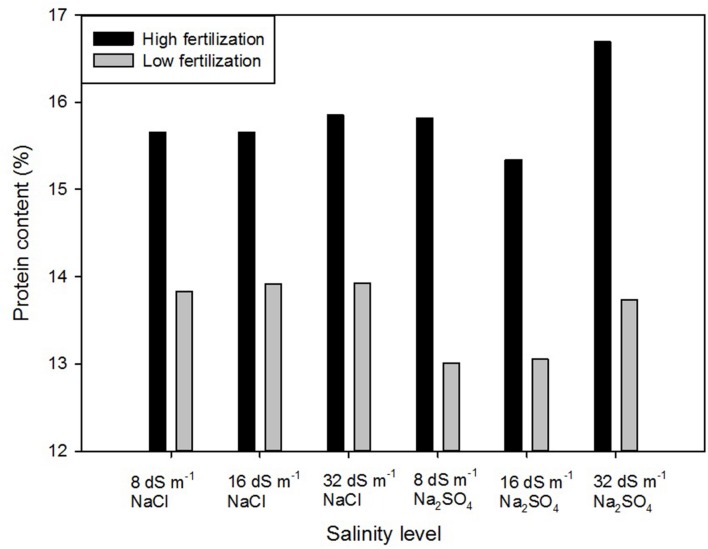
Quinoa (Chenopodium quinoa Willd.) is an Andean crop with an edible seed that both contains high protein content and provides high quality protein with a balanced amino acid profile in embryonic tissues. Quinoa is a halophyte adapted to harsh environments with highly saline soil. In this study, four quinoa varieties were grown under six salinity treatments and two levels of fertilization, and then evaluated for quinoa seed quality characteristics, including protein content, seed hardness, and seed density. Concentrations of 8, 16, and 32 dS m(-1) of NaCl and Na2SO4, were applied to the soil medium across low (1 g N, 0.29 g P, 0.29 g K per pot) and high (3 g N, 0.85 g P, 0.86 g K per pot) fertilizer treatments. Seed protein content differed across soil salinity treatments, varieties, and fertilization levels. Protein content of quinoa grown under salinized soil ranged from 13.0 to 16.7%, comparable to that from non-saline conditions. NaCl and Na2SO4 exhibited different impacts on protein content. Whereas the different concentrations of NaCl did not show differential effects on protein content, the seed from 32 dS m(-1) Na2SO4 contained the highest protein content. Seed hardness differed among varieties, and was moderately influenced by salinity level (P = 0.09). Seed density was affected significantly by variety and Na2SO4 concentration, but was unaffected by NaCl concentration. The samples from 8 dS m(-1) Na2SO4 soil had lower density (0.66 g/cm(3)) than those from 16 dS m(-1) and 32 dS m(-1) Na2SO4, 0.74 and 0.72g/cm(3), respectively. This paper identifies changes in critical seed quality traits of quinoa as influenced by soil salinity and fertility, and offers insights into variety response and choice across different abiotic stresses in the field environment.
藜麦(Chenopodium quinoa Willd.)是一种安第斯作物,其可食用种子蛋白质含量高,且在胚组织中能提供氨基酸组成均衡的优质蛋白质。藜麦是一种适应高盐碱土壤等恶劣环境的盐生植物。在本研究中,四个藜麦品种在六种盐分处理和两种施肥水平下种植,然后对藜麦种子质量特性进行评估,包括蛋白质含量、种子硬度和种子密度。分别向土壤介质施加浓度为8、16和32 dS m(-1)的NaCl和Na2SO4,并设置低肥(每盆1 g氮、0.29 g磷、0.29 g钾)和高肥(每盆3 g氮、0.85 g磷、0.86 g钾)处理。种子蛋白质含量因土壤盐分处理、品种和施肥水平而异。在盐渍化土壤中种植的藜麦蛋白质含量在13.0%至16.7%之间,与非盐渍条件下的含量相当。NaCl和Na2SO4对蛋白质含量的影响不同。不同浓度的NaCl对蛋白质含量没有差异影响,而来自32 dS m(-1) Na2SO4的种子蛋白质含量最高。种子硬度因品种而异,并受到盐分水平的中度影响(P = 0.09)。种子密度受品种和Na2SO4浓度的显著影响,但不受NaCl浓度的影响。来自8 dS m(-1) Na2SO4土壤的样品密度(0.66 g/cm(3))低于来自16 dS m(-1)和32 dS m(-1) Na2SO4的样品,分别为0.74和0.72 g/cm(3)。本文确定了土壤盐分和肥力对藜麦关键种子质量性状的影响变化,并为田间环境中不同非生物胁迫下的品种响应和选择提供了见解。