Cacciatore Ivana, Marinelli Lisa, Fornasari Erika, Cerasa Laura S, Eusepi Piera, Türkez Hasan, Pomilio Cristina, Reale Marcella, D'Angelo Chiara, Costantini Erica, Di Stefano Antonio
Department of Pharmacy, University "G. d'Annunzio" of Chieti-Pescara, Via dei Vestini 31, 66100 Chieti Scalo (CH), Italy.
Department of Molecular Biology and Genetics, Erzurum Technical University, Erzurum 25240, Turkey.
Int J Mol Sci. 2016 Jun 30;17(7):1035. doi: 10.3390/ijms17071035.
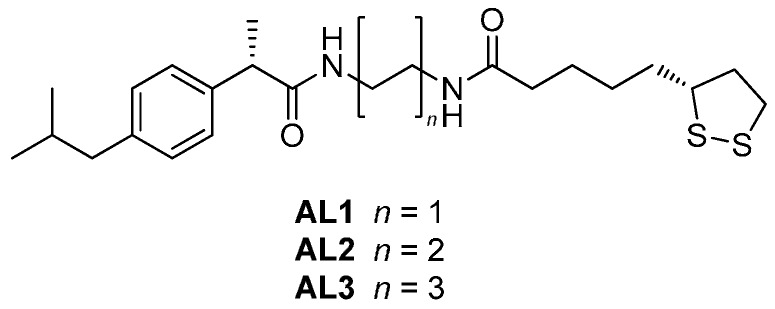
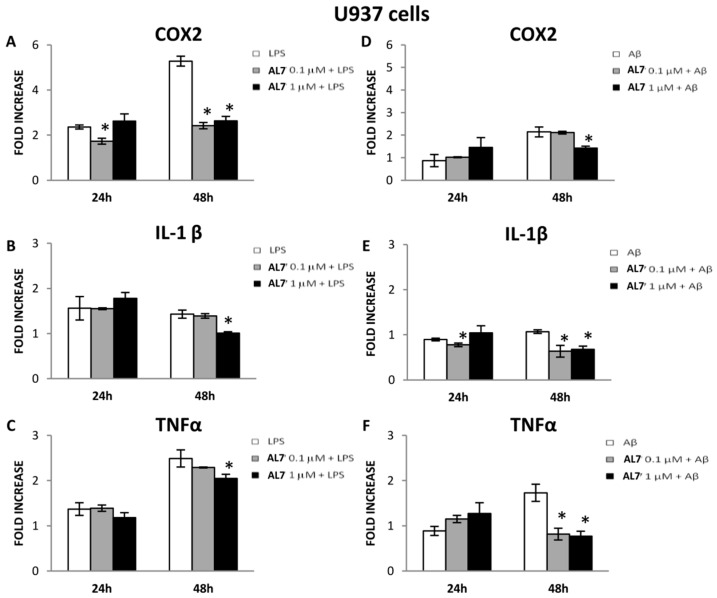
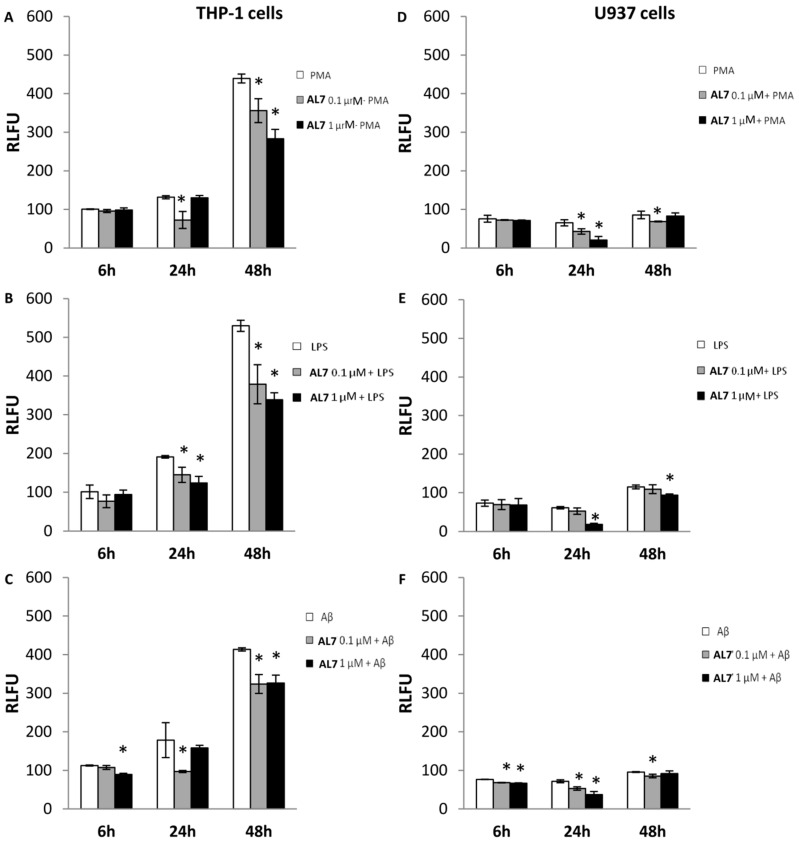
Nonsteroidal anti-inflammatory drugs (NSAIDs) have been suggested for the potential treatment of neurodegenerative diseases, such as Alzheimer's disease (AD). Prolonged use of NSAIDs, however, produces gastrointestinal (GI) toxicity. To overcome this serious limitation, the aim of this study was to develop novel NSAID-derived drug conjugates (Anti-inflammatory-Lipoyl derivatives, AL4-9) that preserve the beneficial effects of NSAIDS without causing GI problems. As such, we conjugated selected well-known NSAIDs, such as (S)-naproxen and (R)-flurbiprofen, with (R)-α-lipoic acid (LA) through alkylene diamine linkers. The selection of the antioxidant LA was based on the proposed role of oxidative stress in the development and/or progression of AD. Our exploratory studies revealed that AL7 containing the diaminoethylene linker between (R)-flurbiprofen and LA had the most favorable chemical and in vitro enzymatic stability profiles among the synthesized compounds. Upon pretreatment, this compound exhibited excellent antioxidant activity in phorbol 12-miristate 13-acetate (PMA)-stimulated U937 cells (lymphoblast lung from human) and Aβ(25-35)-treated THP-1 cells (leukemic monocytes). Furthermore, AL7 also modulated the expression of COX-2, IL-1β and TNF-α in these cell lines, suggesting anti-inflammatory activity. Taken together, AL7 has emerged as a potential lead worthy of further characterization and testing in suitable in vivo models of AD.
非甾体抗炎药(NSAIDs)已被提议用于神经退行性疾病的潜在治疗,如阿尔茨海默病(AD)。然而,长期使用NSAIDs会产生胃肠道(GI)毒性。为克服这一严重局限性,本研究的目的是开发新型NSAID衍生的药物缀合物(抗炎-硫辛酸衍生物,AL4-9),其保留了NSAIDs的有益作用而不引起胃肠道问题。因此,我们通过亚烷基二胺连接体将选定的知名NSAIDs,如(S)-萘普生和(R)-氟比洛芬,与(R)-α-硫辛酸(LA)进行缀合。抗氧化剂LA的选择基于氧化应激在AD发生和/或进展中所起的作用。我们的探索性研究表明,在合成的化合物中,(R)-氟比洛芬和LA之间含有二氨基乙烯连接体的AL7具有最有利的化学和体外酶稳定性特征。预处理后,该化合物在佛波酯12-肉豆蔻酸酯13-乙酸酯(PMA)刺激的U937细胞(人肺成淋巴细胞)和Aβ(25-35)处理的THP-1细胞(白血病单核细胞)中表现出优异的抗氧化活性。此外,AL7还调节了这些细胞系中COX-2、IL-1β和TNF-α的表达,表明其具有抗炎活性。综上所述,AL7已成为一种潜在的先导化合物,值得在合适的AD体内模型中进一步表征和测试。