Thériault Peter, ElAli Ayman, Rivest Serge
Department of Molecular Medicine, Neuroscience Laboratory, CHU de Québec Research Center (CHUL), Faculty of Medicine, Laval University, 2705 Laurier Boulevard, Quebec City, QC G1V 4G2 Canada.
Alzheimers Res Ther. 2015 Apr 15;7(1):41. doi: 10.1186/s13195-015-0125-2. eCollection 2015.
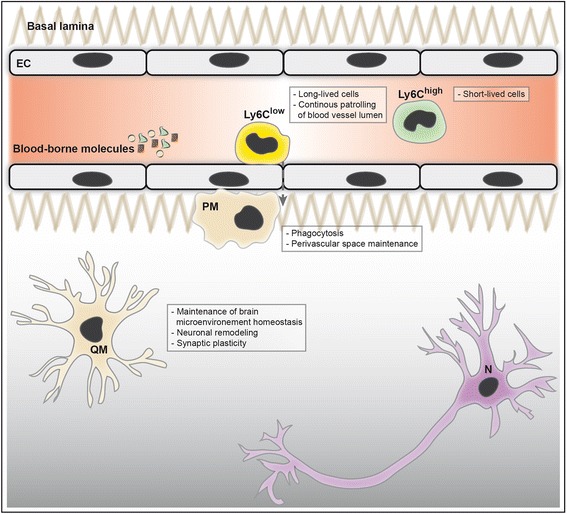
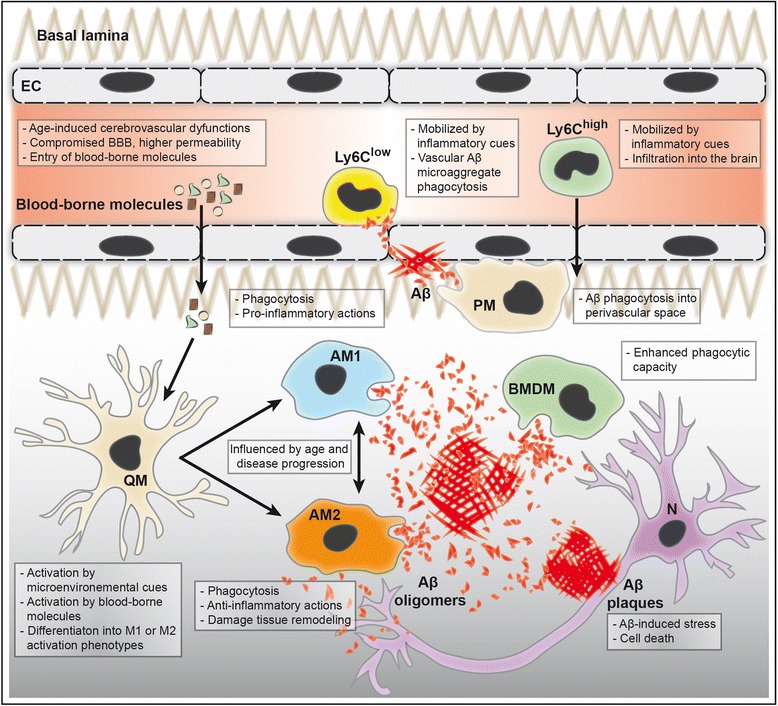
Alzheimer's disease (AD) is the most common neurodegenerative disorder affecting older people worldwide. It is a progressive disorder mainly characterized by the presence of amyloid-beta (Aβ) plaques and neurofibrillary tangles within the brain parenchyma. It is now well accepted that neuroinflammation constitutes an important feature in AD, wherein the exact role of innate immunity remains unclear. Although innate immune cells are at the forefront to protect the brain in the presence of toxic molecules including Aβ, this natural defense mechanism seems insufficient in AD patients. Monocytes are a key component of the innate immune system and they play multiple roles, such as the removal of debris and dead cells via phagocytosis. These cells respond quickly and mobilize toward the inflamed site, where they proliferate and differentiate into macrophages in response to inflammatory signals. Many studies have underlined the ability of circulating and infiltrating monocytes to clear vascular Aβ microaggregates and parenchymal Aβ deposits respectively, which are very important features of AD. On the other hand, microglia are the resident immune cells of the brain and they play multiple physiological roles, including maintenance of the brain's microenvironment homeostasis. In the injured brain, activated microglia migrate to the inflamed site, where they remove neurotoxic elements by phagocytosis. However, aged resident microglia are less efficient than their circulating sister immune cells in eliminating Aβ deposits from the brain parenchyma, thus underlining the importance to further investigate the functions of these innate immune cells in AD. The present review summarizes current knowledge on the role of monocytes and microglia in AD and how these cells can be mobilized to prevent and treat the disease.
阿尔茨海默病(AD)是全球影响老年人的最常见神经退行性疾病。它是一种进行性疾病,主要特征是脑实质内存在β淀粉样蛋白(Aβ)斑块和神经原纤维缠结。目前人们普遍认为神经炎症是AD的一个重要特征,然而固有免疫的确切作用仍不清楚。尽管在包括Aβ在内的有毒分子存在时,固有免疫细胞处于保护大脑的前沿,但这种天然防御机制在AD患者中似乎并不充分。单核细胞是固有免疫系统的关键组成部分,它们发挥多种作用,例如通过吞噬作用清除碎片和死亡细胞。这些细胞反应迅速并向炎症部位移动,在那里它们会响应炎症信号而增殖并分化为巨噬细胞。许多研究强调了循环单核细胞和浸润单核细胞分别清除血管Aβ微聚集体和实质Aβ沉积物的能力,这是AD的非常重要的特征。另一方面,小胶质细胞是大脑中的常驻免疫细胞,它们发挥多种生理作用,包括维持大脑微环境的稳态。在受损的大脑中,活化的小胶质细胞迁移到炎症部位,在那里它们通过吞噬作用清除神经毒性元素。然而,老化的常驻小胶质细胞在从脑实质中清除Aβ沉积物方面比其循环的姐妹免疫细胞效率更低,因此凸显了进一步研究这些固有免疫细胞在AD中的功能的重要性。本综述总结了目前关于单核细胞和小胶质细胞在AD中的作用以及如何调动这些细胞来预防和治疗该疾病的知识。