
二甲双胍在非糖尿病非裔美国人中的药物代谢组学评估
Pharmacometabolomic Assessment of Metformin in Non-diabetic, African Americans.
作者信息
Rotroff Daniel M, Oki Noffisat O, Liang Xiaomin, Yee Sook Wah, Stocker Sophie L, Corum Daniel G, Meisner Michele, Fiehn Oliver, Motsinger-Reif Alison A, Giacomini Kathleen M, Kaddurah-Daouk Rima
机构信息
Bioinformatics Research Center, North Carolina State UniversityRaleigh, NC, USA; Department of Statistics, North Carolina State UniversityRaleigh, NC, USA.
Bioinformatics Research Center, North Carolina State University Raleigh, NC, USA.
出版信息
Front Pharmacol. 2016 Jun 14;7:135. doi: 10.3389/fphar.2016.00135. eCollection 2016.
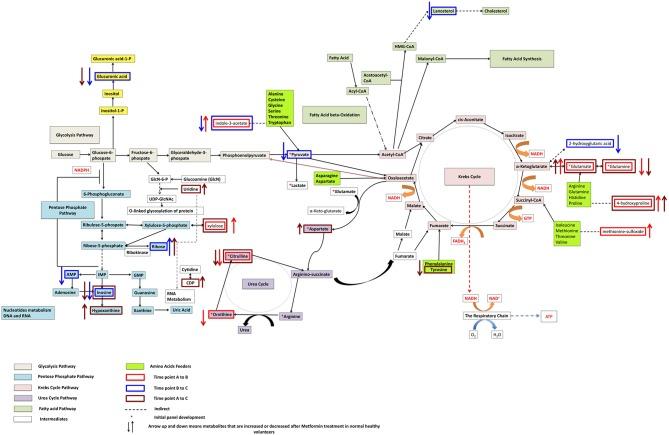
Millions of individuals are diagnosed with type 2 diabetes mellitus (T2D), which increases the risk for a plethora of adverse outcomes including cardiovascular events and kidney disease. Metformin is the most widely prescribed medication for the treatment of T2D; however, its mechanism is not fully understood and individuals vary in their response to this therapy. Here, we use a non-targeted, pharmacometabolomics approach to measure 384 metabolites in 33 non-diabetic, African American subjects dosed with metformin. Three plasma samples were obtained from each subject, one before and two after metformin administration. Validation studies were performed in wildtype mice given metformin. Fifty-four metabolites (including 21 unknowns) were significantly altered upon metformin administration, and 12 metabolites (including six unknowns) were significantly associated with metformin-induced change in glucose (q < 0.2). Of note, indole-3-acetate, a metabolite produced by gut microbes, and 4-hydroxyproline were modulated following metformin exposure in both humans and mice. 2-Hydroxybutanoic acid, a metabolite previously associated with insulin resistance and an early biomarker of T2D, was positively correlated with fasting glucose levels as well as glucose levels following oral glucose tolerance tests after metformin administration. Pathway analysis revealed that metformin administration was associated with changes in a number of metabolites in the urea cycle and in purine metabolic pathways (q < 0.01). Further research is needed to validate the biomarkers of metformin exposure and response identified in this study, and to understand the role of metformin in ammonia detoxification, protein degradation and purine metabolic pathways.
数以百万计的人被诊断患有2型糖尿病(T2D),这增加了包括心血管事件和肾脏疾病在内的大量不良后果的风险。二甲双胍是治疗T2D最广泛使用的药物;然而,其作用机制尚未完全了解,个体对这种治疗的反应也各不相同。在这里,我们使用一种非靶向的药物代谢组学方法来测量33名服用二甲双胍的非糖尿病非裔美国受试者的384种代谢物。从每个受试者身上采集三份血浆样本,一份在服用二甲双胍之前,两份在服用之后。在给予二甲双胍的野生型小鼠中进行了验证研究。服用二甲双胍后,54种代谢物(包括21种未知物)发生了显著变化,12种代谢物(包括6种未知物)与二甲双胍引起的血糖变化显著相关(q < 0.2)。值得注意的是,肠道微生物产生的代谢物吲哚 - 3 - 乙酸和4 - 羟脯氨酸在人和小鼠服用二甲双胍后均受到调节。2 - 羟基丁酸是一种先前与胰岛素抵抗相关的代谢物,也是T2D的早期生物标志物,与空腹血糖水平以及服用二甲双胍后口服葡萄糖耐量试验后的血糖水平呈正相关。通路分析表明,服用二甲双胍与尿素循环和嘌呤代谢途径中的多种代谢物变化有关(q < 0.01)。需要进一步研究来验证本研究中确定的二甲双胍暴露和反应的生物标志物,并了解二甲双胍在氨解毒、蛋白质降解和嘌呤代谢途径中的作用。




 Zotero 插件